
TL;DR: A California slip-and-fall lawsuit may be worth pursuing when serious injuries cause meaningful losses and strong evidence shows a property owner’s negligence. Available insurance, comparative fault, disappearing evidence, and filing deadlines can also affect whether injured people can recover enough compensation to justify litigation.
A California slip-and-fall lawsuit may be worth pursuing when documented injuries result in meaningful financial loss, and there is a clear picture of who is liable. The evidence should also show that the liable party, such as the property owner or an employee, failed to maintain reasonably safe premises under California Civil Code § 1714.
A minor bruise that resolves within a week is different from a herniated disc, fractured hip, or traumatic brain injury. Those more serious injuries may require months of treatment or keep you out of work. More serious injuries and clearer evidence of negligence generally strengthen a case.
Before filing a lawsuit, a personal injury claim may first be investigated and negotiated with the responsible party or its insurer. Filing a lawsuit may be appropriate when liability or damages remain in dispute, settlement efforts do not yield an acceptable resolution, or filing is necessary to protect the claim before a legal deadline expires.
California premises liability attorneys at Arash Law can evaluate what the fall actually costs you. They also review the evidence and consider how the insurer may respond to determine whether it is worth filing a lawsuit.
Key Facts About California Slip-and-Fall Cases
- Property owners must exercise ordinary care. California Civil Code § 1714 requires them to manage their property with ordinary care. This is a foundational statutory basis for California premises liability claims, including most slip-and-fall actions.
- California follows pure comparative negligence. It reduces your recovery by your share of fault, but does not bar recovery solely because you are partly at fault.
- Surveillance footage may be overwritten quickly. Many commercial security systems automatically overwrite old footage on a set schedule. Sending a written preservation demand soon after the fall may help preserve video evidence.
- Most slip-and-fall lawsuits have a two-year filing deadline. California Code of Civil Procedure (CCP) § 335.1 generally gives injured people two years from the date of the accident to file a lawsuit against a private property owner.
- Public-property claims typically have a six-month claim deadline. Government Code (Gov. Code § 911.2) typically requires an injured person to present a written claim to the responsible public agency within six months of the incident. This step usually must occur before a lawsuit against the government entity can proceed.
Table of Contents

What Makes a Slip-and-Fall Case Worth Pursuing?
A California slip-and-fall case may be worth pursuing when the incident results in significant losses, and the evidence clearly establishes negligence. The case may be weaker when either the damages or the proof are limited.
The following considerations can help show whether a slip-and-fall case is strong enough and significant enough to pursue:
Serious Injuries and Higher Financial Losses
More serious injuries typically create greater documented financial losses. Emergency room treatment, imaging tests, physical therapy, injections, future care, such as additional surgery, ongoing therapy, or long-term pain management, and surgery can increase medical expenses. A claim involving only one urgent care visit and no follow-up may have fewer documented damages.
Medical records can also help connect your injuries to the slip-and-fall. Records created soon after the incident document when symptoms appeared and what doctors diagnosed. They may also help address arguments that an injury was preexisting or unrelated.
Consistent Medical Treatment
Consistent medical care can strengthen the documentation of an injury. Gaps in treatment may give an insurer room to argue that the injury improved or was less serious than claimed. Following your treating physician’s recommendations also supports your recovery and creates a clearer medical record. If cost or access prevents treatment, document the reason for the gap.
Clear Evidence of Liability
Clear evidence that the property owner knew or should have known about a hazard can strengthen a claim. Examples may include a wet floor without a warning sign, a broken stair reported before the slip-and-fall, or a light that inspection records show has been out for weeks. These facts can make it easier to establish notice of the dangerous condition.
Disputed liability usually requires stronger evidence. A claim may be harder to prove if the hazard appeared just before the incident and the owner had no reasonable chance to discover it.
The Time That a Case Will Take
The time required to resolve a lawsuit can also affect whether pursuing one makes sense. A slip-and-fall lawsuit can take several months to several years to resolve. The timeline depends on factors such as the severity of the injuries, whether liability is disputed, the number of parties involved, and the amount of evidence that must be exchanged during litigation.
After a lawsuit is filed, the case may move through discovery, depositions, expert evaluations, settlement negotiations, and pretrial motions. Some lawsuits settle during this process, while others proceed to trial. Cases involving serious injuries or contested liability often take longer because both sides may need more time to investigate the evidence and prepare their arguments.
Knowing how long a slip-and-fall lawsuit takes can help you weigh the potential recovery against the time and effort involved in the litigation process.
How Much Is a Slip-and-Fall Case Worth in California?
The potential value of a California slip-and-fall case usually depends on the severity of the injury, the losses it caused, the strength of the liability evidence, available insurance coverage, and any share of fault assigned to the injured person.
Those same factors also explain why average slip-and-fall settlement amounts can vary widely from one case to another. An insurance claim, or potential lawsuit, generally seeks compensation for two main types of losses:
- Economic Damages: These cover measurable financial losses. For example:
- Past and future medical bills, including ER visits, surgery, physical therapy, medication, and assistive devices.
- Lost wages.
- Loss of future earning capacity.
- Out-of-pocket costs, such as transportation to treatment and home care.
- Property damage, such as clothing and your smartphone.
- Non-economic Damages: These address the personal effects of the injury. For example:
- Physical pain and suffering.
- Emotional distress and anxiety.
- Loss of enjoyment of life.
California law imposes no cap on non-economic damages in a standard slip-and-fall claim.
The amount of recoverable damages matters because a claim requires time, evidence, and legal work. A case involving substantial medical expenses, lost income, lasting pain, or future care may justify that effort more readily than one involving minor losses.
However, potential damages alone do not determine the outcome. Liability, available evidence, insurance coverage, and other case-specific facts also affect whether compensation can actually be recovered.
How California’s Pure Comparative Fault System Affects Your Recovery

In a slip-and-fall accident, a property owner, occupier, or other responsible party may be liable if their negligence in creating, failing to discover, remedying, or warning about an unsafe condition contributed to your injuries. However, if you also contributed to the incident, you may still be able to recover compensation under California’s comparative negligence rule.
This rule, established in Li v. Yellow Cab Co. (1975), reduces your compensation by your percentage of fault. For example, if a jury finds you 49% responsible for the incident, you would recover 51% of your total damages. No cutoff point bars your claim entirely.
Insurers and defense attorneys may raise comparative fault arguments when they believe the injured person shares responsibility for the slip-and-fall. Common arguments include:
- Claiming you were distracted by your phone.
- Arguing that your footwear is inappropriate for the conditions.
- Asserting that the hazard was open and obvious and that you should have avoided it.
- Suggesting that you were walking too fast or that you were entering a restricted area.
Note that property owners must exercise ordinary care. California Civil Code § 1714 requires them to manage their property with ordinary care. Evidence such as surveillance footage, expert testimony, and records showing the history of the hazard can help challenge any disputed fault.
Slip-and-fall lawyers can examine the physical conditions and available evidence to address arguments that an injured person should have noticed or avoided the hazard.
Why Evidence Preservation Can Make or Break Your Case
Strong evidence can determine whether a slip-and-fall case is worth pursuing. Even a serious injury may be difficult to prove if key evidence disappears before you can establish what caused the incident or whether the property owner knew about the hazard.
Surveillance footage may provide some of the clearest evidence of how the slip-and-fall happened. Still, property owners, security providers, and third-party vendors may overwrite recordings during normal retention cycles. Promptly identifying the footage and sending a written preservation demand, sometimes called a spoliation letter, can help preserve relevant videos and records.
Other essential evidence can help show whether a slip-and-fall claim is strong enough to pursue:
- Photos of the Scene: Images taken on the day of the fall can document the hazard, warning signs, surrounding conditions, and visible injuries.
- The Incident Report: A report prepared by the business or property owner may document when and where the incident occurred, as well as what staff observed.
- Prior Complaints About the Same Hazard: Earlier complaints may help show that the owner knew or should have known about the dangerous condition. These records may exist in internal files or in city or county code enforcement records available under the California Public Records Act (Gov. Code § 7920.000 et seq.).
- Medical Records: Treatment records can document the injury, diagnosis, and care you received after the slip-and-fall.
The stronger the proof of what caused the slip-and-fall and who knew about the hazard, the easier it becomes to evaluate whether filing a lawsuit makes practical and legal sense. If you are unsure whether your slip-and-fall case is worth pursuing, the slip-and-fall lawyers at Arash Law can review the available evidence and explain your options. Call us at (888) 488-1391 anytime, 24/7, for a free case evaluation.
How Long Do You Have to File a Slip-and-Fall Lawsuit in California?
California slip-and-fall deadlines depend on the type of loss, who may be responsible, and the specific circumstances of the case. Insurance negotiations or requests for records do not necessarily pause these deadlines. Identifying the responsible party and the correct filing process early can help protect your right to pursue compensation.
- Personal Injury Lawsuit: You generally have two years from the date of the injury to file a lawsuit against a private party (CCP § 335.1). If the victim is an injured minor, this deadline tolls until they turn 18.
- Property Damage Lawsuit: You mainly have three years to file a lawsuit for damage to personal property (CCP § 338(c)(1)). If a public entity is responsible, the six-month government claim deadline applies.
Claims involving a public entity follow a separate process before a lawsuit can proceed. This rule may apply when a city, county, state agency, school district, or other public entity owns or controls the property.
- You must present a written government claim within six months (Gov. Code § 911.2).
- Claims against the State of California are primarily handled by the Department of General Services’ Office of Risk and Insurance Management Government Claims Program.
- Claims against a city, county, school district, or other local public entity generally go through that entity’s designated claims process.
- After filing the claim, the public entity typically has 45 days to act under Gov. Code § 912.4 unless the response period is extended.
- If the agency sends a written rejection notice that complies with Government Code § 913, you mostly have six months to file a lawsuit. The period generally runs from the date the qualifying notice is personally delivered or deposited in the mail.
- If the agency does not send a qualifying written rejection notice, Gov. Code § 945.6 generally gives you up to two years from the date the claim arose to file the lawsuit.
If you miss the six-month deadline, your claim is not necessarily lost. Government Code § 911.4 allows you to apply to the public entity for leave to present a late claim, but the application typically must be made within one year after the incident. If the entity denies the application, you may petition the court for relief under Government Code § 946.6. Relief is not automatic, so acting quickly remains important.
How a Lawyer Can Help Determine Whether a Slip-and-Fall Lawsuit Is Worth Pursuing
A lawyer can help you determine whether it’s worth filing a lawsuit in a slip-and-fall case by analyzing four main questions: Can you prove negligence? Are your injuries and losses significant enough to support meaningful damages? Is there insurance or another source of recovery? And does the likely recovery justify the time and effort involved in litigation?
To answer those questions, a California slip-and-fall lawyer can:
- Assess the strength of liability by reviewing photos, surveillance footage, inspection records, incident reports, witness statements, and prior complaints about the hazard.
- Measure the value of your damages by examining medical expenses, lost income, future treatment needs, pain and suffering, and other documented losses.
- Evaluate comparative fault by determining whether the evidence could support an argument that you share responsibility for the fall.
- Identify responsible parties by determining whether an owner, tenant, property manager, contractor, public entity, or another party may be liable.
- Check available recovery options by identifying applicable insurance policies and other potential sources of compensation.
- Review the evidence that can still be preserved before surveillance footage, maintenance records, or other important information disappear.
- Confirm the filing deadlines that affect whether the claim can still move forward.
- Compare the potential recovery with the demands of litigation to help determine whether filing a lawsuit makes practical sense.
This evaluation can help explain why some slip-and-fall cases justify the time and effort required for litigation, while others may not. When serious injuries, substantial losses, and strong evidence come together, the potential recovery may be significant. Arash Law’s case results, shown below, involving fall-related incidents, illustrate how serious injuries can affect case outcomes:
$3,500,000 — Premises Liability: A client suffered a spinal injury after falling in an area with inadequate lighting.
$3,000,000 — Slip-and-Fall: A client suffered a spinal injury in a slip-and-fall incident supported by video evidence.
(Past results do not guarantee future outcomes. Every case is different, and results depend on the specific facts and evidence involved.)
Frequently Asked Questions About Slip-and-Fall Cases in California
What Are the Most Common Injuries in a Slip-and-Fall?
Slip-and-fall injuries often include fractures, back and spine injuries, concussions, soft-tissue injuries, cuts, and facial or dental trauma. More serious injuries can increase medical costs, lost income, and the potential value of the claim.
What If There Was No Wet Floor Sign?
A missing wet floor sign may support a negligence claim, but it does not prove liability on its own. If someone other than the property owner or their employees created the wet condition, you generally need evidence that the owner knew or should have known about it in time to address the hazard or provide a warning.
What If I Fell While I Was Working?
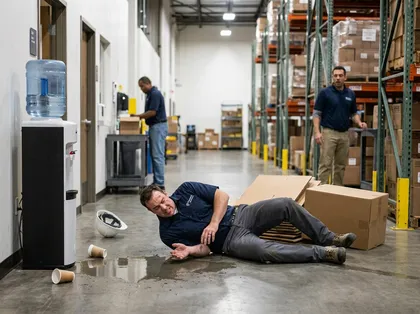
If you fall at work, workers’ compensation is generally your exclusive remedy against your employer under Labor Code § 3602. Because workers’ compensation is a no-fault system, you do not have to prove that your employer was negligent to seek benefits such as medical treatment and partial wage replacement.
You may also have a lawsuit against a responsible third party, such as a property owner or contractor who is not your employer. In a third-party negligence case, you generally must prove that the defendant owed you a duty of care, breached that duty, and caused your injuries and resulting damages.
Do I Need an Incident Report to File a Slip-and-Fall Lawsuit?
No. An incident report is generally not required to file a slip-and-fall lawsuit. However, it can help document when and where the fall occurred, identify witnesses, and record what employees or property representatives observed after the incident.
Is a Slip-and-Fall Lawsuit Worth Pursuing for a Minor Injury?
A lawsuit involving a minor injury, limited treatment, and little financial loss may be less practical to pursue than one involving ongoing medical care, lost income, or lasting symptoms. However, even a seemingly minor injury may justify further evaluation if symptoms worsen, treatment continues, or the evidence strongly supports liability.
Are Slip-and-Fall Cases Hard to Win?
Slip-and-fall cases can be difficult to win when the evidence does not clearly show that the property owner was negligent or knew, or should have known, about the dangerous condition. Strong evidence, such as photos, surveillance footage, inspection records, witness statements, and medical records, can make it easier to prove liability and damages.
Talk to Arash Law About Your California Slip-and-Fall Case
If you sustain an injury in a slip-and-fall on someone else’s property, the key question is whether negligence or other wrongful conduct contributed to your injury. Arash Law can review the circumstances of the slip-and-fall, identify potentially responsible parties, and evaluate the evidence supporting your claim.
Our lawyers can also determine if it is necessary to file a suit. Call (888) 488-1391 anytime, 24/7, for a free evaluation of your slip-and-fall claim.
We have recovered over $1 billion for injured Californians and handle California slip-and-fall claims on a contingency fee basis, so there are no upfront attorney fees.
Make ‘Em Pay. Call AK.
Sources
- California Civil Code § 1714: Establishes California’s general duty of ordinary care and provides a statutory basis for premises liability claims.
https://leginfo.legislature.ca.gov/faces/codes_displaySection.xhtml?sectionNum=1714.&lawCode=CIV- California Code of Civil Procedure § 335.1: Sets a two-year statute of limitations for most personal injury lawsuits.
https://leginfo.legislature.ca.gov/faces/codes_displaySection.xhtml?sectionNum=335.1.&lawCode=CCP- California Code of Civil Procedure § 338(c)(1): Sets a three-year statute of limitations for actions involving injury to personal property.
https://leginfo.legislature.ca.gov/faces/codes_displaySection.xhtml?sectionNum=338.&lawCode=CCP- California Government Code § 911.2: Generally requires presentation of a government claim within six months for claims involving personal injury.
https://leginfo.legislature.ca.gov/faces/codes_displaySection.xhtml?sectionNum=911.2.&lawCode=GOV- California Government Code § 912.4: Generally gives a public entity 45 days to act on a properly presented claim unless the response period is extended.
https://leginfo.legislature.ca.gov/faces/codes_displaySection.xhtml?sectionNum=912.4.&lawCode=GOV- California Government Code § 945.6: Establishes the filing deadlines for lawsuits after a government claim is rejected or when no qualifying written rejection notice is provided.
https://leginfo.legislature.ca.gov/faces/codes_displaySection.xhtml?sectionNum=945.6.&lawCode=GOV- California Evidence Code § 413: Allows the trier of fact to consider a party’s willful suppression of evidence when evaluating the case.
https://leginfo.legislature.ca.gov/faces/codes_displaySection.xhtml?sectionNum=413.&lawCode=EVID- Li v. Yellow Cab Co. (1975) 13 Cal.3d 804: California Supreme Court decision establishing pure comparative negligence in California.
https://scholarlycommons.pacific.edu/cgi/viewcontent.cgi?article=2458&context=mlr- California Department of General Services, Government Claims Program: Explains the process for filing claims for money or damages against the State of California.
https://www.dgs.ca.gov/ORIM/File-A-Claim- California Labor Code § 3602: Establishes workers’ compensation as the exclusive remedy against an employer for most work-related injuries, subject to limited statutory exceptions.
https://leginfo.legislature.ca.gov/faces/codes_displaySection.xhtml?sectionNum=3602.&lawCode=LAB- California Public Records Act (Government Code §§ 7920.000 et seq.): Governs public access to records held by California state and local agencies.
https://leginfo.legislature.ca.gov/faces/codes_displayexpandedbranch.xhtml?tocCode=GOV&division=10.&title=1.&part=&chapter=&article=Disclaimer
This page provides general information and does not constitute legal advice or create an attorney-client relationship. Past results do not guarantee future outcomes. For advice about your specific situation, consult a licensed California slip-and-fall attorney. Call Arash Law at (888) 488-1391.