TL;DR: Self-driving vehicles can reduce car accidents by limiting human error and can shift liability to the manufacturer or software operator when the system fails. Drivers, passengers, cyclists, and pedestrians face injury risks if automation misreads hazards or backup drivers fail to act, and crash data must be preserved quickly to determine fault.
Highlights:
- Identify your vehicle’s automation level before relying on any features.
- Keep hands on the wheel and eyes forward with Level Two systems.
- Use automation only in conditions it’s designed for, like clear weather.
- Learn how your car detects signs, cyclists, and pedestrians.
- Check manufacturer updates and safety recalls for driver-assist software.
- After a crash, document alerts, settings, and any onboard camera footage.
- Talk to a California personal injury attorney if you were injured.
Tip: Save photos, videos, and app or vehicle logs, and stick to facts when describing what the system did.
Table of Contents
Automated driving systems are evolving at a rapid pace, and new developments are making automated driving systems more efficient. Self-driving automobiles will change how we spend time during transportation. Automated driving systems are advancing toward vehicles that can perform all driving tasks without human input. Six stages of driver assistance technology will become evident over the coming decades. Self-driving vehicles may become the norm rather than the exception in the United States.
Which Features Make A Vehicle Completely Automated?
Semi-automated vehicles, equipped with various driver assistance features, are now common throughout the United States. However, fully automated trucks and cars for individual consumers and commercial entities are still in development. Automobile manufacturers such as Tesla, Waymo, Toyota, and Ford are paving the way for automated driving systems in the United States. The following are the five levels associated with self-driving automobiles:
- Level One — Automobiles have additional driver assistance components that assist with lane changing, accelerating, and cruise control.
- Level Two — These systems include autopilot components and advanced cruise control features that provide automated safety responses, such as braking and warning systems. However, the driver still needs to be focused on the road and have their hands on the wheel.
- Level Three — During specific conditions, the automobile can engage in safety functions that are fully automated. The driver may need to authorize automated control of the vehicle, and this element can put drivers and passengers at risk of serious bodily injury if the driver does not exercise extreme care.
- Level Four — Automobiles can perform all driving functions without the assistance of an operator. However, the features may be less reliable during extreme weather conditions or in remote areas.
- Level Five — The automobile is completely automated, and extreme weather conditions or remote areas do not affect the ability of the automobile to perform all functions on its own.
The Benefits Of Self-Driving Systems For Vehicles
Reducing The Overall Number Of Automobile Accidents
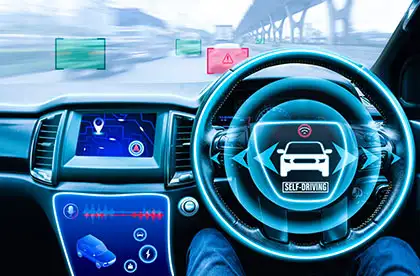
Approximately ninety-four percent of the 37,000 automobile deaths that occurred in 2017 were due to mistakes made by human beings. These errors made by human drivers may be reduced by automated driving systems. Self-driving automobiles are intended to be more consistent and reliable because human drivers will not be operating vehicles while intoxicated or distracted by mobile phones. Research suggests that autonomous vehicles may help reduce traffic accidents, with studies indicating varying levels of potential improvement as the technology advances.
Reducing Costs To Society
Many fully automated driving systems may help reduce the costs to society that arise due to traffic accidents. Research studies predict that nearly $800 billion may be saved annually if fully automated driving systems become prevalent in the United States. Self-driving automobiles may offer other potential benefits, such as reduced fuel costs, more efficient travel time, and less stress on the medical profession and hospitals.
More Efficient Traffic Movement
Automated driving systems have the potential to communicate with each other, calculate risks in real-time, and adjust speeds to maintain safe distances between vehicles. These systems can also use real-time data to choose efficient routes. If widely adopted, such technologies could help reduce traffic congestion and its associated costs.
Ease Of Access And Safer Driving Conditions
Individuals who are unable to drive an automobile may benefit from the increasing availability of self-driving cars. The disabled and the elderly will have greater access to transportation without endangering the lives of others. Some major metropolitan areas only have limited public transit access.
Environmental Benefits Of Fully Automated Driving Systems
The environment is an important factor related to the implementation of fully automated driving systems. Electric vehicles benefit the environment, and the majority of self-driving automobiles do not use engines that run on oil and gasoline. Fully automated automobiles will also travel without an excessive amount of accelerating or braking. Self-driving automobiles may help reduce carbon emissions and improve the environment.
Fuel Costs And Savings
The RAND Corporation’s Autonomous Vehicle Technology Guide estimates that fully automated driving systems could potentially reduce overall fuel costs. Ohio University also conducted a research study that stated drivers in the United States waste approximately 3.1 billion gallons of fuel.
Increased Lane Capacity
The RAND Corporation also stated that overall lane capacity might increase by five hundred percent. Traffic speed may increase due to improved lane capacity. The State Smart Transportation Initiative places the capacity increase at 100 percent. This amount of increased lane capacity may cause a twenty percent increase in overall traffic speed.
Reduced Travel Time
Self-driving automobiles may support more efficient transportation systems, with potential benefits depending on adoption rates and integration with existing infrastructure. Improved travel efficiency could contribute to economic benefits through enhanced productivity and reduced transportation costs.
Much of the labor force in the United States spends an inordinate amount of time commuting. An increased use of self-driving automobiles could help reduce commuting time and may result in significant cost savings.
The Benefits Of Self-Driving Vehicles: Safer, More Efficient, And Convenient Fully Automated Automobiles
Automated driving systems can bring numerous benefits to consumers, countries, and governments. The following are some potential benefits that may result if fully automated automobiles become common.
- According to the National Highway Traffic Safety Administration and the Department of Transportation, human factors contribute to serious traffic accidents in the United States. Automated vehicles may be able to help lower the overall number of traffic accidents and fatalities that occur in the United States.
- Automated vehicles are designed to help find the quickest path to a specific destination. More efficient travel routes may lead to increased fuel efficiency, potentially lowering carbon emissions and fuel costs.
- Distracted driving and impaired driving are both dangerous and costly. Research indicates that self-driving automobiles may help reduce incidents of intoxicated driving.
Self-Driving Vehicles And Human Error
Self-driving vehicles are not affected by distractions such as mobile phones or excessive speed. These automated vehicles are designed to follow traffic laws and detect potential hazards that human drivers may miss. They may also help reduce traffic accidents and improve road safety.
Automated automobiles feature built-in electronic components and software applications that work together synchronously to provide a safer driving experience for all passengers. Light-detecting and ranging sensors are used to create a three-dimensional image of the vehicle’s immediate surroundings. Also, these sensors can recognize moving objects while analyzing their speed and size.
These vehicles also have powerful cameras capable of analyzing traffic signs and traffic signals. While the automobile travels, it filters these readings through a GPS system that places the automobile in a specific area so it can plan the best route to a particular destination.
Self-driving vehicles also feature software applications that analyze the events around the automobile in real-time. The car can recognize other physical objects, such as people and other vehicles, while it is in motion. The systems used in self-driving cars can learn from time spent on the road.
Some individuals are skeptical about whether or not self-driving vehicles can detect cyclists, scooters, and older adults. Furthermore, children are much smaller than adults, and self-driving vehicles need to recognize children and their possible erratic movements that can cause a traffic collision. Waymo is an autonomous vehicle company that has programmed its vehicles to recognize individual cyclists on roadways. As a matter of fact, Waymo recorded a video in which one of its automobiles made a complete stop for a cyclist traveling the wrong way. The cyclist was also rounding a corner after sunset, and the vehicle still recognized the cyclist.
Uber’s automobile recognized Herzberg before the deadly accident in Tempe, Arizona, but the internal system decided not to turn to avoid Herzberg. Apparently, the car’s computer sensors recognized Herzberg, but the software application made a calculated decision not to react to Herzberg’s movements. The National Transportation Safety Board stated that Uber turned off the accident recognition feature and that Uber’s computer system recognized Herzberg approximately six seconds before the accident and did not apply the brakes until 1.3 seconds before the collision.
Prosecutors in Arizona decided not to charge Uber with a criminal offense. The prosecutors stated that “there is no basis for criminal liability for the Uber corporation arising from this matter.”
The automated driving sector in Arizona shut down on May 23, 2018. Additionally, Uber terminated approximately one hundred self-driving jobs in San Francisco and Pittsburgh. The automated driving unit is active in Pittsburgh, but the participants can only engage in testing during the daytime.
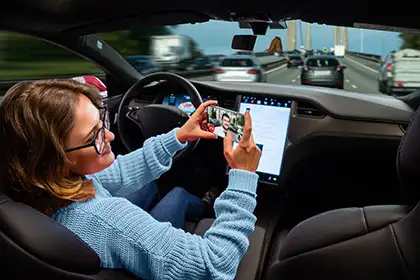
Backup drivers are now a questionable part of self-driving vehicle testing. Tempe police documents apparently demonstrated that a driver named Rafaela Vasquez streamed a recording on her mobile phone at the time of the deadly accident. The report claimed the accident was completely avoidable. “The driver in this case can have reacted and brought the vehicle to a stop 42.61 feet prior to the pedestrian.”
The final NTSB report, released in 2019, established that the accident was attributable to human error. This report placed a lot of blame on Vasquez. During a hearing, the NTSB board members made note that federal safety regulations are not stringent enough and should be revised.
Companies testing the efficacy of self-driving vehicles also create simulations that take place in urban areas. One of the more popular simulated cities is M City in Ann Arbor, Michigan. Self-driving automobile companies have also designed and constructed simulated urban environments to analyze how self-driving vehicles interact with elements in a busy city. Waymo’s simulated city is named Castle, and it features tricycles so that automated automobiles can learn to recognize them. Also, Toyota constructed a place to test vehicle responsiveness to dangerous conditions that are not testable in any public space.
Consult With Our California Personal Injury Attorneys
Call Arash Law, led by Arash Khorsandi, Esq., today at (888) 488-1391 if you suffered an injury in a traffic accident in California. We have years of experience representing clients in accident cases. Our car accident lawyers are committed to pursuing just compensation in accordance with California law.
We serve clients in San Francisco, Riverside, Sacramento, San Jose, Los Angeles, San Diego, Sherman Oaks, and throughout California. Our hit-and-run accident attorneys can help you seek financial compensation for your injuries.