TL;DR: If the other driver breaks their promise to pay for repairs, you can seek benefits from your own auto policy if you have collision coverage, pursue a third-party insurance claim, or sue the driver in California small claims court. Informal negotiations generally do not extend collision-related legal filing deadlines.
If the other driver promised to pay for your repairs and now refuses, start considering formal recovery options. Depending on the facts, you may be able to:
- File a claim under your own collision coverage.
- Pursue a third-party claim with the at-fault driver’s insurer.
- Sue in California small claims court for up to $12,500.
The most suitable choice for your situation depends on the available evidence, whether the other driver is insured, and the total repair cost.
Act promptly. California’s deadline for filing accident-related property damage lawsuits generally runs from the crash date, not from when negotiations broke down. Different deadlines may apply to contract disputes or personal injury claims.
Table of Contents

We Agreed to Discuss Repairs Without Involving the Insurance Company, but Now The Other Driver Is Rejecting the Estimates. What Should I Keep, and What Options Should I Consider?
An informal agreement to keep insurance out of it doesn’t stop you from filing an insurance claim later on. If the other driver rejects your estimates, you can still turn to their insurer or your own.
- What to Keep: Save every itemized estimate, along with all texts, emails, and voicemails about the repairs, especially any message disputing a specific amount. Keep photos of the damage to your vehicle, and hold off on repairs until it is documented or inspected. If the other driver gets their own estimate, ask for a written copy.
- Options to Consider: If the dispute is only about price, invite the other driver to get an estimate from a licensed shop of their choosing, or get a third estimate yourself. If that fails, a third-party claim allows the other driver’s insurer to assess the damage and determine how much to pay.
It’s often quicker to seek benefits through your own collision coverage first. Your insurer may then seek reimbursement from the at-fault driver or their insurer. If insurance is unavailable, your estimates and the driver’s messages can support a small claims case for up to $12,500.
Don’t let a dispute over numbers run out the clock. The window for filing a property damage lawsuit in California generally opens on the date of the crash. A lawsuit over a broken agreement may have a different deadline.
Key Facts About Repair Payment Disputes After a California Car Accident
- A broken promise to pay for repairs does not eliminate your recovery options. If the other driver refuses to pay for repairs, you may still pursue their liability insurance or use your own collision coverage, if available.
- Written communications can help establish what the driver agreed to pay. Save messages, repair estimates, photographs, and other records documenting the collision, damage, and payment discussions.
- Small claims courts in California accept individual cases worth up to $12,500. Attorneys cannot represent either side at the hearing, making it accessible for vehicle repair disputes without the need for full litigation.
- Informal promises do not pause your deadlines. California will still generally give you three years from the date of the crash to file a property damage lawsuit (California Code of Civil Procedure (CCP) § 338(c)(1)).
- A broken agreement may involve a separate legal claim. An enforceable oral agreement generally has a two-year statute of limitations, while a written agreement generally has a four-year statute of limitations, measured from the breach.
The Other Driver Broke Their Promise: Here are Your Three Options
When informal negotiations collapse, three formal paths are available. Before choosing one, check whether you have already accepted a partial payment, signed any release form, or reported the accident to an insurer. Each of those steps affects what you can still do.
- Your Own Collision Coverage: File a claim with your own insurer if you carry collision coverage. This pays for covered repairs (minus your deductible).
- Third-Party Claim with the At-Fault Driver’s Insurer: You can file directly with the at-fault driver’s insurance company without their cooperation or agreement. You owe no deductible. The process can take longer than going through your own insurer. However, it is a direct route to the party whose policyholder caused the damage.
- California Small Claims Court: If insurance routes fail or are unavailable, you may be eligible to sue in small claims court for claims within the court’s filing limit.
If you file a claim against the other driver’s insurer, collision coverage (if you have it) can pay first while the claim is pending. Your own carrier may then seek reimbursement from the at-fault driver’s insurance through a process known as subrogation.
Be cautious if the other driver pressures you to accept a partial cash payment as a final settlement. Accepting that payment could forfeit your right to recover the full cost of your repairs, and possibly your right to pursue injury compensation as well.
Strong records can help support your position, regardless of the path you take. Gathering and organizing your evidence is the next step before filing any claim or lawsuit.
How to Reconstruct the Repair Agreement and Compare Estimates
Reconstructing the agreement shows what the other driver promised, when, and why payment is still outstanding. The state’s courts recognize repair estimates, invoices, photos, and written communications as evidence that may support a vehicle damage claim.
Start with your texts, emails, and voicemails. A promise helps document the dispute. However, it doesn’t automatically prove fault or create an enforceable contract. Its wording, the surrounding circumstances, and your supporting evidence all matter. Check for proof that the driver accepted responsibility, agreed to cover a specific amount, or promised payment by a certain date. Save complete conversations, not isolated messages.
Then, compare your written estimates. If the other driver obtained a separate estimate to challenge yours, compare both documents to see whether they cover the same repairs, replacement parts, labor hours, and rates. If you obtained multiple estimates yourself, review them the same way. Ask the repair shops to explain significant differences in writing.
Use photos and invoices to support the comparison. Photos can help show the damage each estimate addresses. If repairs have already begun or been completed, invoices can show the work performed and the actual charges. Compare those records with the estimates to identify discrepancies.
How to Check Whether Any Payment, Release, or Insurance Notification Occurred
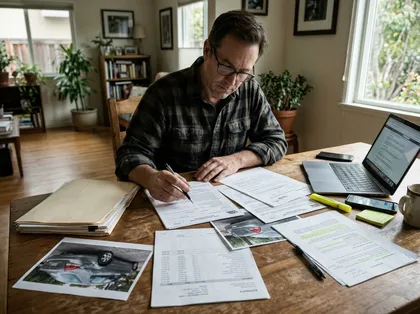
Before pursuing unpaid repair costs, determine whether you or the other driver already made payments, signed an agreement, or notified an insurance company. These actions may affect your remaining recovery options.
Did the Other Driver Make a Partial Payment?
Review bank transfers, payment receipts, checks, and written confirmations. Determine how much the other driver paid and whether they described the payment as partial or final settlement.
A partial payment does not automatically resolve the entire claim. However, accompanying settlement terms may affect how much you can recover later.
Did You Sign a Release?
Check whether you signed any document accepting payment in exchange for releasing further claims. Some agreements cover only vehicle damage, while others may include injuries arising from the same collision. Review the exact language before assuming you can pursue additional compensation.
Did Either Driver Notify an Insurance Company?
Determine whether you or the other driver reported the crash, opened a claim, or received a coverage decision. Preserve claim numbers, adjuster communications, and any denial letters.
If nobody reported the crash, review your policy’s notice requirements and contact your insurer promptly. A private agreement does not eliminate your obligations to notify your own carrier under the policy’s terms.
Pursuing Insurance Coverage When the Other Driver Backs Out
An insurance claim is the primary formal route to recovering your repair costs when direct negotiation with the other driver fails. If that driver now refuses to pay for your vehicle repair costs after initially agreeing to do so, assess their insurance status and your own coverage to determine the right path for your situation.
- If you have collision coverage, file a claim with your own insurer. Collision coverage pays for damage to your vehicle regardless of fault.
- If the other driver caused the crash, you can file a third-party claim with their insurer. This may be an option even if you have collision coverage. The insurer will investigate liability, coverage, and your claimed repair costs.
-
If the other driver has no insurance, review your policy for Uninsured Motorist Property Damage (UMPD) or collision deductible waiver coverage. If you lack collision coverage, UMPD may cover up to $3,500 or your vehicle’s actual cash value, whichever is less. If you have collision coverage, a deductible waiver may apply.
Under Insurance Code § 11580.26, these coverages generally require:
- Qualifying physical contact.
- Identification of the uninsured driver or vehicle.
- Notice to your insurer within 10 business days.
- If the insurer denies your claim, review its written explanation and identify whether it disputes liability, coverage, or repair costs. A denial does not automatically eliminate your right to pursue the responsible driver. You can submit additional evidence and request reconsideration. You can also ask the California Department of Insurance to review potential claim-handling violations.
Filing a Lawsuit in California Small Claims Court
When insurance options fail, California small claims court may help you recover vehicle damage costs up to $12,500. Attorneys generally cannot represent parties at small claims hearings, but you can consult one beforehand.
Generally, you must request payment from the other driver first. Then, you typically have to file the lawsuit in the court that serves the location where the accident occurred or where the defendant lives, subject to venue rules. For example, if the other driver hit you on Rowena Boulevard in Silver Lake, you would likely file your lawsuit with the Los Angeles Superior Court.
Your lawsuit can seek compensation for reasonable repair, towing, storage, and transportation expenses, plus compensation for loss of vehicle use. For a total loss, the vehicle’s pre-accident fair market value may determine its value. Keep records supporting your claimed losses.
If both drivers contributed to the accident, California’s comparative fault rules may apply. Under them, you could still recover compensation. However, your share of fault can reduce the amount you may receive. A small claims court judge will typically consider evidence of each driver’s actions when determining liability and the amount of compensation to award.
Winning a judgment does not guarantee payment, especially if the driver lacks sufficient assets. Certain unpaid accident judgments may support DMV action under California Vehicle Code §§16370 and 16370.5.
Keep in mind that California limits claimants to two small claims actions exceeding $2,500 per calendar year. If your damages exceed $12,500, you can consider filing in regular civil court instead. You may also reduce your small-claims demand to $12,500, but doing so may limit your recovery. You cannot split one claim into separate cases to avoid the limit.
Before filing, consider reviewing how an attorney can help with your car accident claim. An Arash Law attorney can assess whether filing an insurance claim, in small claims court, or a regular civil lawsuit offers a more suitable path to recovery.
What Documents Should You Gather When the Other Driver Refuses to Pay?
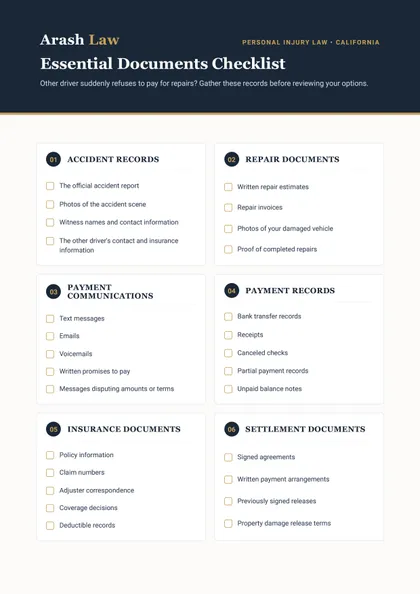
Gathering relevant documents helps an insurer, small-claims advisor, or attorney evaluate your options after a driver who initially agreed to pay for vehicle repairs suddenly refuses to do so. You do not need every document before seeking guidance, but organized records can help make your situation easier to assess.
When preparing for a review of your unpaid repair costs, gather any of the following that you have:
- Accident Records: Police reports, photographs, witness details, and the other driver’s contact information.
- Repair Documents: Written estimates, invoices, photographs of damage, and proof of completed repairs.
- Payment Communications: Text messages, emails, voicemails, and any written promises to pay.
- Payment Records: Bank transfers, receipts, canceled checks, and records of outstanding amounts.
- Insurance Documents: Policy information, claim numbers, adjuster correspondence, coverage decisions, and deductible records.
- Settlement Documents: Any signed agreement, written payment arrangement, or release, including signed releases for injury claims that may also affect your right to recover property damage costs.
An appropriate review can help determine whether an insurance claim, small claims action, or separate personal injury claim warrants further consideration.
Repair Payment Timeline and Decision Checklist: What Should You Do Next?
When the other driver refuses to pay for repairs, reviewing the sequence of events can help you identify what happened and which recovery options remain available. Use the timeline and checklist below to evaluate your situation.
Repair Agreement and Payment Timeline
A repair payment dispute may develop through several stages, from the other driver’s initial promise to their eventual refusal to pay. The timeline below shows how these events may unfold.
Not every case involves a formal payment agreement, partial payment, or insurance notification, and the sequence may vary.
- The Accident: The collision damages your vehicle, prompting discussions about who will pay for repairs.
- The Initial Promise: The other driver offers to cover the repair costs, either verbally or through texts, emails, or other communications.
- Repair Estimates: You obtain repair estimates and share the proposed costs with the other driver. They may question certain charges or request another estimate.
- Payment Discussions: You and the other driver may discuss a specific amount, payment method, or due date without necessarily reaching an enforceable agreement.
- Possible Partial Payments: The other driver may pay part of the repair costs, offer a settlement, or make no payment at all.
- The Payment Dispute: The other driver rejects the estimates, misses a payment, stops responding, or refuses to cover the repairs.
- Possible Insurance Involvement: Either driver may notify an insurer or open a claim during or after the informal negotiations.
- The Current Situation: You still face unpaid or disputed repair costs and may have insurance or legal recovery options to consider.
Understanding this timeline can help clarify what the other driver promised, whether you reached an agreement, and when the payment dispute began. These details can also help you assess which recovery options remain available. The decision checklist below can help you identify what to review before choosing your next step.
Decision Checklist: What Should You Do Next?
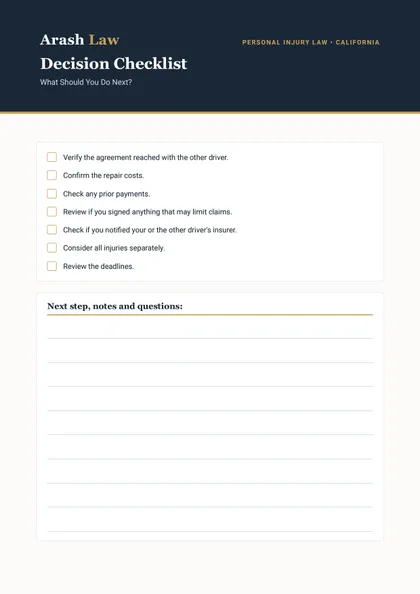
Before choosing a path, take stock of where your claim stands. The checklist below highlights factors that may affect your available recovery options.
- Verify the Agreement: Can you establish what the other driver promised and whether they accepted responsibility?
- Confirm Repair Costs: Do written estimates or invoices support the amount you seek?
- Check Prior Payments: Did the driver pay anything, and was it part of a final settlement?
- Review Releases: Have you signed anything that may limit your ability to make additional claims?
- Check Insurance Coverage: Have you notified your insurer or contacted the other driver’s insurer?
- Consider Injuries Separately: Did anyone suffer injuries requiring medical attention or further evaluation?
- Review Deadlines: Are insurance notification, DMV reporting, or lawsuit deadlines approaching?
- Choose Your Next Step: Is an insurance claim, small claims case, or legal consultation appropriate?
Reviewing these factors can help you identify which recovery options warrant further consideration. Depending on your insurance coverage, available evidence, and any prior agreements or payments, you may pursue an insurance claim, consider small claims court, or seek legal guidance. The appropriate next step depends on your circumstances.
How Broken Promises Affect Your California Legal Deadlines
The other driver’s promise to pay does not pause any legal clock in California. In most traffic-collision cases, key reporting and lawsuit-filing deadlines run from the date of the crash. Exceptions and tolling rules can apply.
- SR-1 Filing: If the accident resulted in injury, death, or property damage exceeding $1,000, California Vehicle Code §16000 requires you to file an SR-1 report with the DMV within 10 days. This obligation applies even if both parties agreed to handle repairs privately and no police report was filed.
- Property Damage Lawsuit: Under CCP §338(c)(1), you have 3 years from the crash date to file a lawsuit for vehicle property damage. Waiting for the other driver to “make good” on a promise does not extend this deadline.
-
Personal Injury Lawsuit: Under CCP §335.1, you have 2 years from the date of the collision to file a personal injury lawsuit. This deadline is not extended by a driver’s promise to pay or ongoing negotiations.
For many private personal injury claims, the filing deadline may be tolled while the injured person is a minor. Government-entity claims, medical malpractice claims, and other specialized claims can have different timing rules, so the applicable deadline should be reviewed with an attorney.
- Breach-of-Contract Lawsuit: If the driver’s promise to repair created an enforceable agreement, a separate contract claim may have a different deadline. Under CCP §337, written contract claims generally have a four-year statute of limitations from the date of breach. Under CCP §339, oral contract claims generally have a 2-year statute of limitations. A new agreement does not automatically extend the original collision-related filing deadline.
Speaking with a car accident lawyer early about claims in California can help you understand which deadlines apply and whether emerging injuries need to be part of your claim.
Why You Should Separate Repair Negotiations From Your Injury-Related Needs
Don’t let a repair dispute delay attention to injuries from the same crash. Property damage and personal injury claims involve different losses, evidence, and legal rules. A repair agreement may not cover medical bills, lost income, or other injury-related losses.
If you experience pain or other symptoms, seek medical care without waiting for the repair dispute to end. Early evaluation can identify injuries, guide treatment, and document your symptoms. Delays may make it harder to establish when symptoms developed and how they relate to the crash.
Before accepting any settlement, confirm whether it covers only vehicle damage or also releases injury claims. A broadly worded release could affect your right to seek additional compensation, even if the negotiations primarily concerned repairs.
A California personal injury attorney can evaluate any injury claim separately from the repair dispute.
Talk to Arash Law About Your California Car Accident Claim
If the other driver is refusing to honor their promise to pay for repairs, Arash Law can help you evaluate your options, including which insurance route applies, whether a small claims filing makes sense, and how to protect any injury rights before you sign a release. Arash Law has recovered over $1 billion for injured Californians across the state.
Call (888) 488-1391 for a free, no-obligation case evaluation.
Frequently Asked Questions About Broken Repair Payment Promises in California
When an informal repair agreement falls apart, people face a predictable set of follow-on questions. The answers below address the situations Arash Law’s attorneys see most often when a driver’s promise to pay collapses.
Do I Need to Hire a Lawyer if the Other Driver Refuses to Pay for Repairs?
Not necessarily. You can file an insurance claim or pursue a qualifying California small claims case without hiring an attorney.
California generally prohibits attorneys from representing parties at small claims hearings, although you can consult one beforehand. If the collision also caused injuries, a personal injury attorney can evaluate whether a separate injury claim warrants representation.
Is a Text Message a Legally Binding Contract to Pay for Repairs?
A text message can serve as evidence of an agreement. However, whether it constitutes a binding contract depends on its terms.
California contract law requires a clear offer, acceptance, and agreed-upon terms. A vague “I’ll take care of it” text is harder to enforce than one that names a specific dollar amount and a payment date.
Will My Insurance Rates Go Up If I Use My Collision Coverage?
Not necessarily. California generally prohibits insurers from increasing premiums because of accidents that were not your fault.
Under 10 CCR §2632.13, insurers generally must find that you were at least 51% responsible before classifying an accident as principally at fault.
Can I Pursue Repair Costs Without a Police Report?
Yes. A police report is not always necessary to pursue compensation for vehicle damage.
You may still use photographs, repair estimates, witness statements, and communications with the other driver to support your claim. An insurer or court can evaluate the available evidence, although missing documentation may make disputed facts harder to establish.
Can the DMV Suspend the Other Driver’s License If They Don’t Pay?
Yes, but not simply because the driver broke an informal promise. An unpaid qualifying accident judgment may trigger a license suspension under California Vehicle Code §§ 16370 and 16370.5. Separate financial responsibility rules may also apply after a reportable accident.
A suspension does not guarantee payment or collection of your repair costs.
What If the At-Fault Driver Asks for More Time to Pay?
You can choose to give them more time. Keep records of payments and communications, and consider documenting the revised payment terms in writing.
However, keep in mind that granting the at-fault driver more time to pay will not pause California’s lawsuit-filing deadlines. Continued delays during informal negotiations with them may affect your available recovery options.
Contact Arash Law About Your California Repair and Injury Claim Today
If the other driver broke their promise and you are not sure what to do next, Arash Law can help. Arash Law has recovered over $1 billion for injured Californians statewide, and we are available 24 hours a day to discuss your situation.
We offer free initial consultations so you can discover your available legal options without any pressure to hire us afterward.
However, if you do choose to work with us, we can handle your case on a contingency fee basis. That means that you won’t pay the attorney’s fees unless we win or settle your case.
Call (888) 488-1391 for your free case evaluation with Arash Law.
Sources
- California Legislature — Code of Civil Procedure § 116.231, limits on the number of small claims actions exceeding $2,500 per calendar year.
https://leginfo.legislature.ca.gov/faces/codes_displaySection.xhtml?sectionNum=116.231.&lawCode=CC- California Legislature, Code of Civil Procedure §335.1: Two-year statute of limitations for personal injury actions caused by another person’s wrongful act or neglect.
https://leginfo.legislature.ca.gov/faces/codes_displaySection.xhtml?sectionNum=335.1.&lawCode=CCP- California Legislature, Code of Civil Procedure §338(c)(1): Three-year statute of limitations for actions involving injury to goods or chattels, including vehicle property damage.
https://leginfo.legislature.ca.gov/faces/codes_displaySection.xhtml?sectionNum=338.&lawCode=CCP- California Legislature, Vehicle Code §16000: Requirement to file an SR-1 accident report with the DMV within 10 days when applicable reporting thresholds are met.
https://leginfo.legislature.ca.gov/faces/codes_displaySection.xhtml?sectionNum=16000.&lawCode=VEH- Judicial Branch of California, California Courts Self-Help Center: Small claims versus limited civil case filing thresholds, including the $12,500 limit for individual claimants.
https://selfhelp.courts.ca.gov/small-claims-or-limited-civil- California Legislature, Insurance Code §11580.26: Uninsured Motorist Property Damage (UMPD), collision deductible waiver coverage, applicable limits, and claim requirements.
https://leginfo.legislature.ca.gov/faces/codes_displaySection.xhtml?sectionNum=11580.26.&lawCode=INS- California Legislature, Code of Civil Procedure §§337 and 339: General four-year filing period for written contract claims and two-year period for oral contract claims.
https://leginfo.legislature.ca.gov/faces/codes_displaySection.xhtml?sectionNum=337.&lawCode=CCP
https://leginfo.legislature.ca.gov/faces/codes_displaySection.xhtml?sectionNum=339.&lawCode=CCP- California Legislature, Vehicle Code §§16370 and 16370.5: Driver’s license suspension provisions involving qualifying unsatisfied accident judgments.
https://leginfo.legislature.ca.gov/faces/codes_displaySection.xhtml?sectionNum=16370.&lawCode=VEH
https://leginfo.legislature.ca.gov/faces/codes_displaySection.xhtml?sectionNum=16370.5.&lawCode=VEH- California Department of Insurance, 10 CCR §2632.13: Rules for determining whether a driver was principally at fault when evaluating driving safety records and Good Driver Discount eligibility.
https://govt.westlaw.com/calregs/Document/IDE88853D5C2F11EC9C68000D3A7C4BC3- Judicial Branch of California, California Courts Self-Help Guide — Small Claims: Before You Start: Guidance on preparing a small claims case, including gathering evidence to support a claim.
https://selfhelp.courts.ca.gov/small-claims/before-you-startDisclaimer
The information on this page is for general educational purposes and does not constitute legal advice. No attorney-client relationship is formed by reading or relying on this content. If you were injured, consult a licensed California personal injury attorney about your specific situation. Arash Law, (888) 488-1391.