TL;DR: Jaywalking in California commonly refers to pedestrian crossing violations, such as crossing outside a crosswalk or against a signal. Police generally cannot stop you for certain crossing violations unless the crossing creates an immediate collision risk. If a car hits you, comparative negligence can reduce your recovery for ER bills, lost wages, and other losses.
Highlights:
- Confirm whether you crossed at an intersection with an unmarked crosswalk.
- Follow pedestrian signals – enter on WALK, not a steady hand.
- A flashing-hand countdown allows crossing only if you can safely finish before the steady hand appears.
- When crossing outside a crosswalk, yield to any vehicle close enough to be hazardous.
- Note the lighting, number of lanes, visibility obstructions, and what you observed about the vehicle’s speed and distance.
- Get the driver’s insurance information, witness contacts, and the police report number.
- Keep medical notes, bills, and missed-work proof to support your damages.
Tip: Take photos and notes first, then stick to observable facts with police and insurers to avoid guessing about fault.
Table of Contents
California law does not formally define an offense called “jaywalking.” Instead, people commonly use the term to describe several possible pedestrian violations. These may include crossing between certain intersections outside a crosswalk, failing to yield while crossing elsewhere, or disobeying a pedestrian-control signal.
California Assembly Bill 2147, commonly called the Freedom to Walk Act, changed when police may stop pedestrians for several crossing violations. It did not eliminate pedestrian crossing laws or give pedestrians the right of way wherever they choose to cross.
Is Jaywalking Still Illegal Under California Law?
California still regulates where and how pedestrians may cross a roadway. Assembly Bill 2147, commonly called the Freedom to Walk Act, did not repeal those rules. It changed when police may stop pedestrians for certain violations.
Under California Vehicle Code (CVC) § 21955, pedestrians crossing between two adjacent intersections that are both controlled by traffic signals or police officers must use a crosswalk. An officer generally cannot stop a pedestrian for this violation unless the crossing creates an immediate risk of a collision with a vehicle, bicycle, or other human-powered device.
AB 2147 took effect on January 1, 2023. The law did not give pedestrians the right of way wherever they choose to cross. Pedestrians must still use reasonable care for their safety, and drivers must continue to exercise reasonable care toward pedestrians in the roadway.
Different questions may arise after a pedestrian crossing:
- Did the pedestrian violate a crossing rule?
- Was an officer legally permitted to stop the pedestrian?
- Did the pedestrian, driver, or both contribute to a collision?
A pedestrian’s conduct may technically violate a rule even when the immediate-danger threshold for a police stop is not met. Similarly, the absence of a citation does not prove that the pedestrian acted reasonably for purposes of a later injury claim.
Factors affecting whether an immediate danger existed may include:
- The speed and distance of approaching vehicles.
- Lighting, weather, and visibility.
- The number of lanes being crossed.
- Parked vehicles or other sight obstructions.
- Whether a driver had to brake or swerve suddenly.
- Whether the pedestrian entered the vehicle’s immediate path.
The Freedom to Walk Act does not permit pedestrians to enter traffic without looking. Being protected from a police stop under particular circumstances is not the same as having the right of way.
The Difference Between Marked And Unmarked Crosswalks
Not every crosswalk is identified by painted lines. In California, crosswalks may be marked or unmarked, and both can affect a pedestrian’s right-of-way protections. Understanding the difference can help determine whether a pedestrian was legally crossing within a crosswalk at the time of a collision.
| Feature | Marked Crosswalk | Unmarked Crosswalk |
|---|---|---|
| How it appears |
|
|
| How its boundaries are identified |
|
|
| Right-of-way considerations |
|
|
This distinction matters because a pedestrian may believe they crossed outside a crosswalk simply because no painted lines were visible. At many intersections, the pedestrian may actually have been within an unmarked crosswalk and may have had different right-of-way protections. Pedestrian accident lawyers evaluate the specific circumstances of each incident to determine liability.
Disobeying A Pedestrian Signal May Constitute Jaywalking
Jaywalking does not only refer to crossing outside a crosswalk. The term may also describe starting to cross against a pedestrian-control signal. CVC § 21456 explains when pedestrians may legally enter a signal-controlled crosswalk.
A pedestrian facing a “WALK” or walking-person symbol may begin crossing but must yield to vehicles lawfully within the intersection when the signal first appears.
When a flashing upraised-hand signal includes a countdown, a pedestrian may begin crossing but must complete the crossing before the countdown ends and the steady hand appears.
A pedestrian generally may not begin crossing when:
- The upraised hand is steady.
- The raised hand flashes without a countdown.
Even if someone breaks these signal rules, police generally cannot stop them unless a reasonably careful person would see an immediate risk of a collision with a vehicle or human-powered device. Pedestrians still have to watch for traffic and cross safely.
When Do Pedestrians Have The Right Of Way?
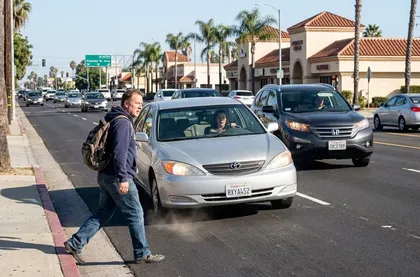
Under CVC § 21950, drivers must yield to pedestrians crossing within marked or unmarked crosswalks at intersections. Still, pedestrians must use reasonable care. Under CVC § 21950(b), they may not suddenly leave a curb or other place of safety and enter the path of a vehicle that is too close to stop safely. Drivers approaching a pedestrian in a crosswalk must reduce speed or take other reasonable action to protect them.
When crossing outside a marked or unmarked crosswalk, pedestrians generally must yield to vehicles close enough to create an immediate hazard under CVC § 21954(a).
However, a pedestrian’s failure to yield does not eliminate a driver’s duty to exercise due care under CVC § 21954(b). A driver may still be responsible for a collision caused by:
- Speeding
- Distracted or impaired driving
- Failing to keep a proper lookout
- Making an unsafe turn
- Ignoring a traffic signal
- Failing to brake or take reasonable evasive action
Having the right of way and being protected from a police stop are separate legal issues. A pedestrian may avoid a citation but still share fault for a collision, while a driver may still be negligent even when the pedestrian crossed outside a crosswalk. Certain pieces of evidence can help determine liability when a car hits a pedestrian in California.
Can You Still Get A Ticket For Jaywalking?
Since the law changed, police have faced tighter limits on when they may stop pedestrians for certain crossing violations. An officer may still stop and potentially cite you for a covered pedestrian violation when a reasonably careful person would recognize an immediate danger of a collision, even if no crash occurs. The law raised the bar but did not end enforcement.
Some crossings can still lead to a citation. Common examples include:
- Entering the roadway so close to an oncoming vehicle that the driver has no time to stop.
- Running across multiple lanes of heavy traffic unpredictably.
- Entering a crosswalk against a red pedestrian signal in a way that forces traffic to stop.
- Crossing outside a marked crosswalk or an unmarked crosswalk at an intersection without yielding to vehicles close enough to constitute an immediate hazard.
Officers use their judgment to decide whether a real hazard existed. If they conclude you crossed dangerously, they can issue a citation, and the court sets the fine. Even without a ticket, a police report may still note unsafe pedestrian behavior. If a crash does occur, insurance companies may use those observations to argue you share the blame.
How Does Jaywalking Affect A Personal Injury Claim?
Jaywalking does not end your personal injury claim on its own. California uses a pure comparative negligence rule. This means you can still seek compensation even if you bear a share of the fault. Your percentage of fault may reduce any compensation available to you, but it is not automatically eliminated.
California adopted this rule in Li v. Yellow Cab Co. (1975). Sharing fault does not automatically bar your claim, but you still must prove the other driver was also at fault and caused your injury. Say a court finds you 30% at fault for crossing mid-block. If your proven damages total $100,000, your award would generally be reduced to $70,000. Jaywalking can reduce any compensation you may be able to recover, but it does not eliminate your ability to seek it.
Seek medical evaluation right away after a pedestrian collision. Call 911 or go to an emergency room for head trauma, severe pain, confusion, or other urgent symptoms. Prompt treatment also documents when your symptoms appeared, which may help support your claim later.
Case Results: When Blame For Crossing Didn’t Decide The Case
The following Arash Law case results involve clients whose actions were cited as factors in pedestrian accidents. These outcomes show that a jaywalking allegation or claim of pedestrian fault does not necessarily determine the result of a personal injury case.
- $2,000,000: Our client received a jaywalking citation after a nighttime incident. Even with the unfavorable police report, we secured a full $2 million recovery on his behalf.
- $5,000,000: The defense blamed our client for looking at his phone, even though he was in the crosswalk. Our client sustained a mild traumatic brain injury due to the incident, and we were able to recover compensation for him.
- $1,250,000: A 5-year-old client darted into the street, and the insurer called the crash unavoidable. Accident reconstruction proved otherwise, and we recovered the full policy limits.
Disclaimer: Past results do not guarantee a similar outcome. Each result depends on the facts, evidence, injuries, insurance, law, and other circumstances.
Frequently Asked Questions About California Pedestrian Laws
California gives pedestrians more legal protection than most people realize. Crossing outside a crosswalk is not automatically your fault, and a jaywalking ticket does not erase your right to seek damages. These answers address the questions pedestrians most often ask after a crash or close call in California.
Is Jaywalking A Crime In California?
Jaywalking-type violations are infractions under California law, not misdemeanors or felonies. Since January 1, 2023, AB 2147 has also limited when officers can stop you for crossing outside a crosswalk.
Can I Sue If I Was Hit While Jaywalking?
Yes. California uses pure comparative negligence. This means your share of fault reduces your potential compensation but does not eliminate your right to seek damages. You may still be able to recover compensation even if you were jaywalking, depending on the facts of your case.
What Happens If A Jaywalking Pedestrian Dies In A Crash?
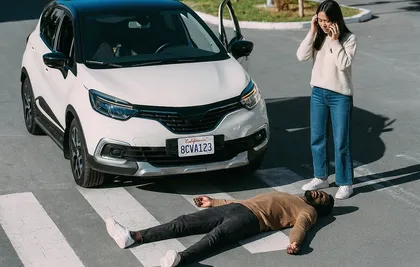
Certain family members, such as a spouse, domestic partner, or children, may file a wrongful death claim. If the pedestrian shared some fault for the crash, the family’s compensation may be reduced by that percentage.
What Is An Immediate Hazard Under The Law?
It means a reasonably careful person would see a real danger of a collision with a moving vehicle. Vehicle speed, distance, and visibility can all factor into that judgment.
Are Drivers Always At Fault For Pedestrian Crashes?
Not always. Both drivers and pedestrians have a legal duty to act safely. A driver who ran a red light may carry most of the fault, but a pedestrian who darted into traffic may share some too.
Does A Jaywalking Ticket Ruin My Injury Case?
No. A ticket does not end your right to sue or decide fault by itself. It may become one piece of evidence when fault is assigned. Speaking with an attorney can help you understand your options.
Don’t Let Jaywalking Become Their Excuse. We Can Help.
Pedestrian accident victims may worry that a jaywalking citation will prevent them from pursuing compensation. However, a citation does not automatically bar a claim. Drivers and other road users may still be liable when their negligence, such as speeding or distracted driving, contributed to the collision.
Our pedestrian accident lawyers at Arash Law can provide the legal support you need. We can evaluate your case, review evidence, and represent you in settlement negotiations. When you reach out, our lawyers can review the facts of your case and explain your legal options. You pay no attorney’s fees unless we recover compensation for you.
Contact AK Law at (888) 488-1391 to schedule a free initial consultation.