TL;DR: After a truck accident in San Francisco, call 911, get medical care, and document the scene promptly. Truck crashes involve federal safety rules, multiple liable parties, and electronic evidence that can be overwritten quickly, depending on the carrier’s system. If you were injured, you have two years to file a personal injury lawsuit, but if a Muni bus or city vehicle was involved, you may have only six months to file a government claim. Missing those deadlines can bar your claim.
After a truck accident in San Francisco, call 911, seek medical attention right away, and begin gathering evidence before the scene is cleared. The steps you take in the first hours after the crash can determine whether you can recover compensation.
Truck crashes are fundamentally different from standard car accidents, and that can change how your personal injury claim proceeds. Commercial carriers must comply with federal rules set by the Federal Motor Carrier Safety Administration (FMCSA), carry much higher insurance coverage than private drivers, and generate digital records that private vehicles do not.
Acting quickly can help preserve evidence and protect your legal options, particularly given strict deadlines such as the two-year limit for personal injury lawsuits and the six-month deadline for government claims.
Contact Arash Law today for a free initial consultation. Call (415) 969-7799 or reach us 24 hours a day at (888) 488-1391.
Five Things That Can Change Your San Francisco Truck Accident Case
Local factors can shape how you file a truck accident claim for compensation. San Francisco’s terrain, dense street grid, mixed transit infrastructure, and active pedestrian corridors create challenging conditions for commercial truck operations. Here’s how those conditions separate a San Francisco truck crash from other California collision claims:
- The San Francisco Superior Court may handle your case. Unlimited civil personal injury claims, including truck accident lawsuits, are filed at the Civil Division, 400 McAllister Street, San Francisco, CA 94102. The court offers an Alternative Dispute Resolution program that can affect how and when your case resolves.
- San Francisco reports a high number of traffic collisions. The California Office of Traffic Safety (OTS) recorded 3,505 victims killed and injured in San Francisco traffic accidents, including truck crashes, in 2023. That underscores the density of risk on the corridors where commercial trucks operate: Market Street carries commercial delivery traffic through the city’s urban core alongside Muni tracks and busy crosswalks, while the I-80 Bay Bridge approach brings heavy freight into the city’s surface street network at interchange zones that require careful maneuvering.
- Digital evidence from the truck can disappear quickly. Federal law sets minimum retention periods for driver logs, and some records can be overwritten according to carrier-controlled schedules. To prevent their deletion, you may need to send a written evidence-preservation demand to the carrier immediately after the crash.
- Truck crash claims may involve FMCSA regulations and multi-party liability. Truck crash claims can involve the driver, the trucking company, cargo loaders, and maintenance contractors simultaneously. Establishing each party’s share of responsibility requires working knowledge of FMCSA rules and the ability to obtain and interpret electronic logging device (ELD) and engine control module (ECM) data.
- Deadlines differ if a public entity is involved. If a Muni bus, City vehicle, or Caltrans-managed road may be part of your claim, tell your attorney immediately so the correct deadline track is identified.
Table of Contents

Your First Steps At A San Francisco Truck Crash Scene
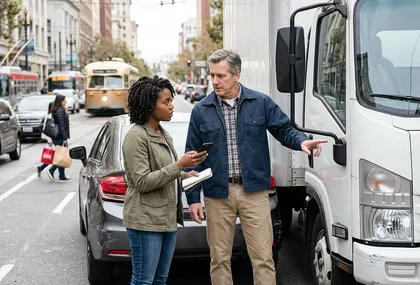
Getting safe and getting help are your two priorities at any crash scene. However, a truck crash in San Francisco warrants additional steps beyond those a standard fender-bender requires. If you were taken to the hospital by ambulance and could not document the scene yourself, a family member or friend can gather this information on your behalf. Otherwise, here’s what you can do:
- Move to Safety: If you can do so without worsening your injuries, move away from traffic and turn on your hazard lights.
- Call 911: Notify law enforcement immediately. Which agency responds depends on where the crash occurred. On city streets, you may see a San Francisco Police Department (SFPD) response. On state freeways such as I-80 and US-101, the California Highway Patrol (CHP) typically responds, though both agencies may be involved depending on the location.
- Get Medical Care: See a doctor, urgent care provider, or emergency room as soon as possible, even if you feel fine. Adrenaline can mask serious injuries. Additionally, injuries like whiplash, internal bleeding, and traumatic brain injuries may not present symptoms for hours or days.
- Collect Truck-Specific Information: Get the driver’s name and license number, the trucking company’s name, the U.S. Department of Transportation (DOT) number on the truck’s door, and the license plate numbers for both the cab and the trailer. Obtain the truck driver’s insurance information and, if available, the carrier’s policy details.
- Talk to Witnesses: Ask witnesses for their names, phone numbers, and email addresses. Do not rely solely on the police report to identify everyone who saw the crash.
- Document the Scene: Use your phone to photograph the vehicles, their positions, skid marks, road conditions, traffic signals, and any visible injuries.
After the accident, avoid posting about the crash on social media. A photo of you at a social event, or a casual comment that downplays your pain, can be introduced to argue your injuries are less severe than claimed. San Francisco carriers operating on high-volume routes like Market Street and the Bay Bridge approach often work with adjusters experienced in minimizing commercial vehicle claims in the Bay Area. Insurers routinely monitor the social accounts of people making injury claims.
If an adjuster for the trucking company or its insurer contacts you, avoid giving a recorded statement or signing any document, including a settlement offer or medical authorization, until you have spoken with an attorney. However, you will want to notify your own auto insurer promptly, even if you believe the truck driver was at fault. Your policy may require timely notice, and reporting the collision can help preserve access to benefits such as collision coverage, MedPay, or uninsured/underinsured motorist coverage if applicable.
Acting on the steps above protects any potential claim you may have. Once you are safe and treated, your next priority is preserving records. A San Francisco truck accident lawyer can help you with that.
Evidence To Gather In The Days After Your San Francisco Truck Crash
Commercial trucking claims rely on early physical, medical, and digital documentation. In San Francisco, some key records can be overwritten quickly depending on the system, so acting promptly is essential. The trucking company’s legal team may also begin investigating soon after the crash. To start building your own case, prioritize gathering the following:
- SR-1 Vehicle Accident Report: A driver, insurance representative, or legal representative must submit it to the California Department of Motor Vehicles (DMV) within 10 days when anyone is injured or killed, or property damage exceeds $1,000, in a traffic accident. This requirement applies even if law enforcement prepared a collision report. Missing the deadline can result in suspension of your driving privileges.
- CHP or SFPD Collision Report: Request a copy of the collision report once it becomes available. It may contain driver and witness information, diagrams, statements, insurance details, and the investigating officer’s observations.
- Vehicle Damage and Repair Documentation: Keep repair estimates, towing records, storage invoices, and related receipts. Avoid repairing, selling, or disposing of your vehicle before important physical evidence has been documented.
- Damaged Personal Property: Preserve other damaged items from the crash, such as a child safety seat, helmet, phone, or clothing. Photograph the items before replacing or discarding them.
- Medical and Financial Records: Keep medical bills, pharmacy receipts, travel or mileage records for treatment, pay stubs, employer correspondence, and other documentation showing medical expenses or lost income.
- Symptom and Recovery Journal: Keep a simple record of your pain, physical limitations, medical appointments, missed activities, and how your injuries affect your daily routine. Contemporaneous notes can help document how your condition changes over time.
- Electronic Evidence: Truck crashes can generate electronic records that may help show what happened. Federal law under 49 CFR § 395.8(k)(1) requires carriers to keep driver records of duty status for a minimum of six months. After required retention periods expire, records may no longer be available, making prompt preservation of the following data vital:
- ELD Data: Records used to document a commercial driver’s hours of service (HOS).
- ECM Data: Depending on the truck and system, onboard data may contain information about speed, braking, throttle use, or other vehicle activity.
- Dashcam and Onboard Camera Footage: Video from the truck, your own vehicle, or other vehicles near the crash may capture the collision or events leading up to it.
- GPS and Telematics Logs: Fleet systems may contain route, location, speed, or stop information.
- Phone and Communication Records: If distracted driving is suspected, relevant phone, dispatch, or electronic communication records may become important evidence and should be identified and preserved through appropriate legal procedures.
- Nearby Camera Footage: Footage cameras on nearby businesses, homes, parking facilities, transit vehicles, or other properties may be overwritten on routine schedules, so sending evidence preservation letters early can be important. The San Francisco Municipal Transportation Agency (SFMTA), which operates the Muni fleet, also maintains onboard cameras on its buses and trains. The specific overwrite schedule for SFMTA footage is not publicly confirmed, so a public records request should be made promptly after a crash involving a Muni vehicle.
- Truck Maintenance and Inspection Records: These records can help show whether required inspections were performed and whether known mechanical problems were repaired before the truck returned to service.
- Truck Ownership and Operating Records: Identify whether the truck was owned, leased, or rented and whether the shipment involved a broker, motor carrier, subcontractor, or other company. These records can help determine which businesses controlled the driver, vehicle, cargo, or delivery at the time of the crash.
Consulting A Lawyer About Your San Francisco Truck Accident
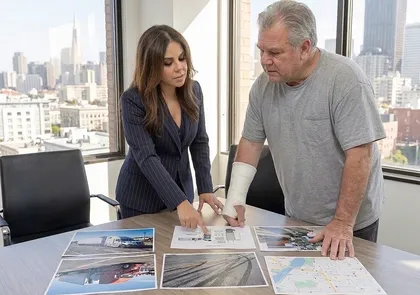
Truck accident claims can involve multiple companies, federal safety records, commercial insurance policies, and evidence that may not remain available indefinitely. A lawyer from a San Francisco injury law firm can help identify potentially responsible parties, preserve records such as ELD or camera data, communicate with insurers, and track the filing deadlines that apply to your claim.
More importantly, an attorney can help you understand how road conditions, agencies, and filing procedures specific to the city will shape your strategy for pursuing compensation. Speaking with a lawyer can be especially important when injuries are serious, liability is disputed, a public entity may be involved, or the trucking company has already begun investigating the crash.
Identifying Who May Be Legally Responsible For Your Injuries
In a truck accident, the driver is rarely the only party at fault. Responsibility in commercial truck crashes often spreads across multiple companies and contractors. Parties who may share liability for your injuries include:
- Truck Driver: Driving while fatigued, distracted, or impaired, or operating the truck without ensuring that required safety equipment was in good working order.
- Trucking Company: Responsibility for negligent hiring practices, inadequate driver training, or keeping drivers with unsafe records on the road.
- Cargo Loaders and Shippers: Overloading the trailer beyond federal weight limits, or failing to secure freight so that it shifts during transit.
- Maintenance Contractors: Performing substandard repairs or clearing a truck with known mechanical defects for another run.
- Public Entities: When a crash involves a Muni bus operated by SFMTA, a Caltrans-managed segment of I-80 or US-101, or another city agency vehicle, that public entity may share responsibility under a different and shorter legal timeline.
Delivery vehicle crashes on San Francisco streets introduce an additional layer of complexity. Amazon’s last-mile deliveries in the city frequently go through third-party Delivery Service Partners (DSPs), independent companies, rather than Amazon’s own drivers. FedEx Express drivers are direct company employees. Independent service contractors typically employ FedEx Ground drivers. Who is legally responsible for the crash depends entirely on the employment structure at the moment of impact. Getting this analysis wrong from the start can mean pursuing the wrong defendant.
A company’s responsibility does not end with its driver’s conduct. A carrier that hired a driver with a documented history of HOS violations, or that sent a truck with known brake problems onto Market Street or the Bay Bridge approach, can face independent liability for those decisions.
Federal Rules That Can Prove The Trucking Company Was Negligent
The FMCSA sets safety standards for commercial carriers and vehicles subject to federal jurisdiction, particularly those operating in interstate commerce. California imposes separate requirements on intrastate carriers, many of which incorporate or parallel federal safety standards.
However, these federal rules are at the center of many truck accident claims in San Francisco:
- HOS Rules: Federal regulations under 49 CFR Part 395 cap how many hours a driver can operate without rest. A driver who has been on the road beyond those limits and then causes a crash has violated a federal safety rule specifically designed to prevent fatigue-related collisions. ELD data can document these violations.
- Vehicle Maintenance Requirements: Carriers must keep brakes, tires, lights, and steering systems in safe operating condition. Maintenance records can show whether a company skipped required inspections or cleared a truck with known defects for another run in San Francisco.
- Cargo Loading and Weight Limits: FMCSA rules govern how freight must be secured, while separate federal and state laws impose applicable vehicle and axle weight limits. An overloaded truck on a steep San Francisco grade takes significantly longer to stop and becomes far more likely to roll over or lose control. Improperly secured cargo can shift and destabilize the vehicle at highway speed.
- Driver Qualification Standards: Every carrier must verify that its drivers are properly licensed, medically certified, and free of disqualifying records before putting them behind the wheel. Failing to run required background checks or ignoring known warning signs is called negligent hiring. When it happens, the company’s liability extends to the harm that the driver causes.
In practice, documented FMCSA violations give an attorney concrete tools to establish the applicable standard of care in a San Francisco claim. ELD and ECM data showing a violation are presented to opposing counsel and, if the case proceeds, to a judge or jury at the San Francisco Superior Court.
Filing Deadlines For San Francisco Truck Accident Claims
Missing a filing deadline in California means losing your legal right to pursue compensation, regardless of how clear-cut the fault is or how serious your injuries are. There is no exception for not knowing a deadline existed.
Here are the key timelines for truck accident claims arising from a San Francisco crash:
- Personal Injury Lawsuits Against Private Parties: Under CCP § 335.1, you have two years from the date of injury to file a lawsuit against a private driver, trucking company, cargo loader, or maintenance contractor. If a minor was injured, this deadline tolls until they turn 18.
- Property Damage Lawsuits: You have three years to sue (CCP § 338).
- Government Entity Claims: Under Government Code § 911.2, if you may have a claim against a public entity, for example, if a Muni bus operated by SFMTA, a city vehicle, or a dangerous condition on a publicly maintained road contributed to the crash, you must file a formal government tort claim within six months of the date of injury. Presenting a timely claim is generally required before suing a public entity. Missing the deadline can bar that public-entity claim. From here:
- A public entity generally has 45 days to act after a claim is presented, although that period can be extended by written agreement.
- If the entity sends proper written notice rejecting the claim, you generally have six months from the date the notice was personally delivered or mailed to file suit.
- If no proper written denial is given, the lawsuit generally must be filed within 2 years after the claim arose.
Claims against the City and County of San Francisco are routed through the San Francisco City Attorney’s Office. You can usually file one through the San Francisco city claim form page. You can also contact the San Francisco City Attorney’s Office directly to request current forms and submission instructions.
A claim involving a Caltrans-controlled roadway, such as I-80 or US-101, must instead be filed against the State of California and follow the applicable Caltrans or California Government Claims Program procedures. Filing with the wrong entity may not preserve your claim.
What Arash Law Has Recovered For Crash Victims
Arash Law has recovered over $1 billion for injured clients across California, including in cases involving serious truck crashes and commercial vehicle negligence. The results below are representative of the firm’s work and reflect cases involving fact patterns similar to those that arise from San Francisco truck collisions.
| Amount | Case |
|---|---|
| $5,500,000 | We recovered this amount for a client who sustained mild head trauma and a spinal cord injury following a rollover trucking accident. |
| $5,000,000 | A work truck ran a red light and T-boned a married couple’s vehicle. The incident led to significant disputes over the circumstances and the extent of our clients’ injuries. We secured this settlement after two years of litigation. |
| $1,150,000 | A vehicle from a large, top-rated delivery truck company rear-ended our client on the freeway. She suffered neck and back injuries, but the defense tried to blame it on her weight and pre-existing conditions. We obtained this result for her before a trial became necessary. |
Prior results described on this page do not guarantee or predict a similar outcome in any future case. Each case is unique, and results depend on the specific facts and circumstances involved.
Mid-Case Checkup: Is Your Claim On Track?
Contact Arash Law for a free case evaluation. Call (415) 969-7799 or reach us anytime at (888) 488-1391. You do not owe the attorney’s fees unless we recover on your behalf. Case costs are addressed separately in the written fee agreement.
Frequently Asked Questions About San Francisco Truck Accident Claims
After a truck crash in San Francisco, your immediate concerns may shift into longer-term questions about your rights, the legal process, and what the trucking company’s team may do next. The questions below arise consistently in truck accident cases like yours.
How Long After A Truck Crash In San Francisco Can You Still Report It?
California has separate reporting requirements. You or your insurance representative must generally submit an SR-1 to the DMV within 10 days if anyone was injured or killed, or property damage exceeded $1,000. This filing is required even if the police responded. If you need to contact the California DMV regarding your vehicle registration or driving record after a crash, you can do so through its online records request portal.
When a crash causes injury or death, the motor-vehicle driver must also generally make or ensure a written report to the CHP or local police within 24 hours. A report completed by a responding officer may satisfy that 24-hour requirement.
What If The Trucking Company Says The Driver Was An Independent Contractor?
This is a common defense of carriers. Under 49 CFR § 390.5, federal law defines “employee” to include independent contractors operating a commercial vehicle under a carrier’s authority. As a result, classifying a driver as an independent contractor does not necessarily eliminate a carrier’s responsibilities under applicable federal safety regulations. Civil liability still depends on the facts and applicable law.
Can You Still Recover Compensation If You Were Partly At Fault?
Yes. California follows a pure comparative negligence system, meaning you may still recover compensation even if you share fault for the crash. Your percentage of fault reduces your compensation, but it is not eliminated unless you bear 100% of the responsibility.
Do Commercial Trucks In California Carry Higher Insurance Than Passenger Vehicles?
Yes, significantly higher. Federal rules generally require for-hire interstate or foreign carriers transporting nonhazardous property in vehicles rated at 10,001 pounds or more to maintain at least $750,000 in financial responsibility. Different limits apply to certain hazardous-material carriers and other operations.
Higher policy limits do not simplify the claims process. Insurers with large policies typically have more resources dedicated to defending against claims, particularly in high-value Bay Area corridors such as the Port of San Francisco, Market Street, and the Bay Bridge approach.
What If The Trucking Company Is Headquartered Outside California?
A carrier’s out-of-state headquarters does not necessarily prevent a lawsuit in California. California courts may exercise specific personal jurisdiction when the carrier purposefully conducts business in the state, and the claim arises from or relates to those activities. If the collision and injuries occurred in San Francisco, San Francisco County is generally a proper venue.
Interstate carriers are typically required under federal regulations to designate an agent for service of process in each state where they operate, making it easier to serve them with legal papers.
Talk To Arash Law About Your San Francisco Truck Accident Claim
The trucking company’s legal team began building its defense the moment the crash was reported. If you choose to hire Arash Law, our attorneys can help with key steps such as contacting insurers, sending preservation demands to carriers, gathering electronic records, and negotiating your claim, so you can focus on recovering.
Arash Law works on a contingency basis, meaning you pay no attorney’s fees unless we recover compensation for you. Case costs are addressed separately in the written fee agreement.
Our legal team helps injured people throughout San Francisco and the Bay Area, including clients from Oakland, San Jose, Berkeley, Palo Alto, Mountain View, San Mateo, Sausalito, and Napa.
Call Arash Law at (888) 488-1391. Your initial consultation is free.
Make ’em pay; call AK.
About This Guide
This guide uses legal citations drawn from the California Code of Civil Procedure, the California Government Code, and federal regulations published in the Code of Federal Regulations, available at eCFR. Evidence custodian and retention information reflects FMCSA regulatory minimums under 49 CFR Part 395. Court and agency information was verified against the official website of the San Francisco Superior Court at sf.courts.ca.gov and the San Francisco Municipal Transportation Agency at sfmta.com as of August 2026. This guide addresses San Francisco County specifically. The OTS rankings cited here are the latest available from the OTS. They do not represent statewide averages or the experience of other California cities, and will be updated once new OTS data becomes available.
Sources
- San Francisco Superior Court, Civil Division: https://sf.courts.ca.gov/divisions/civil-division
- California Office of Traffic Safety, San Francisco 2023 Collision Rankings: https://www.ots.ca.gov/rankings/san-francisco-2023
- California Code of Civil Procedure § 335.1 (two-year personal injury statute of limitations): https://leginfo.legislature.ca.gov/faces/codes_displaySection.xhtml?sectionNum=335.1.&lawCode=CCP
- California Government Code § 911.2 (six-month government tort claim deadline): https://leginfo.legislature.ca.gov/faces/codes_displaySection.xhtml?sectionNum=911.2.&lawCode=GOV
- 49 CFR § 395.8, Hours-of-Service Records Retention (eCFR): https://www.ecfr.gov/current/title-49/subtitle-B/chapter-III/subchapter-B/part-395/subpart-A/section-395.8
- San Francisco Municipal Transportation Agency, Public Records Requests: https://www.sfmta.com/public-records-requests
- San Francisco City Attorney, Government Tort Claim Information: https://www.sfgov.org/services/city-claim-form. Claimants should contact the City Attorney’s Office directly to confirm current forms and the submission process.
- Arash Law, Case Results: https://arashlaw.com/case-results/
- 49 CFR § 390.5, FMCSA Definitions, Employee includes independent contractors: https://www.ecfr.gov/current/title-49/subtitle-B/chapter-III/subchapter-B/part-390/subpart-A/section-390.5
Disclaimer
The information on this page is for general educational purposes only and does not constitute legal advice. Reading this page does not create an attorney-client relationship between you and Arash Law. Laws and procedures change. Do not rely on this page as a substitute for professional legal counsel specific to your situation. Verify current requirements with a licensed California attorney. Arash Law — (888) 488-1391.