TL;DR: The driver who violates the right-of-way or other traffic rules is generally at fault. If you were turning into a business, you may be responsible if you failed to yield or turned unsafely, but the other driver may share fault for speeding, following too closely, or other negligent conduct. California allows fault to be divided between both drivers.
If you were turning into a business, fault depends on whether you made the turn safely and whether another driver also violated a traffic rule or acted negligently. Turning into a driveway does not automatically make you responsible for the crash.
Before making a left turn, you have a specific duty to yield to oncoming vehicles that are close enough to create a hazard. A right turn into a business involves different considerations, including signaling and whether the movement could be made safely. If another driver rear-ended you, followed too closely, or otherwise contributed to the collision, fault may be shared.
California uses comparative fault, so more than one driver can be responsible for the same collision. Your share of responsibility can reduce the damages you recover, but partial fault does not automatically prevent a claim.
Key Facts About Fault When Turning Into a Business in California
- Left turns require yielding. A driver turning left onto public or private property must yield to opposing vehicles that are close enough to pose a hazard (California Vehicle Code (CVC) § 21801(a)).
- Every turn must be reasonably safe. A driver cannot turn or move right or left until the movement can be made safely (CVC § 22107).
- Turn signals matter. A turn signal must generally be given continuously during the last 100 feet before the turn (CVC § 22108).
- Following drivers also have duties. A motorist cannot follow another vehicle more closely than is reasonable and prudent (CVC § 21703).
- Fault can be divided. California comparative fault rules reduce an injured person’s recovery according to their percentage of fault (Li v. Yellow Cab Co. (1975) 13 Cal. 3d 804; Judicial Council of California Civil Jury Instructions (CACI) No. 405).
- The SR-1 deadline is separate. A reportable California crash must be reported to the Department of Motor Vehicles within 10 days (CVC § 16000).
Table of Contents

What California Law Says About Turning into a Business
The applicable right-of-way rule depends on how the collision happened. A driver making a left turn into a business faces different duties from someone turning right, exiting a driveway, or traveling behind the turning vehicle. These state laws usually become relevant after a crash involving turning into a business:
-
Turning Left Into a Business: CVC § 21801(a) requires a driver turning left into public or private property to yield to vehicles approaching from the opposite direction when they are close enough to constitute a hazard during the turn. The driver must continue yielding until the turn can be made safely.
That means a driver who turns left across the path of an oncoming vehicle may bear some or all of the fault. However, the left-turning driver is not automatically 100% responsible. Evidence showing that the other motorist also drove negligently can affect how liability is divided.
Our left-turn accident lawyers can review the circumstances surrounding a disputed left-turn collision.
-
Turning Right Into a Business: A right turn into a driveway generally does not require crossing opposing traffic, but the driver must still make the turn with reasonable safety. CVC § 22107 also requires an appropriate signal when another vehicle may be affected, while § 22108 generally requires continuous signaling during the last 100 feet before the turn.
A sudden turn without adequate signaling may support an argument that the driver who made the turn contributed to the collision. At the same time, a driver traveling behind that vehicle must maintain a reasonable and prudent following distance under CVC § 21703.
-
Exiting a Business Driveway: The rule changes if you are leaving the business rather than turning into it. CVC § 21804 requires a driver entering or crossing a highway from private or public property to yield to traffic approaching close enough to constitute an immediate hazard.
This distinction matters when witnesses or an insurance report simply describe the collision as a “driveway accident.” Whether a vehicle was entering or leaving the driveway can change the right-of-way analysis.
How Negligence Is Proven in a California Turning Crash
If you want to hold another driver responsible for a turning crash, you generally have to prove four things:
- Duty: The other driver owed you a duty to drive with reasonable care and prevent harm (Civil Code (CIV) § 1714).
- Breach: They failed to do that, whether by speeding, tailgating, or ignoring a right-of-way rule.
- Causation: Their conduct was a substantial factor in causing your injuries.
- Damages: The crash actually harmed you, such as by resulting in an injury, medical bills, lost wages, or property damage.
Evidence such as medical records, photos, witness statements, and financial documents can help tie everything together and show both what caused the crash and what it actually cost you. Proof of a traffic violation can also go a long way toward proving negligence. If it meets the requirements under California Evidence Code (EVID) § 669, it can even create a presumption of negligence in your favor.
Who May Be Liable for a Crash at a Business Entrance?
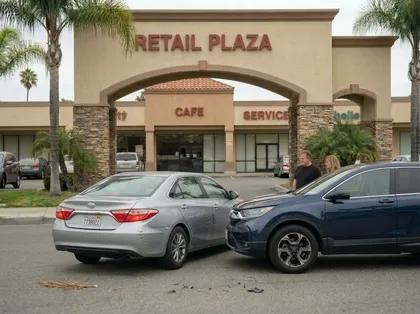
Liability may extend beyond the drivers when another person or entity contributed to the conditions that caused the crash:
- Another Driver: A motorist may be responsible for conduct such as speeding, following too closely, failing to yield, or making an unsafe maneuver.
- An Employer: If a driver was acting within the scope of employment when the crash occurred, the employer may also be liable for the employee’s negligence.
- A Business or Property Owner: Premises liability may apply if a dangerous condition under the owner’s or occupier’s control contributed to the collision. Examples include obstructed sightlines, poorly maintained driveways, or other property conditions that make entering or leaving the business unsafe. Liability generally depends on control of the property, negligence in its use or maintenance, and whether that negligence substantially contributed to the injury (CIV § 1714(a); CACI No. 1000).
- A Public Entity: If the crash involved a dangerous condition of a public road, intersection, traffic-control feature, or other public property, a city, county, or state agency may potentially be liable under California Government Code (GOV) § 835. These claims have additional requirements and shorter claim-presentation deadlines (GOV § 835).
A business is not liable simply because the crash happened at its entrance. There must be a legally relevant act, omission, or property condition that contributed to the collision.
How Shared Fault Can Affect Your Claim
State law follows a rule called “pure comparative fault.” In plain terms, that means fault for a left-turn accident in California can be divided up among everyone involved, and your compensation gets adjusted accordingly. If you played a part in causing your own injuries, your payout shrinks by your share of the blame.
Say you’re owed $100,000 in damages. However, you started your left turn a beat too soon, and a court says that makes you 20% responsible. The other driver takes the remaining 80%. Your payout is $80,000.
Traffic violations often come up in these cases, too. However, running a red light or rolling through a stop sign doesn’t automatically make someone negligent in the eyes of the law. EVID § 669 lays out specific conditions that must align first, including whether the violation actually caused the harm, what kind of harm occurred, and whether the injured person was someone the law was designed to protect in the first place.
What Evidence Can Show Who Had the Right of Way?
Figuring out who’s at fault in a driveway collision usually comes down to the evidence: where the vehicles were positioned, how fast they were moving, and whether the driver making the turn gave enough warning before doing so.
Here’s what can help build your case:
- Photos and videos of the vehicles and the scene.
- Dashcam footage from either car.
- Surveillance video from nearby businesses or properties.
- Witness statements and their contact info.
- Police or CHP reports.
- Where the vehicles were damaged and where they made impact.
- Electronic data from the vehicles, if it’s available.
- Phone records, if distracted driving is a factor.
- Medical records showing your injuries after the crash.
Surveillance footage from a nearby business can be especially valuable. It might capture the actual turn, how traffic was flowing, where the vehicles were positioned, and the moment of impact. The catch is that there’s no set rule requiring businesses to retain footage for a specific period, so it’s worth reaching out to ask them to preserve it as soon as you can.
If you were hurt in a driveway or intersection accident and there’s a dispute over who caused it, the intersection accident attorneys at Arash Law can look at the evidence with you and walk through your options. Call (888) 488-1391 for a free case evaluation.
What to Do After a Crash at a Business Entrance
Once you’ve taken care of any immediate medical needs, there are a few practical steps you’ll want to take to document what happened and protect your evidence:
- Exchange information. Get the other driver’s name, contact details, license number, vehicle information, and insurance information.
- Take photos of the scene. Capture where the vehicles ended up, the damage, driveway markings, any traffic signs or signals, sight obstructions, and the surrounding businesses.
- Track down witnesses. If anyone saw the turn or the impact, get their name and a way to reach them.
- Ask around about video. Nearby businesses, homes, or even other drivers might have footage of the crash.
- Get medical care. This isn’t just for your health. It also creates a paper trail documenting your injuries and treatment.
- File an SR-1 if the law requires it. In California, you’re required to submit an SR-1 to the DMV within 10 days if the crash caused an injury, a death, or more than $1,000 in property damage. This applies regardless of who was at fault, and it’s a completely separate requirement from reporting the crash to the police or your insurer.
Deadlines and Reporting Rules After a California Crash
It’s easy to mix up the SR-1 deadline with the deadline for filing a lawsuit. However, they’re not the same thing. One is a reporting requirement. The other is your window to actually take legal action for a crash that occurred when you were turning into a business. It can also vary depending on the type of case you’re filing:
- Personal Injury Lawsuits: You generally have two years from the crash to file a personal injury lawsuit (Code of Civil Procedure (CCP) § 335.1).
- Property Damage Lawsuits: If your vehicle or other personal property was damaged, you generally have three years to sue (CCP § 338(c)).
- Claims Against the Government: These move on a much tighter clock. If a government entity might be responsible for the crash, you generally must file a claim within six months of the incident (GOV § 911.2). If the government sends a written rejection that meets the proper requirements (GOV § 913), you then have six months from when that notice was mailed or delivered to file a lawsuit (GOV § 945.6). Skip the proper notice, and the timeline can shift.
On top of all that, there’s a separate kind of urgency to think about: preserving evidence. Though you might have years before your legal deadline arrives, surveillance can get deleted, physical evidence may disappear, and witnesses’ memories can fade much faster than that. Don’t wait on the legal clock to start protecting what you’ll need to prove your case.
Insurance Issues That Can Affect Recovery
California’s crash numbers show exactly why insurance coverage matters so much when a serious collision happens. The California Office of Traffic Safety’s Traffic Safety Quick Stats reported 4,061 traffic fatalities across the state in 2023, working out to a mileage death rate of 1.26 fatalities per 100 million vehicle miles traveled.
When a crash leaves someone seriously injured or facing major losses, however, specific issues can affect the type and amount of insurance available and make a real difference in how much they’re able to recover:
- Your Own Auto Policy: In some cases, you may be able to seek benefits from your own policy, including from your:
- Uninsured Motorist (UM) Coverage: California auto policies generally include this protection unless it’s been rejected or modified in the specific ways allowed by law (Insurance Code § 11580.2).
- Underinsured Motorist (UIM) Coverage: This can kick in when the at-fault driver has insurance, but it’s not enough to cover your damages.
- Proposition 213 Limits: If you didn’t carry the financial responsibility required by California law, this measure may block you from recovering non-economic damages like the pain and suffering caused by your injuries. There are exceptions, including cases where the at-fault driver is later convicted of DUI (CIV § 3333.4).
- Employer Liability: If the at-fault driver was on the clock when the crash happened, their employer might share responsibility. That said, simply having a job doesn’t automatically make the employer liable. The driver has to have been acting within the scope of their employment.
What Arash Law Has Recovered in Traffic Injury Cases
Our case results page gives you a sense of the outcomes our attorneys have pursued for clients hurt in serious California traffic collisions:
$8,800,000 — Settlement for a Speeding-Related Incident: A commercial van driver, going well over the speed limit, caused severe injuries to our client at a business entrance. Key depositions confirmed that the driver was acting within the scope of his employment, thereby establishing employer liability.
$12,000,000 — Pedestrian Accident Resolution: A 74-year-old pedestrian suffered severe injuries after being violently struck while crossing the street. The case settled just as jury selection was set to begin.
Past results don’t guarantee what will happen in your case. Every situation is different, and outcomes depend on the specific facts and evidence involved.
Frequently Asked Questions About Turning-Into-a-Business Crashes in California
Who Is at Fault in a T-Bone Crash when I Was Turning Left?
If you’re turning left and get hit broadside because the other driver failed to give you the right of way after you properly yielded and began the turn when it was reasonably safe, California law may find them negligent. However, shared fault often arises in these cases.
Insurers are likely to argue over whether the oncoming car was actually “close enough to constitute a hazard” under CVC § 21801(a). If there’s evidence that the oncoming driver was speeding or distracted, that can shift some of the blame away from you.
Should I Admit Fault at the Scene if I Think the Crash Was My Fault?
Don’t. California law requires you to stop, stay at the scene, and exchange information and insurance details with the other driver. However, it doesn’t require you to admit fault. That’s a legal call made later, based on evidence, police reports, and sometimes a courtroom.
Anything you say in the heat of the moment isn’t a binding admission of liability, but it can still complicate things down the road. Stick to exchanging the required information and let the facts sort themselves out.
Will My Personal Auto Insurance Cover Me if I Was Driving for My Limited Liability Company?
Probably not, at least not automatically. Personal auto policies are built for personal driving, not business use. So if you were out doing work for your LLC when the crash happened, your insurer might deny the claim or fight you on coverage. That’s usually where a commercial auto policy, or a business-use endorsement tacked onto your personal policy, comes in. Talk to an attorney if you’re not sure which policy actually applies to your situation.
How Long Do Business Security Cameras Hold Footage Before It Overwrites?
How long a business keeps its surveillance footage depends entirely on the system they’re running, so don’t wait around to ask for it. Sending a written request to preserve the footage puts them on notice that it might be relevant to a claim. However, that alone won’t make them liable if the footage is gone anyway.
That said, if a business intentionally destroys or hides evidence that matters, courts can step in with remedies, including allowing a jury to draw an unfavorable conclusion from it (EVID § 413; CACI No. 204).
What Happens if the Driver Who Hit Me Had No Insurance?
Your own UM coverage may step in to cover your injuries and losses, up to your policy limits. It can be especially important when the vehicle that caused the crash cannot be identified in a qualifying hit-and-run claim. The exact coverage available depends on your policy and the facts of the crash.
However, California auto policies generally include uninsured motorist coverage unless the policyholder validly rejects it or selects lower limits in writing (Insurance Code § 11580.2). If you waived UM coverage in this manner and do not carry it, an attorney can help identify whether you can pursue compensation from any third parties who contributed to the crash.
Talk to Arash Law About Your California Turning-Crash Claim
Left-turn and driveway crashes tend to get messy fault-wise. Figuring out what the turning driver should have done depends just as much on how the other driver was behaving. On top of that, California’s comparative fault rules allow responsibility to be split between the drivers when both contributed to the crash.
That’s exactly why acting fast matters. Surveillance footage, photos, vehicle data, and witness accounts all get harder to track down as time passes. Locking down what evidence you can, early, goes a long way toward proving what actually happened.
Arash Law handles intersection and driveway accident cases across California. We track down every bit of footage, build your fault case from scratch, and push back hard when an insurer tries to pin the blame on you.
We’ve recovered over $1 billion for injured clients throughout the state, and we do it all on a contingency basis: you don’t pay a dime in attorney’s fees unless we win. California law requires that contingency agreements be in writing and spell out specific terms under Business and Professions Code § 6147. Your attorney will walk you through the fee agreement before your case even gets started.
To schedule your free case evaluation, call (888) 488-1391. Arash Law is ready to help. Make Them Pay, Call AK.
Sources
- California Office of Traffic Safety (OTS). California Traffic Safety Quick Stats: Score Card. https://www.ots.ca.gov/ots-and-traffic-safety/score-card
- California Legislative Information. Vehicle Code § 21801: Left Turn / U-Turn Yield Obligation. https://leginfo.legislature.ca.gov/faces/codes_displaySection.xhtml?lawCode=VEH§ionNum=21801
- California Legislative Information. Vehicle Code § 22107: Turning Safety and Signal Requirement. https://leginfo.legislature.ca.gov/faces/codes_displaySection.xhtml?lawCode=VEH§ionNum=22107
- California Legislative Information. Code of Civil Procedure § 335.1: Two-Year Statute of Limitations. https://leginfo.legislature.ca.gov/faces/codes_displaySection.xhtml?lawCode=CCP§ionNum=335.1
- California Legislative Information. Government Code § 911.2: Six-Month Government Claim Deadline. https://leginfo.legislature.ca.gov/faces/codes_displaySection.xhtml?lawCode=GOV§ionNum=911.2
- California Department of Motor Vehicles (DMV). SR-1 Report of Traffic Accident Occurring in California. https://www.dmv.ca.gov/portal/dmv-virtual-office/accident-reporting/
Disclaimer
The information on this page is for general educational purposes and does not constitute legal advice. No attorney-client relationship is formed by reading or relying on this content. If you were injured, consult a licensed California personal injury attorney about your specific situation. Arash Law: (888) 488-1391.