TL;DR: Trucks often provide better occupant protection in collisions with smaller vehicles because their heavier weight reduces the impact forces felt inside the cabin. However, truck occupants also face heightened risks of single-vehicle rollovers and crashes due to loss of control. When collisions happen in California, liability can be split among drivers, trucking companies, and other parties.
Highlights:
- Seek medical care immediately and maintain all follow-up records to establish a clear link between your injuries and the crash.
- Send a spoliation letter through an attorney to preserve critical evidence, such as black box data and dashcam footage, before it’s erased.
- Avoid giving recorded statements to the trucking company’s insurer without first consulting with an attorney.
- Understand that multiple parties — the driver, maintenance contractors, manufacturers, or government entities — may share liability for the crash.
- Under California law, you may pursue economic damages (medical bills, lost wages, etc.) from any at-fault party, while each party is only liable for non-economic damages (pain and suffering) in direct proportion to their percentage of fault.
- Contact a lawyer early to navigate the legal process better and protect your legal rights.
Tip: Multiple parties often bear responsibility in truck accidents, so gathering and preserving all evidence immediately is critical to securing fair compensation for your injuries.
Table of Contents
Trucks can provide better protection for their occupants due to their size, weight, and strong build. This applies to pickup trucks, delivery trucks, commercial vehicles, and big rigs. In a crash with a smaller car, the truck typically experiences a lesser change in speed, which may lessen the force on its occupants.
However, this same size and weight can pose dangers to occupants of smaller vehicles, as well as to pedestrians, cyclists, and motorcyclists. Trucks may keep their own passengers safer in some crashes, but they are not always safer for everyone else on the road.
California roads have many truck types. You’ll see personal pickups, delivery vans, tankers, and big tractor-trailers. Passenger vehicles regularly share highways, city streets, and rural roads with trucks of different sizes and designs.
Why Trucks Offer More Protection For Their Occupants
Trucks offer greater protection for their occupants, mainly due to their massive size and weight. Pickup trucks usually weigh more than passenger cars, while fully loaded tractor-trailers may weigh much more on many Interstate routes.
Because of this weight difference, the smaller vehicle may move or stop more suddenly during the collision. This can place greater stress on the people inside it.
Truck occupants may also benefit from:
- Larger Vehicle Structure: Some trucks provide more space and material between the occupants and the point of impact.
- Higher Seating Position: Pickup trucks, commercial trucks, and big rigs offer drivers a higher seating position. This can help improve visibility in certain situations.
- Longer Front Structure: These vehicles have longer front sections between the occupants and the point of impact.
- Modern Safety Systems: Trucks have various features, depending on the model and year. These may include:
- Automatic emergency braking
- Blind-spot warnings
- Lane-departure alerts
- Reinforced compartments for passengers
These features may help protect truck occupants, but truck design also creates risks for other road users.
The Hidden Risks Of Trucks
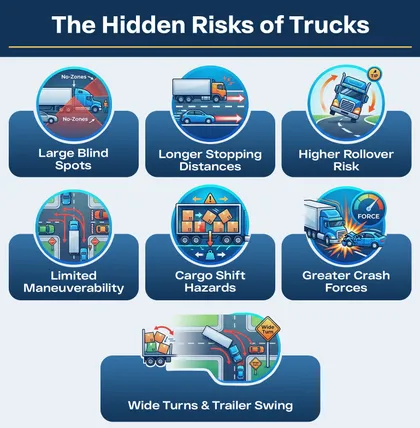
Although trucks may offer greater protection to their occupants, they carry hidden risks beyond their massive size, including severe blind spots and significant weight discrepancies. The risks vary among pickup trucks, delivery trucks, commercial vehicles, and tractor-trailers.
California crash data show how often different types of trucks are involved in deadly collisions. In 2023, the National Highway Traffic Safety Administration (NHTSA) recorded 5,621 vehicles involved in fatal crashes in the state. Light trucks, including pickups, SUVs, and vans, accounted for 38% of those vehicles, while large trucks accounted for 7%. These statistics don’t reveal which driver caused the crash. However, they show that both light and large trucks are often involved in serious collisions in California.
Heightened Dangers For Truck Occupants
Although trucks may offer greater protection in collisions with smaller cars, their design can create additional risks to handling and control. Trucks can be harder to stop, steer, and maneuver than smaller vehicles. Their higher center of gravity, heavy cargo load, and limited maneuverability can increase the risk of rollovers and other serious crashes.
-
Rollover Risk: Trucks have a higher center of gravity than passenger cars. Sharp curves, steep grades, sudden steering, excessive speed, and uneven or shifting cargo are factors that increase the risk of truck rollovers.
Rollovers subject truck occupants to severe dangers such as roof crush, head trauma, and ejection.
-
Longer Stopping Distances: Heavier trucks generally need more time and distance to stop. This can be especially dangerous on California freeways, where traffic may slow suddenly. The risk is greater for loaded commercial trucks and tractor-trailers.
Trucks may hit roadside objects, such as guardrails, concrete barriers, and trees, at higher speeds, leaving occupants with more serious injuries.
-
Limited Maneuverability: Larger trucks need more room to turn, merge, and change lanes. Tractor-trailers may swing wide during turns, and their trailers can move into adjacent lanes.
Truck occupants may get injured if the driver loses control, leaves the roadway, or strikes a roadside object while attempting a difficult maneuver.
Heightened Dangers To People In Smaller Vehicles
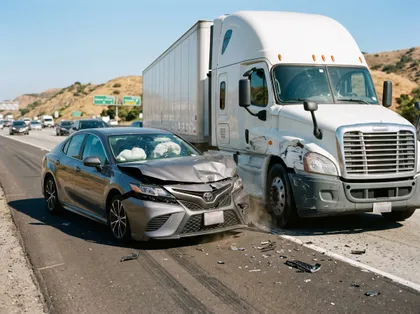
People in smaller vehicles may face more severe injuries in truck crashes because of the truck’s weight, height, and force. The smaller vehicle may experience a sharper change in speed, greater structural damage, and an increased risk of the passenger area being crushed inward.
- Large Blind Spots: Trucks generally have larger blind spots than passenger cars. These areas can hide cars, motorcycles, cyclists, and pedestrians, increasing the risk of collisions during lane changes, turns, or other maneuvers.
- Greater Force on Smaller Vehicles: A truck’s greater weight can cause a smaller vehicle to change speed more suddenly during a crash, exposing its occupants to stronger forces and more severe injuries, especially when the passenger area is crushed inward.
- Greater Crash Severity: A truck’s height and weight can increase the risk of severe or fatal injuries to people in smaller vehicles. A tall front end may strike higher parts of a passenger vehicle and can also pose greater dangers to pedestrians and cyclists.
Liability And Compensation In California Truck Accidents
In a California truck crash, more than one party may share legal blame for what happened. Getting compensation often means finding every party that helped cause the crash. California law allows victims to seek money from more than one at-fault party, called a defendant. This makes truck cases more complex than most car crashes.
Several parties may be liable, or legally responsible, for a truck crash:
- Truck Driver: Speeding, distracted driving, or other reckless behavior behind the wheel.
- Maintenance Contractor: A repair firm that failed to catch a safety problem during inspection.
- Truck Company: Companies that failed to properly train drivers, maintain vehicles, or follow safety regulations.
- Cargo Loading Company: Responsible for improperly loading, securing, or distributing cargo, which may cause shifting loads, rollovers, or loss of control.
- Vehicle Manufacturer: A maker of faulty brakes or tires that caused the crash.
- Government Entity: Caltrans or another public agency could be liable if a dangerous condition of public property contributed to the crash. This may apply if a public employee’s negligent or wrongful act created the condition, or if the agency knew or should’ve known about it.
Commercial carriers must also comply with the Federal Motor Carrier Safety Regulations (FMCSRs), which cover driver hours-of-service limits, drug and alcohol testing, and vehicle inspection standards. Violations of these federal rules can support a negligence claim.
When a crash involves a commercial truck, maintenance records may become important evidence. California’s Basic Inspection of Terminals program, commonly called the BIT program, requires covered motor carriers to:
- Maintain regulated vehicles in accordance with a scheduled preventive-maintenance program.
- Keep required inspection and repair records.
California law may allow an injured person to recover economic and non-economic damages. In some cases, California courts can award punitive damages.
- Economic Damages: These may include medical bills, lost earnings, and other easily measurable losses. Any one defendant can be held responsible for the full amount.
- Non-Economic Damages: These cover intangible losses victims may suffer. These may include pain and suffering.
- Punitive Damages: These may be available under California Civil Code § 3294 if clear and convincing evidence shows that an at-fault party acted with malice, oppression, or fraud.
For economic damages, California uses joint and several liability. This means any one defendant can be made to pay the full amount owed. For pain and suffering, Proposition 51 uses several liability, meaning each party pays only their own share of the fault. A trucking company that is 30% at fault, for example, pays 30% of those damages.
Brain injuries and spinal cord damage can affect your ability to work and care for yourself. A claim may seek to cover those long-term costs, depending on the facts of your case. Delivery trucks and commercial carriers operate under these same rules. The evidence needed to prove each party’s share of fault can vanish quickly after a crash.
Steps To Protect Your Legal Rights After A Truck Crash
Taking immediate, intentional action after a truck collision is critical to preserving vital digital evidence and protecting your legal rights. Whether your accident involved a light pickup, a commercial delivery van, or an 18-wheeler, documenting your injuries and securing legal representation early can prevent insurance companies from undermining your claim.
Here are several recommended steps you can take:
- Seek medical care and follow through. See a doctor as soon as possible and attend all recommended follow-up visits, including chiropractic care when appropriate. Medical records can document your symptoms, diagnosis, and treatment. An unexplained gap in care may cause an insurer to question the seriousness of your injuries.
- Avoid giving a recorded statement. Be careful about giving a recorded statement to the other driver’s insurance company before speaking with an attorney. What you say may affect how the insurer evaluates fault, injuries, and damages.
- Preserve evidence with a spoliation letter. Save photos, videos, dashcam footage, repair estimates, medical records, and witness information. A truck accident lawyer could send a preservation letter to the truck owner, employer, insurer, or others. This letter asks them to keep important electronic data and records safe.
- Seek legal help early. After a serious crash, working with a personal injury lawyer can help you manage the legal process. Speaking with one early may help you identify responsible parties, preserve evidence, and understand what compensation may be available.
Medical records and preserved crash evidence can work together to strengthen a claim. The evidence needed will depend on which issues, such as fault, causation, or the extent of the injuries, are disputed.
Important evidence may include photos, videos, electronic vehicle data, and dashcam footage. Some of this evidence may be lost or overwritten if it is not preserved quickly.
Frequently Asked Questions About Truck Accidents
A truck accident can turn your life upside down. Beyond the physical injuries, you may be dealing with fear, financial pressure, and uncertainty about what comes next. The answers below address the concerns people most commonly have after a truck crash.
Do Cars Have Any Safety Advantages Over Trucks?
Yes. Cars are smaller, which generally makes them easier to steer and stop quickly. They may be able to change direction fast when danger appears. They can also stop at shorter distances than large trucks can.
Are Trucks More Likely To Flip Over In An Accident?
In many situations, yes. Large trucks and tractor-trailers are generally more susceptible to rollovers than standard passenger cars because they are taller and often have a higher center of gravity. The risk varies by vehicle design, speed, roadway conditions, steering movements, and cargo loading.
Rollover risk increases when a driver enters a curve too quickly, makes an abrupt steering movement, or carries cargo that is high, unevenly distributed, unsecured, or capable of shifting.
What If I Was Partly At Fault For The Truck Accident?
You may still be able to recover compensation. California follows a “pure comparative negligence” rule. Under this rule, your percentage of fault only reduces your damages and doesn’t disqualify you from filing a claim.
For example, if a court finds you 20% at fault and your damages total $100,000, you could still recover $80,000. Insurance companies often try to assign drivers a higher share of fault than is accurate, so it’s worth having a truck accident attorney review the evidence before accepting a fault assignment.
How Long Do You Have To File A Truck Accident Claim In California?
You generally have two years from the date of the truck crash to file a personal injury lawsuit under California Code of Civil Procedure § 335.1. It could be against the driver, the trucking company, or the manufacturer.
If a government entity is at fault, the time limit shortens. Under California Government Code § 911.2, you have a six-month deadline from the incident to file an administrative claim. This step is required before you are allowed to sue the entity.
Do I Need A Lawyer After A Truck Accident In California?
If you’ve suffered serious injuries or significant financial losses after a truck accident, it may be worth talking to a truck accident lawyer. These cases can be more complicated than typical car accident claims, especially when it comes to proving damages. You might need to communicate with the trucking company’s insurer or several responsible parties. Such situations can make the claims process harder to manage on your own.
If you’re asking, “Do lawyers only get paid if they win?” Some of them do. Most truck accident lawyers work on a contingency fee basis. This means you pay nothing up front. The lawyer only collects attorney’s fees if your case results in a settlement or a court award.
Victim Of A Truck Accident? Arash Law Can Provide Legal Help
Getting legal help after a truck accident is one of the most important steps you can take. Arash Law — better known as AK Law — is here to help you explore your options and handle your claim. We work to hold reckless or careless trucking companies and all responsible parties accountable for the harm they caused.
Our truck accident lawyers understand how complex these cases can be. Medical bills, lost wages, and disputes with the trucking company’s team can add up quickly. We review your case and work to build the strongest claim for you.
Our team has handled several truck accident cases:
- $5,000,000: We represented a married couple who got injured in a T-bone accident with a work truck after its driver ran a red light. Despite disputes over the case, we secured a settlement after two years of litigation.
- $3,500,000: We represented a 6-year-old boy who sustained a traumatic brain injury when a pickup truck hit him as he crossed the street with his bicycle. The defendant attempted to blame him for the crash, but our investigation, discovery, and depositions established that the driver had been distracted.
- $1,150,000: Our client was injured when a delivery truck rear-ended her car on a freeway. Despite the defense’s claim that her neck and back pain resulted from her weight and pre-existing conditions, we settled through mediation.
Past results do not guarantee or predict a similar outcome in future cases. Each case is evaluated individually based on its own facts and circumstances.
Call (888) 488-1391 today to speak with our truck accident attorneys about your options at no cost.