TL;DR: Wrongful death claims after a fatal fire in California help families seek compensation for negligence. Evidence like fire reports, maintenance records, and witness statements is crucial. Liability may stem from unsafe conditions, faulty products, or safety violations. Act quickly to preserve evidence.
Highlights:
- Preserve all evidence immediately, including photos, videos, and witness statements.
- Request the fire department case number and contact information for relevant agencies.
- Save maintenance records, insurance correspondence, and repair logs related to the fire.
- Preserve damaged items, such as smoke alarms, wiring, and appliances, for investigation.
- File a wrongful death claim within two years of the victim’s death.
- If the defendant is a public entity, file a government claim within six months.
Tip: Gather and protect critical evidence before cleanup to preserve the integrity of your case.
Table of Contents
Wrongful death claims after a fatal fire in California allow eligible family members to seek compensation. They can generally file these cases when another person or company caused the death through negligence or a wrongful act. The focus is on proving what caused the fire, who had a duty to prevent it, and how the death affected the surviving family.
Typical causes of fatal fires in California that may lead to wrongful death claims include:
- Unsafe property conditions
- Faulty wiring
- Defective products
- Ignored complaints
- Building code violations
- Preventable wildfires
Fire-related wrongful death cases can quickly become complex. The cause of the fire might not always be clear, and multiple parties might be at fault. More crucially, key evidence can vanish during cleanup or repairs.
Records like photos, videos, maintenance logs, and inspection reports are crucial. These pieces of evidence help establish liability and detail the family’s losses. Witness statements and fire investigation reports can also support wrongful death claims.
What Should Families Do After A Fatal Fire In California?
The first goal is to preserve evidence. Fire scenes in California can change fast. Investigators work to determine a fire’s origin and cause. Early scene documentation can shape the entire case. Families should identify the involved agencies. They should also keep records and avoid throwing away important items until they understand the cause.
Start by doing the following:
-
Request the incident report number. Ask for the names of the involved firefighters, police officers, and coroners. You can also obtain the contact numbers of investigating agencies, such as:
- The local fire department (city or county).
- The state fire marshal.
- CAL Fire (for wildfires).
- Save photos, videos, texts, emails, lease records, maintenance requests, and insurance correspondence.
- Preserve damaged items that may show the fire’s origin or how it spread. These include smoke alarms, outlets, power strips, chargers, heaters, appliances, or wiring components.
- Keep the death certificate, autopsy information, medical bills, and funeral or burial records.
- Write down witness names and testimonies. Note what each person saw, heard, smelled, or reported before and during the fire.
Taking these actions can be important before cleanup crews make any changes to the scene. Wrongful death lawyers can also send evidence preservation letters to the potentially liable parties. These can include landlords, property managers, insurers, utilities, and product manufacturers.
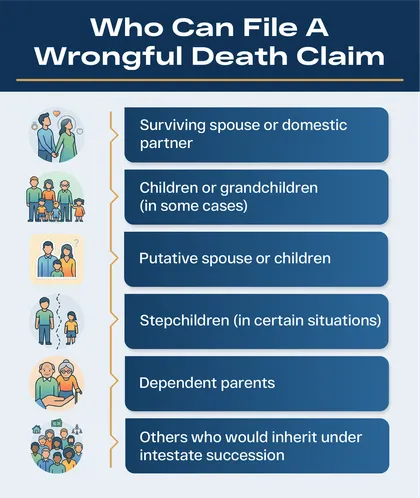
Who Can File A Wrongful Death Claim In California?
If a victim dies because of another person’s negligence or wrongful actions, their family members could pursue a claim against the responsible party. However, not all relatives can do so.
California law identifies who may be eligible, including:
- Surviving spouse or domestic partner.
- Children or, in some cases, grandchildren.
- Putative spouse or children.
- Stepchildren in certain situations.
- Dependent parents or others who would inherit under intestate succession.
Wrongful death claims are usually handled as a single legal action, with all eligible family members joined together. When a fire causes a death, the types of damages a family can seek may vary depending on the circumstances. Wrongful death lawyers can assess evidence to help potentially eligible parties determine if a claim is valid.
What Evidence Matters In A Fatal Fire Wrongful Death Case?
A strong fire-related death case requires more than just showing that a fire occurred. The main questions are why the fire started, whether it was preventable, and who was aware of the danger.
Important evidence that can help prove wrongful death includes:
- Fire department incident reports.
- Fire investigation reports.
- Photos, surveillance video, dashcam footage, and phone metadata.
- 911 recordings and dispatch logs.
- Repair requests, inspection records, prior complaints, and work orders.
- Smoke alarm, sprinkler, and electrical maintenance records.
- Product manuals, recalls, and damaged product components.
- Death certificate, autopsy findings, and medical records.
- Funeral and burial bills.
- Employment and support records.
- Medical documentation, such as hospital, rehabilitation, or chiropractic records.
These pieces of evidence can help show the fire’s origin and whether negligence contributed to it. They can also demonstrate the full financial impact of the death.
What Claim Options Do Victims Have After A Fatal Fire In California?
In California, families may have a wrongful death claim, a survival action, or both. A wrongful death claim applies to eligible relatives and seeks damages for their losses caused by the death. A survival action belongs to the estate. It seeks compensation for the losses the deceased person incurred before passing. Families can pursue both claims simultaneously.
-
Wrongful Death Claim: This type of claim may seek compensation for losses such as:
- Financial support the deceased would have provided.
- Funeral or burial expenses.
- The value of household services, guidance, or training.
- Loss of companionship.
-
Survival Action: This claim allows the deceased’s estate to seek certain damages, including:
- Medical expenses incurred before death.
- Lost wages between the injury and death.
- Punitive damages when the law and facts allow.
California Code of Civil Procedure Section 377.34 allowed survival actions to include pre-death pain and suffering for cases filed from January 1, 2022, to December 31, 2025. If the estate recovers these damages, it must report the judgment or settlement to the Judicial Council within 60 days. New filings may not qualify unless the statute is extended.
Here’s a quick overview of the difference between a wrongful death claim and a survival action:
| Aspect | Wrongful Death | Survival Action |
|---|---|---|
| Who Can File? | Spouse, domestic partner, children, stepchildren, parents, or others financially dependent on the decedent. | Decedent’s estate (personal representative or executor). |
| Whose Losses Are Compensated? | The losses suffered by the surviving family members. | The losses the decedent experienced before death. |
| Available Damages | Loss of financial support, loss of companionship, loss of parental guidance, and funeral and burial expenses. | Decedent’s medical expenses before death, lost income before death, punitive damages (if applicable). |
| Damages Not Available | Decedent’s non-economic damages and certain non-economic damages for the survivor’s family, such as grief or emotional distress. | Pain and suffering (as of 2026) and family losses, such as the loss of support or companionship. |
A wrongful death lawyer can look over case details. They help family members find out which claims fit their situation. They can also assess evidence of losses to determine potential wrongful death settlements.
Who May Be Liable For A Fatal Fire Death?
Liability depends on how the fire started, the condition of the property, and who had a duty to prevent the danger. In rental and commercial cases, safety issues are often vital. There may also be multiple parties responsible for a single fire incident.
Depending on the facts, potential defendants may include:
- Landlords or Property Managers: When a fire occurs in an apartment building.
- Homeowners: When a fire happens on private property.
- Product Manufacturers or Distributors: If a defective product caused or contributed to the fire.
- Contractors, Electricians, or Maintenance Companies: If their work may have caused the fire.
- Employers or Business Owners: If the fire happened at a workplace or on commercial property.
Violations of building codes or fire safety regulations can help show that a defendant failed to act with reasonable care. These safety issues can include:
- Missing fire alarm systems
- Ignored repair requests
- Blocked exits
- Faulty wiring
- Building code violations
The following are common causes of fatal residential fires:
- Cooking
- Unintentional careless acts
- Heating equipment
- Smoking
- Electrical malfunction
- Intentional actions
Cases can be complicated in apartment fires because determining liable parties can be complex. Apart from the property owner or landlord, other tenants and contractors could also be responsible. In these types of incidents, apartment accident lawyers review available evidence to help victims determine who may be liable.
Determining who may be liable in a fatal fire can be complicated. Some family members of victims seek free advice from a wrongful death lawyer to understand their situation and possible options.
Special Considerations For Wildfire Deaths
Wildfire-related deaths present unique challenges in determining liability. Wildfires are different from regular house or commercial fires. They can have many sources, cause widespread damage, and involve complex safety rules. Establishing responsibility may require examining utility practices, government actions, and emergency response measures. Specific types of evidence are often needed to show who may be at fault.
- Utility Negligence Claims: California utilities must follow oversight and mitigation plans set by the California Public Utilities Commission (CPUC). Liability can arise if a utility fails to maintain equipment, such as power lines or transformers. For example, a poorly maintained power line could spark a wildfire that spreads to homes, causing fatalities.
- Claims Involving Public Entities: If a government agency delays addressing fire hazards or fails to maintain fire safety, a wildfire might spread. In this case, it could be held responsible for any deaths that occur.
Evidence can play a crucial role in demonstrating who had the responsibility to prevent the fire and whether they violated that duty. Wildfire injury attorneys can use the following evidence to support fire-related claims:
- Evacuation notices
- Emergency alert logs
- Vegetation management records
- CAL FIRE investigation reports
What Injuries And Medical Issues Often Appear In Fatal Fire Cases?
Fires can cause devastating injuries and long-term health problems. These often affect more than just the skin. Understanding the types of injuries that occur in fatal fires is important for families, investigators, and medical professionals. These details help determine the cause of death. They may also influence legal claims related to the incident.
Common injuries and health problems that lead to fatalities after a fire include:
- Severe Burns: Destroy skin and underlying tissues, leading to infection, shock, and organ failure.
- Smoke Inhalation: Typically damages the lungs and airways. It can lead to respiratory failure or suffocation.
- Carbon Monoxide Exposure: A colorless, odorless gas. It can prevent oxygen from reaching vital organs, causing rapid death.
- Other Heat-Related Injuries: Examples include heatstroke, organ damage, or cardiac arrest.
In some instances, victims can also sustain fatal injuries when fleeing the fire. Traumatic brain injuries (TBIs), crush injuries, or internal bleeding can be fatal in certain situations.
According to the U.S. Fire Administration (USFA), there were approximately 200 documented cases of multiple-fatality fires in U.S. residential structures each year between 2021 and 2023. These incidents resulted in about 720 deaths annually during this period.
Injury documentation in these cases matters for two reasons. First, they help fire-related injury attorneys prove the cause of death. Second, if the person survived for any period before passing, these details can affect the estate’s separate survival claim for pre-death losses.
What Deadlines Matter In A California Wrongful Death Claim?
In California, wrongful death is a statutory tort claim with a two-year filing deadline. The key difference is that this statute of limitations begins on the date of the victim’s death, not when the injury occurs.
If the claim is against a public entity, such as a city, county, or other government body, a separate government claim must usually be filed within six months of the death. You can only sue if:
- The public agency rejects the claim. You have another six months from the date of the denial to file a lawsuit.
- You receive no response within 45 days. The general statute of limitations for wrongful death claims applies.
Missing these deadlines can end a case, even when the evidence of fault is strong. However, timing matters for more than just filing the lawsuit. It also affects the ability to:
- Inspect the scene of the fire or accident.
- Test defective products or equipment.
- Locate and interview witnesses.
- Preserve electronic records or other critical evidence.
For this reason, wrongful death attorneys start gathering and protecting evidence before waiting for insurance companies to take a position on liability. Acting promptly helps protect legal rights. It also reduces the risk of crucial proof getting lost.
Frequently Asked Questions About Wrongful Death Claims After A Fatal Fire In California
Families dealing with a fatal fire usually have the same urgent questions: Who can sue? What damages can I recover? How fast will the case move? The answers below focus on California wrongful death law and on practical steps to protect a claim.
Do I Need A Personal Injury Lawyer Who Handles Fire-Related Cases?
You may need one if the case is complex and involves substantial losses. Wrongful death claims generally fall under personal injury. However, a fatal fire case is not a routine injury claim. It often involves more extensive losses and severe injuries from which the victim does not recover.
Families should look for wrongful death attorneys who understand fire investigation, code issues, product evidence, and estate coordination. Consulting an attorney can also help them learn whether they’re eligible to file wrongful death claims, survival actions, or both.
Do Lawyers Only Get Paid If They Win?
Many injury and wrongful death lawyers, like those at Arash Law, work on a contingency fee basis. Under this fee structure, they only get paid if they recover compensation for you. In California, contingency fee agreements must be in writing. Clients should review the agreement carefully to understand how their attorney’s fees are calculated.
How Do You Prove Liability After A Fatal Fire?
You generally need to show the following elements are present in your case:
- The defendant had a duty to act with reasonable care.
- They failed to do so.
- Their negligence caused the fatal fire.
- You suffered losses due to the death of a loved one.
In fire-related cases, proof often comes from several sources. These include origin-and-cause analysis, photos, witness statements, and maintenance logs. Inspection records, evidence of smoke alarms, electrical evidence, and documents showing notice of a dangerous condition are also important.
Can I Bring A Wrongful Death Claim If The Defendant Wasn’t Criminally Charged?
Yes, it’s often possible. Even if no one was charged with a crime, a wrongful death lawsuit may still move forward. Civil cases use different rules of proof than criminal trials. A lack of criminal charges does not necessarily mean all legal options are gone.
Get Legal Guidance If Your Loved One Died In A Fatal Fire In California
If your family is searching for answers after a fatal fire, our wrongful death lawyers at AK Law can review the facts. We can explain whether a wrongful death claim, a survival action, or both may apply. From here, we can discuss your next steps and provide clear, case-specific guidance. Call us at (888) 488-1391 to schedule a free initial consultation.