TL;DR: Look for a lawyer experienced in children’s injury cases and disputed e-bike collisions. Ask how they investigate conflicting evidence, assess serious injuries, and handle decisions and court-approved settlements involving minors. A police statement or riding-rule violation does not automatically establish civil fault.
The right lawyer for your child’s e-bike injury is a California personal injury attorney with experience handling serious injuries involving minors, investigating disputed collisions, and navigating court-approved settlements. Look for someone who can explain how they would evaluate conflicting evidence, address your child’s medical needs, and protect their interests throughout the legal process.
A child’s age, the e-bike’s classification, or a police officer’s assessment does not automatically determine civil fault. When comparing attorneys, ask about their investigation methods, experience representing children, communication practices, and approach to settlement decisions. Their answers can help you determine who is best suited to handle your child’s case.
Key Facts About Child E-Bike Injury Claims in California
- The device’s legal classification matters. California recognizes three e-bike classes. The device’s actual capabilities help determine which riding rules apply.
- A police characterization does not automatically decide civil fault. An officer’s preliminary comment or report should be reviewed alongside witness statements, physical evidence, and applicable California negligence rules.
- Medical documentation should address the child’s prognosis. California’s minor-settlement process requires information about the injuries and recovery, including whether their effects are temporary or permanent.
- A child’s injury settlement generally requires court approval. A Minor’s Compromise petition gives the judge information needed to review the settlement and proposed handling of the child’s funds.
- Being a minor does not extend every deadline. Many private injury lawsuit deadlines are paused during childhood, but government injury claims generally require a written claim within six months.
Table of Contents

My Child Was Hurt While Riding an E-Bike. What Should I Ask a Lawyer About Investigating the Collision and Handling a Child’s Injury Claim?
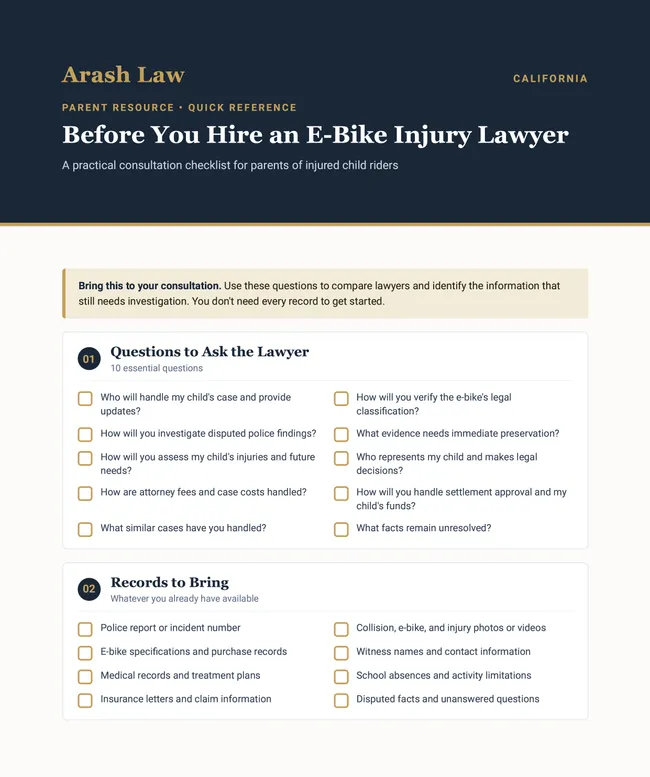
When interviewing a lawyer about your child’s e-bike injury, focus on their experience, investigation methods, and approach to handling claims involving minors. The questions below cover how the attorney would review disputed police findings, assess the bike’s classification, document medical needs, and manage settlement procedures. They also address who will handle the case, how decisions are made, how your family will receive updates, and what fees and costs to expect.
Parent-to-Lawyer Interview Checklist
Use these questions to compare attorneys and understand how they would handle your child’s e-bike injury case.
- Who will handle my child’s case and keep us informed? Confirm your main contact, how often you’ll receive updates, and who answers questions between meetings.
- How will you verify the e-bike’s legal classification? Ask whether the lawyer will review manufacturer specifications, modifications, and the bike’s actual capabilities.
- How will you investigate disputed police findings? Find out whether the lawyer will interview witnesses, obtain footage, and compare the report with physical evidence.
- What evidence needs immediate preservation? Discuss surveillance recordings, the e-bike, helmet, and records that could be lost or altered.
- How will you assess my child’s injuries and future needs? Ask about medical evaluations, rehabilitation, developmental effects, and documenting ongoing limitations.
- Who represents my child and makes legal decisions? Clarify your authority as a parent, whether a guardian ad litem is needed, and when court approval is required.
- How are attorney fees and case costs handled? Review the written agreement, including expense deductions and responsibility for costs if the case is unsuccessful.
- How will you handle settlement approval and my child’s funds? Discuss the court petition, proposed deductions, and options for protecting the settlement proceeds.
- What similar cases have you handled? Focus on experience investigating disputed collisions and representing injured minors, not past settlement amounts.
- What facts remain unresolved? Ask which missing records, insurance questions, or conflicting accounts could affect the investigation.
What Records Should Parents Bring to the Consultation?
Bring any available police reports, crash photos, e-bike specifications, witness information, medical records, school records, and insurance correspondence. Include notes about disputed facts or unanswered questions.
You do not need every document before consulting a lawyer. Available records can help identify what needs further investigation.
Is the attorney licensed and in good standing? Before your consultation, look up the lawyer on the State Bar of California’s Attorney Search. Confirm their license status is “Active” and review any public disciplinary history. You can also ask whether any other attorneys or staff working on the case are licensed in California.
Why Your Lawyer Must Understand E-Bike Classification and Insurance
The e-bike’s legal class is an important fact an attorney should investigate, but classification alone does not establish fault, determine whether a child can seek compensation, or automatically decide insurance coverage. The lawyer should examine the device’s actual features, applicable riding rules, policy language, and circumstances of the collision.
California Vehicle Code § 312.5 defines an electric bicycle as a device with fully operable pedals and an electric motor of 750 watts or less. It assigns one of three classifications based on how the motor assists the rider and the device’s top assisted speed:
- Class 1: Pedal-assist only; motor stops assisting at 20 mph. Helmets required for riders under 18.
- Class 2: Throttle-assisted, which means the motor can engage without pedaling. The motor stops assisting at 20 mph. Helmets are required for riders under 18.
- Class 3: The motor generally assists only while pedaling and stops assisting at 28 mph, subject to the limited low-speed assistance permitted by law. These e-bikes must have a speedometer. Operators must be at least 16, and riders must wear helmets. Class 3 e-bikes face restrictions on certain bicycle paths and trails, with exceptions under state law and applicable local rules.
A device that exceeds California’s e-bike limits, has prohibited modifications, or lacks working pedals may fall outside the legal definition of an electric bicycle. Its correct classification depends on its actual design and capabilities. Other vehicle categories, including motorized bicycles and certain electric motorcycles, have different operating requirements.
Ask the attorney whether the manufacturer label is accurate, whether the device was modified, whether the motor or throttle requires testing, and which rules applied at the collision location. If the child was too young to operate a particular class of e-bike or was allegedly violating a riding rule, ask how that fact relates to the actual cause of the collision and California’s standards for evaluating a minor’s conduct. Neither an age restriction nor a classification dispute automatically establishes civil liability.
Reclassification may affect insurance coverage, depending on the policy’s terms and exclusions. Ask how the lawyer would review device specifications, technical documents, and manufacturer records to establish its legal class. The attorney should also explain which applicable policies may respond, including potentially relevant homeowners, renters, or automobile coverage, and whether a product defect warrants investigation. Coverage depends on the facts and policy terms.
Has your child been hurt in an e-bike crash? Call Arash Law at (888) 488-1391 for a free case evaluation. Our electric bike accident lawyers can review the records you already have, including a disputed police report, available device information, and medical documents. Parents can ask what additional investigation may be necessary before conclusions are drawn about classification, fault, or possible claims.
We evaluate financial losses, including future medical care, alongside pain, emotional harm, and lasting effects on your child’s development, schooling, and daily life.
Evaluating an Attorney’s Approach to Evidence
Look for a lawyer who can explain what evidence they need, how they will obtain it, and what needs immediate protection. A police report provides useful information, but disputed statements should be checked against other available evidence.
Parents should distinguish an officer’s preliminary statement at the scene from a completed written report. Even a completed police report does not necessarily establish civil fault. An attorney should explain which observations, witness statements, measurements, and other evidence support the reported characterization, and whether further investigation could clarify disputed facts.
Ask how the attorney will investigate these key areas:
- The E-Bike and Helmet: Preserve their condition and document the motor, throttle, brakes, battery, and class labels. An inspection may help establish the device’s capabilities or identify a mechanical problem.
- Video and Scene Evidence: Seek surveillance footage before it is erased and document road conditions, signs, visibility, and crash locations.
- Witness Accounts: Contact people who saw the collision and compare their accounts with the report and physical evidence.
- Evidence Held by Others: Send preservation requests when appropriate to businesses, drivers, or other parties holding relevant records or recordings.
- Medical Records and Recovery: Gather records from all treating providers and track symptoms, treatment needs, and effects on school and daily life.
If the report assigns your child some blame, ask what evidence supports that conclusion and what remains unresolved. California’s comparative fault principles may permit recovery even when an injured person shares responsibility, with compensation potentially reduced by an established share of fault. For children, the analysis must also account for the applicable age-related standard of care rather than automatically treating their conduct like an adult’s.
A useful answer goes beyond “we will investigate.” The lawyer should explain who will do the work, which steps come first, and whether expert help may be needed.
How Should a Lawyer Document Serious Injuries and Future Needs?
Ask how the attorney would develop medical evidence if your child’s injuries are serious or recovery remains uncertain. Medical records should describe the diagnosed injuries, treatment, symptoms, functional limitations, and expected follow-up care. Depending on the injury, the lawyer may need medical opinions addressing rehabilitation, future treatment, developmental effects, or lasting limitations.
Parents can also ask how school attendance records, therapy recommendations, and documented changes in daily activities may support the medical evidence. The attorney should distinguish established needs from possible future complications and explain how uncertainty affects the evaluation of any proposed settlement.
Understanding the Minor’s Compromise Process and Filing Deadlines
California law generally requires judicial approval of a minor’s disputed personal injury settlement. Parents should ask who is authorized to act on behalf of the child, whether the court must appoint a guardian ad litem during litigation, and how the lawyer handles potential conflicts of interest. A parent’s authority depends on the circumstances and is not unlimited; the court independently reviews a proposed settlement to protect the child.
A Minor’s Compromise petition asks a judge to approve a child’s injury settlement. California Probate Code § 3500 and California Rules of Court, rule 7.950, govern this process.
- What the Petition Includes: Details about the collision, injuries, medical outlook, settlement amount, proposed deductions, and plans for the child’s funds.
- What the Judge Reviews: Whether the settlement protects the child’s interests and whether attorney fees, costs, and other suggested payments are reasonable.
- How Funds are Protected: The court directs where the child’s remaining money goes, such as a blocked account, structured settlement, or approved trust.
- What Parents Can Access: Parents cannot freely use the child’s settlement money. Any payment to a parent must follow the court’s order.
- When Funds Become Available: Blocked-account funds are generally available at age 18, unless the court authorizes an earlier withdrawal. Other approved arrangements may provide different payment schedules.
Ask the lawyer how a proposed settlement would be evaluated if your child’s medical prognosis is still developing. Discuss who prepares the petition, whether a hearing may be necessary, how fees and medical liens will be presented, and who will explain the court’s requirements to your family.
What Filing Deadlines Should Parents Ask Counsel to Check?
California has different deadlines for injury claims. Some are extended for children, while others apply even when the injured person is a minor.
Ask your lawyer to review these three deadlines:
- Personal Injury Claims: California Code of Civil Procedure § 335.1 generally gives injured people two years to file a lawsuit. Under § 352, this deadline is usually paused until a child turns 18, giving them until age 20 to sue.
- Property Damage Claims — 3 Years: Under California Code of Civil Procedure § 338, claims for property damage generally have a 3-year deadline. The applicable period may depend on who owns the property.
- Government Claims — 6 Months: Under Government Code § 911.2, injury claims against public entities generally require a written claim within six months. This may apply if a dangerous public road, government vehicle, or school district contributed to the collision.
Where Should a Government Claim Be Filed?
The correct office depends on the public entity involved:
- Cities, Counties, and School Districts: Submit the claim through the responsible entity’s claims process.
- California State Agencies: Claims are generally handled by the Department of General Services’ Office of Risk and Insurance Management (DGS/ORIM). Certain smaller Caltrans claims may be submitted directly to a district office.
What If the Government Claim Deadline Has Passed?
Late claim relief may be available, especially for minors. An application generally must be made within one year of the injury. California Government Code §§ 911.4–911.6 provide special protections for qualifying claims involving children.
If the government rejects the claim, the deadline to file a lawsuit generally depends on the notice received:
- Written Rejection With Proper Notice: Usually six months from mailing or personal delivery of the notice.
- No Legally Sufficient Written Rejection Notice: Generally two years from when the claim arose.
Why Should Parents Act Early?
Missing a lawsuit or government claim deadline may prevent recovery. Other delays have different consequences:
- Late accident reports may create administrative problems or weaken evidence.
- Lost footage or records may make it more difficult to prove what happened.
Ask your lawyer to identify all applicable deadlines, including those for any separate claims belonging to a parent. Even when your child’s lawsuit deadline is extended, important evidence may disappear much sooner.
Frequently Asked Questions About Child E-Bike Accident Claims in California
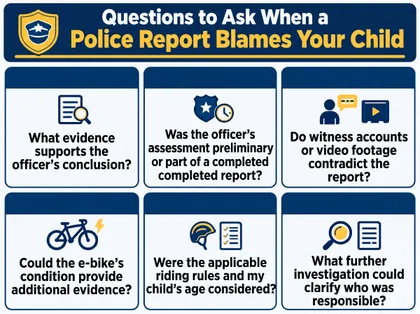
What Should I Ask a Lawyer If the Police Report Blames My Child?
Ask what the report’s conclusion is based on, whether it reflects a completed finding or an officer’s preliminary comment, and how the attorney would test it against witness accounts, footage, and the e-bike’s condition. A strong answer describes specific steps, not a prediction.
Can I Pursue a Claim If My Child Was Not Wearing a Helmet?
Yes. The absence of a helmet does not bar a claim under California law. The lack of a helmet may reduce the compensation available for head injuries because a court could find it contributed to the severity of those injuries. It does not affect your family’s right to seek recovery for broken bones, internal injuries, or any other harm unrelated to head protection.
How Long Does a Child Have to File an Injury Lawsuit in California?
For most private personal injury claims, a child generally has until age 20 to file a lawsuit. The usual two-year filing period mostly does not begin until they turn 18.
Claims against public entities are subject to shorter timelines, even for children. A written government claim must be presented within six months of the injury.
Are E-Bikes Considered Motor Vehicles Under California Law?
Generally, no. A device that meets California Vehicle Code § 312.5’s requirements is treated as an electric bicycle. It does not require a driver’s license, vehicle registration, or motor vehicle insurance.
A device that exceeds the legal speed or power limits may qualify as a motorized bicycle or motorcycle. Different licensing, registration, and insurance rules may then apply.
What Should I Avoid Doing During My Child’s Injury Claim?
Avoid actions that could weaken the evidence or create confusion about the crash and your child’s injuries. For example:
- Giving a recorded statement to any insurance company without your attorney present. Insurers are experienced at using recorded statements to minimize or deny claims.
- Posting about the accident or your child’s injuries on social media. Photos, comments, and location data can all be used by the opposing party to undercut your child’s claimed damages.
- Repairing or discarding the e-bike or helmet. Both items are potential evidence: the device’s condition can establish its class and its mechanical state at the time of the crash, and the helmet’s damage pattern can document the severity of head impact.
Talk to Arash Law About Your Child’s E-Bike Injury Claim
Choosing a lawyer starts with understanding how they would handle your child’s case. Arash Law can review the collision evidence, medical records, and device information to explain your family’s options. We can also discuss filing deadlines, your child’s representation, and court approval of a potential settlement.
Arash Law has recovered over $1 billion for injured clients across California. Our lawyers handle personal injury cases on a contingency fee basis, meaning you pay no attorney fees unless we recover compensation. Our written agreement explains how case costs and expenses are handled.
Call (888) 488-1391 for a free case evaluation. Bring your questions and any available records to learn how our attorneys can help.
Sources
- California Vehicle Code § 312.5: Electric Bicycle Classification (Classes 1, 2, and 3). https://leginfo.legislature.ca.gov/faces/codes_displaySection.xhtml?lawCode=VEH§ionNum=312.5.
- California Code of Civil Procedure § 335.1: Two-Year Statute of Limitations for Personal Injury. https://leginfo.legislature.ca.gov/faces/codes_displaySection.xhtml?lawCode=CCP§ionNum=335.1.
- California Government Code § 911.2: Six-Month Deadline for Government Injury Claims. https://leginfo.legislature.ca.gov/faces/codes_displaySection.xhtml?lawCode=GOV§ionNum=911.2.
- California Probate Code § 3500: Compromise of a Minor’s Disputed Claim. https://leginfo.legislature.ca.gov/faces/codes_displaySection.xhtml?lawCode=PROB§ionNum=3500.
- California Rules of Court, Rule 7.950: Minor’s Compromise Petition Requirements. https://courts.ca.gov/cms/rules/index/seven/rule7_950
Disclaimer
Past results do not guarantee future outcomes. Every case is different. The information on this page is for general educational purposes and does not constitute legal advice. No attorney-client relationship is formed by reading or relying on this content. If you were injured, consult a licensed California personal injury attorney about your specific situation. Arash Law, (888) 488-1391.