TL;DR: Yes, you can sue after a parking lot accident in California if another party’s negligence caused your injuries and insurance does not fully cover your losses. Drivers, pedestrians, and shoppers may recover medical bills, lost wages, and vehicle damage, but comparative fault or missed deadlines can reduce or bar your compensation.
Highlights:
- Photograph vehicles, injuries, signs, lighting, lane markings, and pavement hazards.
- Ask the property manager or security for an incident report and a copy.
- Request surveillance or dashcam footage immediately before it is overwritten.
- Exchange names, contact details, license plates, and insurance information on scene.
- Get medical care promptly and keep all treatment notes, bills, and work-loss records.
- File a DMV SR-1 within 10 days if injury/death or damage exceeds $1,000.
- If injury or death occurred, make a written report to the police/CHP within 24 hours.
Tip: Preserve every photo, video, receipt, and message, and when speaking with insurers, stick to observable facts and avoid guessing.
Tabla de Contenidos
Yes. You can sue after a parking lot accident in California if another person, business, property owner, contractor, valet company, or government entity caused your injuries through negligence. A lawsuit may help you seek compensation for medical bills, lost income, pain and suffering, future care, and vehicle damage when an insurance claim does not fully resolve the case.
Parking lot accidents can involve backing crashes, pedestrian injuries, unsafe pavement, broken drain covers, poor lighting, missing signs, or unsafe traffic flow. The key question is whether someone failed to use reasonable care and whether that failure caused your injuries.
When Can You Sue After A Parking Lot Accident?
You can sue after a parking lot accident when another party’s negligence caused your injuries, and an insurance claim does not fully resolve the case. A lawsuit lets you ask a court to award compensation when the insurance claim does not end fairly.
Common situations that may lead to a parking lot accident lawsuit include:
| Situation | Why A Lawsuit May Be Necessary |
|---|---|
| There is a dispute over fault. | The drivers, property owner, or insurer may disagree about who caused the accident. |
| The insurer denies or undervalues the claim. | A lawsuit may be needed if the insurer refuses to offer fair compensation. |
| The injuries are serious. | Severe injuries can lead to medical bills, lost income, future care, and long-term pain. |
| Unsafe property conditions contributed to the accident. | Poor lighting, broken pavement, missing signs, or unsafe traffic design may support a premises liability case. |
| A filing deadline is approaching. | Filing a lawsuit before the deadline can preserve your right to seek compensation. |
You do not have to file a lawsuit in every parking lot accident case. Many cases start as insurance claims. A lawsuit may become necessary when the insurer denies fault, blames you, undervalues your injuries, disputes the cause of your injuries, or refuses to pay for future medical care.
What Causes Most Parking Lot Accidents?
Distracted driving is a major safety risk in parking lots. Many drivers pay less attention in parking lots because vehicles move slowly, but parking lots still contain pedestrians, shopping carts, parked cars, and vehicles moving in different directions. A few seconds of distraction can cause a driver to miss a pedestrian, a reversing vehicle, or a stop sign.
According to the National Safety Council Distracted Driving Public Opinion Poll, tens of thousands of crashes happen in parking lots and parking garages each year. The NSC also found that many drivers admit to doing distracting activities while driving through parking lots:
| Distracting Activity In Parking Lots | Percentage Of Drivers Who Said They Would Do It |
|---|---|
| Make phone calls | 66% |
| Program GPS systems | 63% |
| Text | 56% |
| Use social media | 52% |
| Send or receive emails | 50% |
| Take photos or watch videos | 49% |
Who Is Liable For Parking Lot Injuries In California?
In a parking lot injury case, liability depends on who created or failed to correct the unsafe condition. Liability means legal responsibility for the resulting harm. Responsibility can fall on the driver, the property owner, or a third party. Each of these parties owes a duty to others in the lot. A duty is a legal responsibility to act with care.
Commonly liable parties include:
- Drivers: A driver may be liable for speeding through aisles, backing up without looking, driving while distracted, or failing to yield to pedestrians.
- Property Owners: Property owners must maintain reasonably safe parking lots. They may be liable if broken pavement, poor lighting, missing signs, or other hazards contributed to the injury.
- Repair Contractors: A contractor may share liability if negligent repairs or maintenance create an unsafe condition in the parking lot.
- Valet Services: A valet company may be responsible if its employee causes an accident while moving or parking a vehicle.
- Government Agencies: A city or other government entity may be liable if it owns or maintains the parking lot where the injury occurred. Special rules and deadlines apply to these claims.
Proving fault requires concrete evidence. Parking lot accident lawyers gather camera footage, maintenance records, and witness statements. These pieces of evidence can help connect the unsafe condition to the party responsible.
How To Establish Liability In A Parking Lot Accident
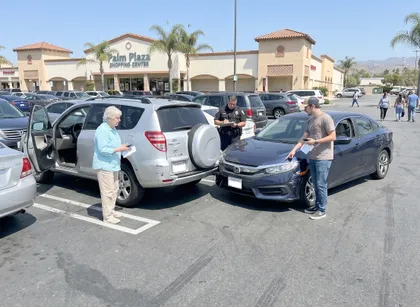
Establishing liability requires more than showing that an accident happened. You must prove that another party acted negligently and that their actions caused your injuries. California law requires four elements in every negligence claim. If any element is missing, recovering compensation becomes much more difficult.
- Duty of Care: Every driver in a parking lot must act safely toward others, including other drivers, pedestrians, and cyclists sharing the space.
- Breach of Duty: The other party failed that duty, such as by speeding through a lane, ignoring a stop sign, or not watching for pedestrians.
- Causation: The other party’s careless act or unsafe property condition must be a substantial reason you were hurt.
- Damages: You suffered losses, such as medical bills, lost wages, vehicle damage, pain, or reduced quality of life.
Proving these four elements helps determine whether you have the right to pursue a claim or lawsuit. Without evidence of negligence, holding another party responsible becomes difficult. Free advice from a parking lot accident lawyer can help you evaluate liability and understand whether you may be eligible to pursue compensation.
In premises liability cases, the injured person usually must also show that the owner, business, or person in control of the property knew, or should have known, of the dangerous condition. For example, a property owner may be liable if broken pavement, poor lighting, or a missing drain cover existed long enough that a reasonable inspection should have found it.
California also uses comparative fault. That means your compensation can be reduced if you were partly responsible for the accident. For example, if your damages are $100,000 and you are found 20% at fault, your recovery may be reduced by $20,000.
Essential Evidence That Can Strengthen Your Parking Lot Accident Case
Evidence can show how the accident happened, who had the right of way, and whether another party caused your injuries.
Parking lots usually have different types of lanes. Main travel lanes carry through-traffic and generally have priority over smaller feeder lanes. Drivers entering from a feeder lane must yield to traffic in the main lane. Drivers backing out of parking spaces must usually yield to moving traffic. These right-of-way rules often become key facts in a claim.
The following evidence can help prove a parking lot accident case:
| Evidence | What It Can Help Prove |
|---|---|
| Surveillance footage | How the accident happened and who had the right of way. |
| Scene photos and videos | Lighting, signs, lane markings, pavement defects, vehicle positions, and hazards. |
| Witness statements | What other people saw before, during, and after the accident. |
| Police, DMV, or incident reports | The date, location, parties involved, and reported facts. |
| Dashcam footage | Vehicle movement, speed, and driver behavior. |
| Vehicle damage photos | Angle of impact and severity of the collision. |
| Maintenance and inspection records | Whether the property owner knew or should have known about a hazard. |
| Medical and chiropractic records | The injuries, treatment, pain levels, and connection to the accident. |
| Expert accident reconstruction | How the crash likely happened when fault is disputed. |
Records can help document the extent of your injuries that can support your claim for medical expenses, lost income, and pain and suffering. The stronger the documentation, the easier it becomes to prove your damages.
What Should You Do After A Parking Lot Accident?
The actions you take after a parking lot collision can affect your ability to recover compensation. Evidence can disappear, memories can fade, and insurers may challenge your claim.
Following these steps can help protect your legal rights and strengthen your case.
- Move to a safe place if you can do so without worsening your injuries.
- Call 911 if anyone is injured, threatened, intoxicated, or refusing to exchange information.
- Exchange names, phone numbers, license plates, driver’s license details, and insurance information.
- Take photos of the vehicles, injuries, signs, lighting, pavement, skid marks, and the surrounding area.
- Ask the store, property manager, or security office for an incident report.
- Ask whether surveillance cameras recorded the area.
- Get medical care as soon as possible, even if your pain seems minor at first.
- File a DMV SR-1 within 10 days if anyone was injured or killed, or if property damage was over $1,000.
- Avoid admitting fault or guessing about what happened.
- Speak with a lawyer if you find yourself thinking that you need a personal injury lawyer. Don’t wait too long to seek legal guidance. An attorney can preserve evidence, identify liable parties, and handle insurance negotiations before important deadlines pass.
These steps can help preserve proof before the video is deleted, witnesses forget details, or insurers dispute your version of events.
Parking Lot Accident Lawsuit FAQs
Parking lot accidents often raise questions about fault, insurance, and liability. The answers below address the most common issues that arise after these accidents.
What If Someone Hits My Parked Car And Leaves?
Take photos of the damage and write down any details you remember about the vehicle. Request any available surveillance footage from the property owner as soon as possible. Then report the hit-and-run to the police and obtain a copy of the report. If the driver is never identified, your available coverage depends on your policy and the type of loss.
Collision coverage may help pay for damage to your vehicle. Uninsured motorist bodily injury coverage may help if you were injured in a qualifying hit-and-run crash. In California, uninsured motorist property damage coverage is limited and generally applies only when the uninsured driver is identified, so do not assume it covers every unknown hit-and-run.
Do Police Respond To Accidents In Private Parking Lots?
Call 911 if anyone is injured, killed, intoxicated, aggressive, uninsured, or refusing to exchange information. In California, under Vehicle Code § 20008, a driver involved in a crash causing injury or death generally must file a written report with the CHP (or, within a city, the CHP or local police) within 24 hours, unless an officer already took a report at the scene. This is separate from the SR-1 report that must be filed with the DMV within 10 days.
You must also file a DMV SR-1 within 10 days if anyone was injured or killed, or if property damage was over $1,000. Police may not send an officer to every minor private-lot property-damage crash, so file any available report and preserve your own evidence.
Will My Insurance Go Up If Someone Hits My Parked Car?
Generally, your insurer should not charge you more for an accident that was not your fault. California insurance rules focus on whether the driver was principally at fault. If your insurer says you were at fault, ask for the basis of that decision and provide evidence such as photos, witness statements, video, and the police or incident report.
What If The Other Driver Says It Was No One’s Fault?
That statement does not determine fault. Evidence determines fault, not the drivers’ opinions. Photos, surveillance footage, witness statements, and right-of-way rules carry more weight than a driver’s claim.
Do Parking Lot Accidents Follow The Same Traffic Laws As Road Accidents?
Not entirely. Parking lots are usually private property, so some traffic laws apply differently. However, drivers still have a duty to operate safely, follow posted signs, and yield when required. Negligence rules still apply when determining fault.
Discuss Your Parking Lot Accident Case With Our California Attorneys
A parking lot accident can leave you with injuries, medical bills, lost income, and questions about what to do next. Insurance companies may dispute fault or try to minimize your claim.
Arash Law helps California accident victims pursue compensation from negligent drivers, property owners, and other responsible parties. Our attorneys can gather evidence, handle insurance communications, and protect your rights throughout the claims process.
Many people ask, “Do lawyers only get paid if they win?” At AK Law, the answer is yes. You pay nothing up front, and you don’t owe the attorney’s fees unless your case results in a recovery.
Call (888) 488-1391 today for a free initial consultation and learn about your legal options.