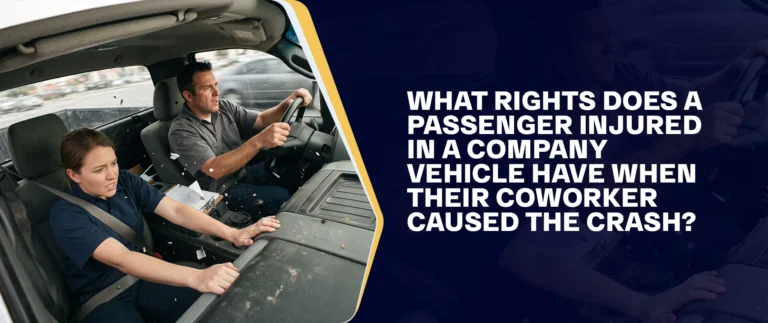
TL;DR: Wrong-way parked delivery trucks create deadly blind spots due to their size. They block sight lines, pushing drivers and cyclists into oncoming traffic to see past them, causing head-on collisions, sideswipes, and pedestrian strikes that contribute to serious and sometimes fatal collisions. Potentially responsible parties may include the driver, the driver’s employer, and any other company that independently contributed to the crash.
Highlights:
- Photograph the truck facing the wrong direction, curb position, and blocked lanes.
- Capture wide-angle shots showing the blind spot area and sightline obstruction.
- Save and back up all dashcam, phone videos, and photos the same day.
- Get driver, company, and vehicle identifiers, plus witness names and contact details.
- Request a preservation letter for ELD data, dashcam footage, and route schedules.
- Get prompt medical evaluation and keep every record, bill, and discharge instruction.
- File a California injury lawsuit within 2 years. A lawsuit against the government requires that a formal administrative claim be filed within 6 months of the incident. (CCP §335.1).
Tip: When speaking with insurers, stick to objective facts and documented symptoms, and avoid guessing.
Table of Contents
A delivery truck parked the wrong way creates a visual barrier. Its size blocks sightlines, making it hard for drivers, cyclists, and pedestrians to see. This forces them into oncoming traffic just to look around it, leading to head-on collisions, sideswipes, and pedestrian strikes that contribute to serious and sometimes fatal crashes.
Delivery drivers, like those from Amazon, FedEx, and food services, follow set routes and time windows. A tight schedule might lead to stopping in no-parking zones. When a large truck sits facing against traffic, its cargo box can substantially obstruct sightlines for drivers, cyclists, and pedestrians.
How Wrong-Way Parking Creates Deadly Blind Spots
A delivery truck parked facing the wrong way can block drivers’ view of oncoming traffic. It’s even more dangerous when that truck then pulls out and crosses into a live lane.
Wrong-way parking breaks the law and turns a delivery truck’s blind spots into a trap. The Federal Motor Carrier Safety Administration (FMCSA) uses the term “No Zones” for four large blind spots around a truck:
- Front: approximately 20 feet
- Rear: approximately 30 feet
- Driver’s side: one lane
- Passenger’s side: two lanes
These operating blind spots are different from the roadway sightline obstruction created when a large truck is parked near a crossing, driveway, bicycle lane, or intersection.
This hazard takes four main forms:
- Nose-First Pull-Out: A truck parked facing the wrong way has to cross active traffic to pull away. Its size can block the driver’s view until part of the truck is already in the lane.
- Forced Centerline Crossing: To see around a wrong-way-parked truck, drivers may have to drift toward the centerline, putting them closer to oncoming traffic and leaving less room to react.
- Blocked Crosswalks: A truck facing the wrong way while parked near a crosswalk can obscure pedestrians from drivers, pushing them farther into the road before drivers can see or be seen.
- Displaced Cyclists: If the truck blocks a bike lane, cyclists may have to merge into traffic and face faster-moving vehicles.
Together, the truck’s wrong-way position, large size, and parking location can obstruct sightlines and create conflicts when road users enter active traffic.
California generally requires vehicles parked on a two-way street to park with their right wheels within 18 inches of the curb, facing the same direction as traffic (Vehicle Code §22502). There are some exceptions, but even commercial loading doesn’t allow parking against the flow of traffic.
California also protects visibility near crosswalks. Vehicles generally can’t stop, stand, or park within 20 feet of a crosswalk (or 15 feet if there’s a curb extension), under Vehicle Code §22500. A local authority can allow commercial loading in that zone only if it adopts a specific ordinance and installs proper curb markings or signs.
Common Collisions Caused By Wrong-Way Delivery Vehicles
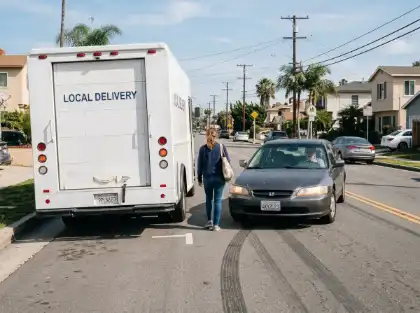 Possible collisions involving delivery trucks parked facing the wrong way include:
- Head-On and Sideswipe Collisions: To see past a truck parked against traffic, drivers must move into the oncoming lane. That puts them in the path of other vehicles, causing head-on or sideswipe crashes.
- Pedestrian and Cyclist Strikes: Someone stepping out from behind a box truck can stay hidden from approaching drivers until they actually reach the road or move past the truck’s blind spot.
- Underride Crashes: In a less common impact involving the side or rear of a sufficiently high commercial vehicle, an underride crash may also occur, depending on the vehicles and angle of impact.
Delivery truck accidents can cause catastrophic or fatal injuries. Broken bones, head trauma, and spinal damage may need emergency surgery, hospitalization, rehabilitation, physical therapy, and ongoing specialist care. These expenses can place a significant financial burden on victims, and delivery truck accident lawyers can help identify who may be liable for the resulting losses.
Who Is Liable When A Delivery Truck’s Blind Spot Causes A Crash?
The driver isn’t always the only one responsible. Depending on the situation, liability could fall on:
- The driver.
- The driver’s employer, under a rule called respondeat superior, which can be held responsible for what employees do on the job.
- The delivery company (e.g., Amazon), though this gets complicated with the Delivery Service Partner (DSP) model, where a small subcontractor is technically the driver’s real employer. Companies like Amazon typically argue that only the DSP is liable.
- A contracting or affiliated company, in some cases.
The key question is negligence, meaning did someone fail to use reasonable care?
Who’s actually liable depends on things like:
- Did the company control the work (and actually use that control)?
- Did they create an unsafe policy?
- Was there an employment or agency relationship with the driver?
Proving Negligence In A California Delivery Truck Accident
To establish negligence in a California delivery truck accident, you generally must prove that the driver owed a duty of reasonable care, breached that duty, and that the breach was a substantial factor in causing the person’s harm. Evidence is what may tie these companies to your injuries.
The evidence to prove fault in a delivery truck accident includes:
- Dashcam or security footage capturing what the truck driver was doing before the accident.
- Logs and records from truck drivers.
- Available data from the truck’s EDR, engine control module, GPS, or other onboard systems, if equipped.
- Record instances of negligent parking, hours-of-service violations, or other violations that played a role in the incident.
- Eyewitness descriptions of the delivery driver’s reckless actions just before the crash.
- UPS package cars and feeders may generate electronic information, such as GPS location, vehicle speed, engine data, route information, or hours-of-service records, depending on the vehicle and the carrier’s systems. Federal rules require retaining Electronic Logging Device (ELD) data for a minimum period, but proprietary telematics data may be retained for a shorter period.
An attorney can send a legal preservation letter placing the company on notice that relevant evidence from your delivery truck crash should be retained. An attorney can also explain what happens after a delivery truck crashes, including how liability and insurance claims may be handled.
Establishing liability helps determine which person or company may be legally responsible for the damages caused by the delivery truck accident. Depending on the facts and available policies, payment may come from the delivery driver’s or employer’s commercial auto liability insurance, which may cover bodily injury and property damage caused by an insured driver.
What To Do After A Wrong-Way Delivery Truck Accident
After a collision involving a delivery truck parked against traffic, taking the right steps can protect your health and preserve evidence that may help determine who was responsible.
- Call 911 and seek medical care. Report the accident and request medical assistance for anyone who may be injured. Even symptoms that initially seem minor should be evaluated promptly.
- Document the truck and the surrounding area. Photograph the truck’s direction, license plate, company markings, curb position, blocked crosswalks or bicycle lanes, traffic signs, vehicle damage, and your injuries.
- Collect identifying information. Obtain the delivery driver’s name, license information, insurance details, employer, vehicle number, and delivery company information. If you can, ask witnesses for their names and contact details.
- Give officers an accurate account. Explain what occurred before, during, and after the collision without guessing about facts you did not observe. The CHP recommends providing information about the people, vehicles, roadway, and surrounding environment.
- Preserve available evidence. Save photographs, videos, dashcam recordings, medical documents, repair estimates, and damaged personal property.
- Notify the appropriate parties. Report the crash to your insurer. In California, an SR-1 must generally be submitted to the DMV within 10 days when someone is injured or killed or when property damage exceeds $1,000, even if police prepared a separate report.
California personal injury and wrongful death claims generally must be filed within 2 years (CCP §335.1), though the start date and exceptions can vary.
- If the claim is against a public entity, you must first file a written claim within 6 months of the incident (Gov. Code §911.2).
- If the entity properly rejects your claim in writing, you then have 6 months from that notice to file your lawsuit (Gov. Code §945.6).
Contact an attorney to help understand the official deadlines. If you are wondering, “Do I have to pay up front to hire an attorney?” Many personal injury attorneys offer contingency-fee arrangements, meaning the attorney’s fee is generally tied to obtaining a recovery. The written fee agreement should explain the percentage charged and whether the client may be responsible for case costs or expenses.
Frequently Asked Questions About Delivery Truck Blind Spot Accidents
If you were hurt near a wrong-way parked delivery truck, you likely have questions about deadlines, liability (who can be held legally responsible), and next steps. California law protects accident victims, and knowing your rights helps you decide what to do. Under California law, you can seek compensation even if multiple parties share fault.
Can Backup Cameras Eliminate Parking Blind Spot Risks?
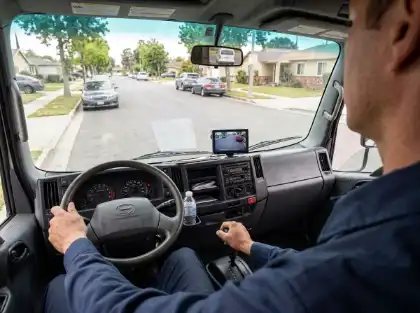 No. A backup camera does not replace the duty to use reasonable care. A driver can be held liable if their failure to make reasonable observations significantly contributed to the crash, though overall responsibility depends on all the surrounding circumstances.
Are Delivery Trucks Allowed To Park On The Wrong Side Of The Street In California?
Generally, not on a two-way road. California Vehicle Code §22502 requires a vehicle’s right-hand wheels to be parallel to and within 18 inches of the right-hand curb. Although a commercial vehicle may deviate from the curb-position requirements when reasonably necessary for loading or unloading, that exception expressly does not permit the vehicle to park opposite the normal direction of traffic.
What If The Delivery Driver Works For A Third-Party Contractor?
You can still seek compensation. A company may still share liability if it creates unsafe conditions, such as tight delivery deadlines. That arrangement does not shield the larger company from responsibility. An attorney can help identify who may be responsible.
A Case Involving A Delivery Truck
Delivery Truck Accident Settlement
Our client, a middle-aged woman, suffered neck and back injuries after a large delivery truck rear-ended her vehicle on the freeway. The defense attempted to attribute her injuries to her weight and pre-existing conditions. We ultimately resolved the matter for $1,150,000 through mediation before trial.
Motorcycle vs. Truck Accident Settlement
Our client was initially listed as the at-fault party in the police report following a motorcycle-versus-truck accident. Through a detailed investigation, we demonstrated that the truck driver caused the collision and recovered the available $1,000,000 policy limits for our client.
Rollover Truck Accident Settlement
Our client suffered a spinal cord injury and a mild traumatic brain injury in a rollover truck accident while working within the scope of his employment. We secured a $5.5 million settlement on his behalf.
Past outcomes are not a guarantee of future results. Each case is unique, and any result depends on the individual circumstances, evidence, and legal issues involved.
Contact A California Delivery Truck Accident Attorney
Dashcam footage from a delivery truck can be overwritten after the crash. Other trucking records, like driver logs, are kept for a limited time under federal rules. An attorney can act quickly to secure this evidence before it is gone.
Arash Law, known as AK Law, helps injured victims and their families across California. Our lawyers work to identify every party that may be at fault and to preserve the evidence your case needs. Contact our team to discuss how to protect your right to seek compensation. Our firm handles every personal injury case on a contingency fee basis, meaning no attorney fees unless we win your case. Call (888) 488-1391 to schedule a free consultation.