TL;DR: NHTSA’s 2024 data show that light trucks, including SUVs, pickups, and vans, were involved in more pedestrian deaths than passenger cars in single-vehicle crashes where the first harmful event was a collision with a pedestrian. SUVs alone did not exceed passenger cars.
Key Facts
- NHTSA’s final 2024 data report 7,080 pedestrian deaths nationwide, and California recorded 1,090 deaths, the highest state total that year.
- The Insurance Institute for Highway Safety (IIHS) found that vehicles with hoods over 40 inches had about a 45% higher risk of pedestrian fatalities than lower, sloped-front vehicles.
- California Vehicle Code § 21950 requires drivers to yield to pedestrians in marked and unmarked crosswalks at intersections, and requires pedestrians to use due care.
- California’s pure comparative negligence rule comes from Li v. Yellow Cab Co., 13 Cal. 3d 804 (1975), so a pedestrian can still recover damages reduced by their percentage of fault.
- Government Code § 911.2 generally requires that a public-entity injury claim be presented within six months after it accrues, and the article notes that state claims go through the DGS/ORIM Government Claims Program.
- Effective January 1, 2025, SB 1107 raised California’s minimum auto liability limits to $30,000 per person/$60,000 per occurrence/$15,000 property damage (30/60/15), per the California Department of Insurance.
Table of Contents

The National Highway Traffic Safety Administration’s (NHTSA) final 2024 data counted 2,990 pedestrian deaths in single-vehicle crashes involving light trucks nationally. Passenger cars accounted for 1,988 deaths. SUVs alone accounted for 1,758. Light trucks include SUVs, pickups, vans, and other similar vehicles.
Overall, 7,080 pedestrians died in U.S. traffic crashes in 2024. California recorded 1,090 deaths, the highest state total that year. Vehicle design is one factor that can affect crash severity. Speed, visibility, road conditions, and driver behavior can also matter.
Which Type Of Vehicle Kills The Most Pedestrians In California?
California shows a somewhat different pattern from the national data. A California Transportation Commission study finalized in 2026 found that passenger cars were involved in the most fatal and serious-injury pedestrian crashes during the study period. Passenger cars were also the most commonly registered vehicle type in California.
SUVs, however, showed the fastest growth in fatal and serious-injury pedestrian crashes. From 2010 to 2022, fatal and serious-injury pedestrian crashes involving SUVs increased faster than those involving cars, pickups, or vans.
The risk may be especially serious for children. A separate systematic review published in 2025 found that children who were pedestrians or cyclists had 82% higher odds of being killed when struck by an SUV or other light-truck vehicle rather than a passenger car.
Pickup trucks are also, on average, much larger than sedans in California. The study found that the average pickup registered in California was 47% heavier, 26% taller, and had 59% more ground clearance than the average sedan.
Why Taller SUVs And Pickup Trucks Can Be Deadlier To Pedestrians
Taller SUVs and pickups can cause more severe pedestrian injuries due to their higher front ends, front-end shape, and limited visibility. Vehicle size alone does not decide whether a pedestrian survives a crash.
-
Higher Front Ends: Lower passenger cars often strike an adult around the legs, throwing the person onto the hood. Taller SUVs and pickups are more likely to strike higher on the body.
IIHS found that vehicles with hoods over 40 inches had about a 45% higher risk of pedestrian fatalities than lower, sloped-front vehicles. Higher front ends can increase the risk of serious torso and head injuries, and can make pedestrians more likely to be knocked down.
-
Vehicle Weight Can Increase Crash Severity: Larger vehicles can transfer more kinetic energy in a crash, but weight alone does not explain pedestrian outcomes. California’s 2026 study could not separate weight from speed, vehicle design, road conditions, and driver behavior.
Front-end height and shape can also affect injury severity, and IIHS found that taller vehicles increase the risk of serious injury as crash speeds rise. At 30 mph, IIHS estimated a 37% serious-injury risk for a midsize car and 76% for a midsize pickup.
- Blind Zones Can Limit Pedestrian Visibility: Large SUVs and pickups can have wider blind zones and narrower forward views. IIHS found that SUVs, pickups, and vans were more likely than cars to strike pedestrians while turning, suggesting that visibility may contribute to the risk.
Tall hoods, A-pillars, and side mirrors can block parts of a driver’s view. Vehicle design can increase injury severity, but it does not decide legal fault on its own. Driver conduct, pedestrian conduct, speed, and road conditions all matter too.
Common Causes Of Fatal Pedestrian Accidents In California
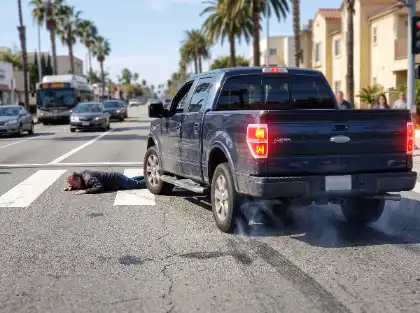 California crash data show several recurring factors in fatal and serious-injury pedestrian crashes, including pedestrian violations, pedestrian right-of-way violations, unsafe speed, and improper turns. These crash codes do not determine legal fault on their own. Driver distraction can also contribute to a pedestrian crash.
- Distracted driving. A driver looking at a phone may miss a pedestrian, a changing signal, or another hazard. Larger blind zones can make that loss of attention more dangerous. Phone use and other forms of driver inattention can contribute to pedestrian crashes, including crashes involving SUVs and trucks.
- Speeding. A pedestrian struck at 40 mph faces a dramatically lower chance of survival than one struck at 20 mph. Faster speeds mean less reaction time, longer stopping distances, and greater kinetic energy at impact. Higher speeds can greatly increase the risk of serious or fatal pedestrian injuries.
- Failure to yield. Left turns at busy intersections are a documented high-risk moment. A vehicle’s A-pillar, the structural post between the windshield and the front side window, can block the driver’s sightline to a pedestrian already legally crossing. California law governs who bears responsibility for these failures, as discussed in the fault section below.
These are the driver errors California law examines when determining who caused a crash. They are also the foundation of how fault is assigned and how a personal injury claim is built. Pedestrian accident lawyers often rely on evidence to assess liability. These pieces of evidence may include dashcam footage, phone records, and eyewitness accounts, among others.
Arash Law has recovered over $1 billion for injured Californians. If you or a family member was struck by an SUV or truck, the clock on your claim is running. Call (888) 488-1391 for a free case evaluation. Available 24 hours a day.
How California Law Determines Fault In A Pedestrian Crash
California Vehicle Code § 21950 requires drivers to yield in marked and unmarked crosswalks at an intersection. Pedestrians must also use due care and cannot enter a vehicle’s path when it is close enough to be an immediate hazard.
California follows pure comparative negligence, established in Li v. Yellow Cab Co., 13 Cal. 3d 804 (1975). A pedestrian who shares fault may still pursue compensation, with their award reduced by their percentage of responsibility rather than eliminated. A pedestrian found 30% at fault may still recover 70% of proven damages from other responsible parties.
When a pedestrian dies from their injuries, surviving family members may bring a wrongful death claim. Under CCP § 377.60, the persons who may file include a surviving spouse, domestic partner, children, and certain other persons specified by statute. CCP § 377.61 governs the damages available to those heirs, separate from the two-year filing deadline under CCP § 335.1.
When A Government Entity May Also Be Liable
Dangerous crosswalk design, missing signals, or unrepaired road hazards may support a claim against a public entity in some cases. Government Code § 835 requires proof that the property was in a dangerous condition, that the condition proximately caused the injury, and that it created a reasonably foreseeable risk. The plaintiff must also show either that a public employee’s negligent or wrongful act or omission created the condition, or that the entity had actual or constructive notice of it in time to take protective measures.
Government Code § 911.2 generally requires an injury claim within six months after it accrues. Missing that period can create a serious problem, though limited late-claim procedures may exist under Government Code § 911.4. The applicable deadline should be reviewed promptly.
Claims against the State of California generally go through the DGS/ORIM Government Claims Program. For Caltrans claims, however, claims for death, personal injury, or property damage of $12,500 or less may be filed directly with Caltrans, while claims over $12,500 generally must be filed with the Government Claims Program.
Insurance Minimums In California After SB 1107
Effective January 1, 2025, Senate Bill 1107 raised California’s minimum auto liability insurance limits to:
- $30,000 for bodily injury to or death of one person.
- $60,000 for bodily injury to or death of two or more persons in one accident.
- $15,000 for property damage.
Those limits may fall short of the losses caused by a serious pedestrian injury. Uninsured/underinsured motorist (UM/UIM) coverage may provide an additional source of recovery if the pedestrian qualifies as an insured. Available coverage depends on the policy and the facts of the claim.
What Evidence Matters Most In Pedestrian Accident Cases
The evidence that matters depends on how the pedestrian crash happened. Reports, video, vehicle data, witness statements, and medical records may all help build the claim. Evidence pedestrian accident attorneys pursue immediately after a crash includes:
- California Traffic Collision Report: A CHP Form 555 or a report from the responding city or county law enforcement agency may identify the vehicle’s make, model, and type, as well as details about the collision, such as the point of impact or the estimated pre-crash speed.
- Surveillance, Dashcam, and Local Traffic-Camera Footage: California businesses, homes, buses, intersections, and nearby vehicles may have captured the crash. Retention periods vary by system, so prompt preservation requests may help prevent useful footage from being overwritten.
- Event Data Recorder (EDR): Many newer vehicles involved in California crashes may contain EDR data, sometimes referred to as “black box” data. Depending on the vehicle, it may record speed, braking, throttle use, and other pre-impact information.
- California Medical Records: Emergency room, trauma-center, ambulance, and follow-up treatment records can document the location and severity of the pedestrian’s injuries. They may also be reviewed alongside crash-reconstruction or biomechanical evidence.
- California DMV Vehicle Records: DMV records may help confirm the striking vehicle’s registered owner and vehicle type. Ownership can matter when evaluating theories such as negligent entrustment or owner liability.
The evidence available in a pedestrian accident case is not limited to the examples above. Other records may become important depending on how the crash happened. An attorney can help identify and preserve the evidence that may support your claim. Knowing how to choose a pedestrian accident lawyer in California can help you find someone who can handle that process effectively.
What Arash Law Has Recovered For Pedestrian Accident Victims
Arash Law has represented pedestrians in serious accident cases across California. The following pedestrian accident case results show examples of past recoveries:
$10,000,000 — Pedestrian Accident: A client suffered serious injuries after being run over by a speeding vehicle. Arash Law secured a financial recovery and helped the client obtain needed medical care.
$6,100,000 — Pedestrian Accident: A 6-year-old child was struck in a pedestrian accident. The firm recovered $6.1 million on the child’s behalf.
Past results do not guarantee future outcomes. Every case is different, and results depend on the specific facts and evidence involved.
Frequently Asked Questions About Pedestrian Accidents Involving SUVs And Trucks In California
Pedestrian crashes involving SUVs and trucks can raise questions about fault, insurance, injuries, evidence, and filing deadlines. The answers below explain some of the most common issues California pedestrians and their families may face after a serious crash.

Who Pays My Medical Bills If I Am Hit By An SUV Or Truck?
The at-fault driver’s liability coverage may compensate you for medical expenses caused by the crash, but it usually does not pay each bill as treatment occurs. Health insurance or applicable MedPay may help with costs simultaneously, and UM/UIM coverage may also apply if you qualify under the policy.
Can I Still Get Compensation If I Was Jaywalking?
Possibly. California’s pure comparative negligence rule allows a pedestrian who shares fault to recover damages attributable to another party’s fault. The pedestrian’s percentage of responsibility reduces any award. Evidence about the vehicle’s impact and the pedestrian’s location or conduct may address different parts of the liability analysis. Both can be relevant when determining causation and comparative fault.
How Long Do I Have To File A Pedestrian Accident Claim In California?
California Code of Civil Procedure § 335.1 generally gives an injured person two years to file a personal injury lawsuit. Wrongful death actions also generally have two years, usually running from the date of death. Public-entity injury claims generally must be presented within six months of accrual. The usual minority tolling rule for lawsuits generally does not extend the six-month Government Claims Act claim-presentation deadline. Exceptions can alter these deadlines, so the applicable period should be reviewed on a case-by-case basis.
What If The At-Fault Driver Was Operating A Commercial Vehicle Or Delivery Truck?
An employer may be responsible when a driver causes a crash while acting within the scope of employment, under a theory called respondeat superior. Negligent entrustment is a separate theory that may apply to a vehicle owner who lets an unfit driver use the vehicle. Some commercial vehicles are also subject to state or federal safety rules, depending on the carrier and type of operation.
What Happens If A Hit-And-Run Driver Hits Me?
If the driver is unknown, uninsured motorist coverage may apply if you qualify as an insured under the policy. California generally requires physical contact for an unknown-driver bodily injury UM claim, a police report within 24 hours, and a sworn statement to the insurer within 30 days.
Do I Have To Pay Arash Law Upfront To Handle My Case?
No. Arash Law handles pedestrian accident cases on a contingency fee basis. Attorney’s fees are owed only if the firm obtains a recovery. The written fee agreement explains the contingency percentage and how case costs affect your recovery.
Talk To Arash Law About Your California Pedestrian Accident Claim
After a pedestrian crash, video and vehicle evidence may be lost under different retention schedules, and witness memories can fade over time. Arash Law handles pedestrian accident claims in California and has recovered over $1 billion for clients. Our pedestrian accident lawyers can investigate fault, preserve available evidence, identify insurance coverage, and document the losses resulting from the crash.
After a crash involving an SUV or light truck, key evidence can vanish in hours. Witnesses become harder to reach with each passing day. Call Arash Law at (888) 488-1391, available 24 hours a day, for a free case evaluation. Make ‘em pay. Call AK.
Sources
- NHTSA. Pedestrians: 2024 Data, Traffic Safety Facts, DOT HS 813 818, June 2026. National Highway Traffic Safety Administration. National pedestrian fatality data and state totals. crashstats.nhtsa.dot.gov
- California Transportation Commission. Vehicle Weight Safety Study Report to the Legislature, 2026. California vehicle-fleet trends, pedestrian crash involvement by vehicle type, and vehicle size comparisons.
- Robinson, E., Edwards, P., Laverty, A., & Goodman, A. “Do Sports Utility Vehicles (SUVs) and Light Truck Vehicles (LTVs) Cause More Severe Injuries to Pedestrians and Cyclists Than Passenger Cars in the Case of a Crash? A Systematic Review and Meta-Analysis.” Injury Prevention, first published online April 29, 2025.
- Insurance Institute for Highway Safety (IIHS). “New Study Suggests Today’s SUVs Are More Lethal to Pedestrians Than Cars,” June 2020. SUV front-end strike-point biomechanics and comparative lethality findings. iihs.org
- UC Berkeley Safe Transportation Research and Education Center (SafeTREC). “2025 SafeTREC Traffic Safety Facts: Pedestrian Safety,” 2025. California pedestrian fatality, serious injury, and primary crash-factor data. safetrec.berkeley.edu
- California Office of Traffic Safety (OTS). Pedestrian Safety Campaign. Statewide pedestrian fatality and injury data; OTS coordinating role. ots.ca.gov
- California Department of Transportation. Submit a Damage Claim. Caltrans claims procedures and the $12,500 routing threshold.
- California Legislative Information. California Code of Civil Procedure § 335.1 (two-year statute of limitations); § 377.60 (who may file wrongful death); § 377.61 (wrongful death damages); Government Code § 911.2 (six-month government claim deadline). leginfo.legislature.ca.gov
California Department of Insurance. “New Year Means New Changes for Insurance,” 2025. SB 1107 auto insurance minimums effective January 1, 2025 (30/60/15). insurance.ca.gov
Disclaimer
Past results do not guarantee future outcomes. Every case is different. The information on this page is for general educational purposes and does not constitute legal advice. No attorney-client relationship is formed by reading or relying on this content. If you were injured, consult a licensed California personal injury attorney about your specific situation. Arash Law at (888) 488-1391.