TL;DR: You are not automatically required to stop driving after a crash. However, injuries, medications, vision changes, slower reactions, or severe anxiety may mean you should wait before driving again. The DMV may restrict, suspend, or revoke your license for certain violations, reporting failures, medical conditions, or safety concerns. California injury claims generally have a two-year lawsuit deadline, with shorter deadlines for government claims.
Highlights:
- A license may be suspended for reasons such as too many points, DUI, driving uninsured, or failing to report crashes with injury or damage over $1,000.
- Watch for physical signs like neck stiffness, vision changes, slower reflexes, or chronic pain that make driving unsafe before getting back on the road.
- If symptoms may affect your ability to drive, ask your doctor when it is safe to return.
- Document crash-related anxiety, PTSD, and treatment to support your injury claim.
- Use grounding techniques like the 5-4-3-2-1 sensory method or box breathing if anxiety hits while driving, and pull over safely if panic builds.
- File your injury claim within two years of the crash (or six months if a government vehicle was involved) to protect your legal rights.
- Consider therapy or defensive driving classes to rebuild confidence and address trauma that professional medical support can help resolve.
Tip: If panic or physical symptoms prevent you from driving safely, pulling over and seeking professional help is far smarter than pushing through and risking your safety or others’ on the road.
Table of Contents
After an accident, asking yourself ‘Should I give up driving?’ is natural, but California law has no automatic answer. No rule forces you to stop driving after a crash. The Department of Motor Vehicles (DMV) can suspend your license in certain cases, but unless that happens, the choice is yours.
You may not need to give up driving permanently after a crash. A temporary break may be enough while injuries, medication, or anxiety affect your safety. When you return, you may choose to avoid freeways, nighttime driving, or heavy traffic. If symptoms continue, ask your doctor whether a driving evaluation may help.
After a crash, fear of getting back behind the wheel is natural, and it tells you something real about your readiness. If you have physical limits or severe anxiety, taking a break is a smart choice. The law, though, sets its own rules about when you can be required to stop driving.
When Does California Legally Suspend Your License?
The California DMV generally suspends your license for serious violations or missed legal requirements, not for every crash. Most everyday accidents with no injuries or other issues do not trigger a suspension. The DMV can act after a single accident if it raises concerns about unsafe driving, a medical condition, insurance, or required reporting.
The DMV may suspend your license if:
- Too Many Points: For many noncommercial drivers, four points in 12 months, six points in 24 months, or eight points in 36 months can lead to probation and a license suspension.
- DUI (Driving Under the Influence): You were driving drunk or on drugs when the crash happened.
- No Insurance: If you were involved in a reportable accident and cannot establish that you had the required financial responsibility at the time, the DMV may suspend your driving privilege under Vehicle Code §16070.
- Failure to Report: You did not submit an SR-1 to the DMV within 10 days after a crash involving injury, death, or more than $1,000 in damage to any one person’s property. Failure to file a required report can result in a license suspension.
A crash alone does not automatically lead to a DMV reexamination. However, a doctor, family member, or police officer may report safety concerns to the DMV. The DMV may review medical information or require vision, knowledge, or driving tests. Depending on the results, it may take no action, add restrictions, suspend, or revoke your license.
A single minor crash with no injuries and no other violations will not ordinarily result in suspension. However, the DMV can act after one incident if it involves serious injuries, unsafe driving, or information suggesting that a physical or mental condition affects the driver’s safety.
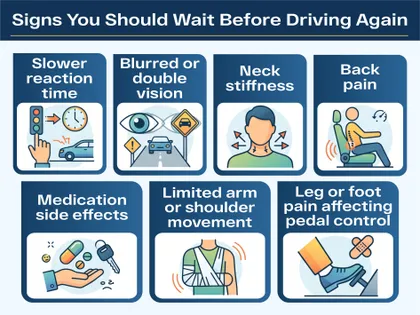
Physical Signs You Should Wait To Drive
Pain, vision problems, or slower reactions may make driving unsafe. A crash can limit your movement, affect your reflexes, or make it harder to control the vehicle.
Signs to watch for include:
- Neck or Back Stiffness: You cannot turn to check blind spots or move quickly.
- Vision Changes: Blurred vision, double vision, or light sensitivity affect your view of the road.
- Slower Reaction Time: Pain, injuries, or medication make it harder to brake or swerve quickly.
- Chronic Pain: Pain distracts you from traffic, intersections, or lane changes.
If these symptoms affect your driving, stop and seek medical advice. Chiropractic care may also help with certain muscle or joint injuries.
Mental Signs You Should Wait To Drive
Brain fog, anxiety, or trauma may affect your focus, judgment, and reactions behind the wheel.
Signs to watch for include:
- Brain Fog: You struggle to track traffic, signals, or pedestrians.
- Intense Anxiety or Panic: A racing heart, sweating, or freezing up affects your control.
- Hypervigilance: You brake too often, remain tense, or startle at normal traffic sounds.
Do not drive on the day of a suspected concussion. Ask your healthcare provider for specific instructions about when it is safe to return, especially if you have problems with attention, processing speed, vision, or reaction time.
When Might You Need To Stop Driving Permanently?
Permanent driving cessation may be appropriate when a medical condition causes lasting problems with vision, judgment, reaction time, consciousness, or vehicle control that cannot be corrected through treatment, restrictions, or adaptive equipment.
If your ability remains uncertain, ask about a comprehensive driving evaluation from an occupational therapist or certified driving rehabilitation specialist. The evaluation may assess vision, reaction time, decision-making, physical control, and on-road performance. It may also identify useful restrictions or adaptive equipment. A failed evaluation does not always require a complete cessation, as the DMV may instead impose restrictions, such as daylight-only driving, or require adaptive equipment.
How To Overcome The Fear Of Driving After A Crash
Overcoming driving fear after a crash takes time. There is no quick fix, but with medical clearance, a step-by-step return to driving, and the right mental health support, you can rebuild your confidence behind the wheel.
Formal medical clearance is not required after every crash, but it may be necessary depending on your condition or a DMV review. Your physician can check that your injuries have healed and that any medications you take will not affect your driving. Once you have the all-clear, you can start a gradual return:
- Sit in a parked motor vehicle with the engine off.
- Sit in a parked motor vehicle with the engine running.
- Drive slowly in an empty parking lot.
- Take short drives on quiet, familiar streets.
- Gradually move to roads with more traffic.
- Consider a defensive driving class to rebuild your skills and confidence.
If panic starts while you are driving, stay focused on the road and pull over safely as soon as you can. Once parked, try the 5-4-3-2-1 grounding method or slow breathing to help your body calm down. One common box breathing pattern also helps. If anxiety gets too strong, it is always safe to pull over.
Severe anxiety after a crash may require professional treatment, such as therapy or trauma-focused counseling. That kind of care can be a real financial burden on top of your other recovery costs.
Can You Include Driving Anxiety In An Injury Claim?
California law treats mental trauma as a real injury. That means you can seek money for driving anxiety and post-traumatic stress disorder (PTSD) after a crash. At Arash Law, we handle these cases. Medical documentation can help support a claim for therapy costs, medical bills, and pain and suffering.
To support your claim, you may use:
- Medical Records: Diagnoses, therapy notes, and treatment plans.
- Personal Testimony: Details about how symptoms affect your daily life.
- Witness Statements: Observations from family members, friends, or co-workers.
- Psychological Evaluations: Formal assessments that may support serious or disputed claims.
- Expert Testimony: Professional opinions that may help establish causation and damages.
California personal injury lawsuits generally must be filed within 2 years of the date the claim accrues. If the case is against a California state or local public entity or a public employee, an administrative claim generally must be presented within 6 months of accrual. If the entity sends a compliant written rejection, the lawsuit generally must be filed within 6 months of the notice’s personal delivery or mailing. Exceptions may change these deadlines.
If you feel “I need a personal injury lawyer,” act quickly. Our distracted driving lawyers can build your case with the medical evidence it needs.
Case Results Of How Our Team Helped Injured Drivers
- $2,200,000 Recovery: A newly married couple expecting their first child was trapped in an overturned truck after another driver caused the crash. Their baby was born healthy, but one client developed lasting post-concussion symptoms. Arash Law secured a $2.2 million settlement for the family.
- $1,550,000 Recovery: Our client suffered spinal and wrist injuries in a motorcycle-versus-rideshare crash. The case settled in July 2021 and was reported as Tulare County’s largest motorcycle settlement that year.
- $2,500,000 Recovery: Our client was parked along the roadside when a speeding driver struck their vehicle. After initially securing the defendant’s insurance policy limits, our firm pursued the insurance company for failing to issue the payment promptly. We ultimately recovered $2.5 million for our client.
Disclaimer: These case results do not guarantee or predict future outcomes in legal matters. The outcome of a case depends on the circumstances surrounding it.
Frequently Asked Questions About Driving After An Accident
After a crash, it is normal to have questions about what you are feeling and whether you are ready to drive again. Many crash survivors struggle with fear, anxiety, and trauma that lasts well beyond the accident itself. The answers below explain what may help and when to seek professional support.
Is It Normal To Not Want To Drive After An Accident?
Yes. A crash can trigger a strong threat response, causing your brain to associate driving with danger even after the immediate risk has passed. This reaction is common, but not every crash survivor develops PTSD.
Can I Drive While Taking Pain Medication After A Crash?
It depends on the medication and how it affects you. Some pain relievers, muscle relaxers, sleep aids, and anxiety medications can cause drowsiness, blurred vision, or slower reactions.
Check the warning label and follow your doctor’s or pharmacist’s advice. Do not drive if the medication makes it harder to stay alert, see clearly, or react safely.
How Long Does Driving Anxiety Last After A Traffic Accident?
There is no fixed timeline. Symptoms may improve gradually, but a qualified mental health professional should assess persistent, worsening, or disabling anxiety.
What If I Have A Panic Attack While Driving?
Pull over safely, turn on your hazard lights, and stay parked until you feel calm. Try slow breathing and focus on what you can see, hear, and touch around you. Do not try to push through a panic attack while you are driving.
Can A Traffic Crash Cause Long-Term PTSD?
Yes. PTSD after a serious crash can become long-lasting, but it is not possible to predict that it will be permanent. Trauma-focused treatments can significantly reduce symptoms for many people.
Should I Force Myself To Drive If I Am Scared?
Do not drive when panic or other symptoms prevent you from operating a vehicle safely. However, avoiding driving indefinitely can maintain the fear. A therapist may recommend gradual, planned exposure to safe driving situations as part of treatment.
Not Ready To Get Back Behind The Wheel? We Can Help.
A crash can leave you with more than physical injuries. If someone else caused the accident, you may be entitled to compensation for your fear of driving, your anxiety, and your pain. Acting quickly can help protect your right to recover.
Call (888) 488-1391 today to get free advice from a distracted driving accident lawyer at Arash Law, with no cost and no obligation. Every personal injury case is handled on a contingency fee basis, meaning you pay nothing unless we win.