TL;DR: Taking a personal injury case to trial offers benefits when an insurer refuses a fair settlement. A jury may award the full compensation supported by the evidence. Taking a case to trial also creates public accountability and gives you leverage in negotiations. However, trials take longer and carry unpredictability, and a jury verdict is not guaranteed.
Highlights:
- Ask your lawyer what discovery tools could reveal missing documents or witnesses.
- Work with experts early to prove causation, future care, and lost earning capacity.
- Compare any settlement offer to full damages, including long-term medical needs.
- Evaluate collectability by reviewing insurance coverage, assets, liens, and reimbursement claims.
- Plan for the time commitment needed for depositions, exams, conferences, and court appearances.
- Prepare for appeals and post-trial motions that can delay payment after a verdict.
Tip: Preserve evidence and communications in dated files, and stick to facts rather than guessing about fault or injuries.
Table of Contents
Taking a personal injury case to trial offers benefits when an insurer refuses a fair settlement. A jury may award full compensation supported by admissible evidence and permitted under California law. Moreover, bringing a case to trial establishes public accountability and may strengthen your negotiating position.
However, the amount you may recover will depend on several factors, including comparative fault, legal limits, insurance coverage, and the defendant’s ability to pay the judgment. Even when an attorney can explain the case’s strengths and weaknesses and recommend the best action, the client must decide whether to accept a settlement or go to trial.
Why You Should Consider Taking A Personal Injury Case To Trial
Consider taking a personal injury case to trial when the insurer disputes liability, undervalues your losses, or refuses to make a fair settlement offer. A trial allows you to present evidence to a neutral judge or jury, pursue the full damages the law permits, and hold the responsible party publicly accountable.
Because an insurer’s evaluation may differ significantly from what the evidence supports, placing the dispute before a neutral decision-maker can offer several important benefits:
More Evidence May Be Considered
A lawsuit gives your injury attorney access to formal discovery tools that are generally unavailable during ordinary insurance negotiations. Through depositions, written questions, document requests, subpoenas, inspections, and other procedures, your legal team may uncover evidence that was not available when the insurer first evaluated the claim.
A trial also allows the parties to present admissible expert testimony. Depending on the case, experts may address accident reconstruction, medical causation, future treatment needs, permanent impairment, lost earning capacity, or the long-term effects of an injury. Their testimony can help a judge or jury understand complicated evidence and determine how the accident affected the injured person’s health, work, and daily life.
You May Pursue A Larger Potential Award
 At trial, damages are determined by the evidence and the law, rather than by the amount the insurance company is willing to offer. That means you may be awarded the full amount of your proven damages, even when that amount exceeds the other party’s available insurance coverage.
That’s especially true since:
- A defendant’s insurance policy limits generally are not disclosed to the jury, so they do not influence the amount you may be awarded.
- Under the California Constitution (Article I, Section 16), personal injury plaintiffs generally have a right to a jury trial. Both parties can also agree to waive that right and have the case decided by a judge alone in a bench trial. This choice matters: a jury of your peers may weigh non-economic (personal) damages such as pain and suffering differently than a single judge would.
- Punitive damages may be available in limited cases where there is clear and convincing evidence that the defendant acted with oppression, fraud, or malice. Punitive damages are intended to punish that conduct rather than compensate the plaintiff for ordinary losses.
However, obtaining a judgment does not guarantee that the entire amount can be collected. Actual recovery may still depend on available insurance, the defendant’s assets, liens, and other collection issues.
A Neutral Decision-Maker Decides The Case
During the trial, the insurance company no longer controls the final evaluation of liability and damages. Instead, a neutral judge or jury reviews the admissible evidence, considers the testimony of the parties and witnesses, evaluates credibility, and applies the law to the facts of the case.
This benefit can be especially important when the insurer disputes how the accident happened, argues that the injured person shares responsibility, questions whether the accident caused the injuries, or minimizes the seriousness of the losses. At trial, both sides have the opportunity to present evidence and challenge the other side’s claims. The final decision is based on what can be proven in court rather than on the insurer’s internal valuation, settlement strategy, or financial interests.
A Trial Can Create Public Accountability
A trial and verdict generally create a public court record showing how the dispute was resolved. If the defendant is found liable, the judgment formally determines responsibility.
A confidential settlement usually does not create the same public finding. Although some settlement-related documents may appear in the court record, the parties can often resolve the matter without a public decision addressing fault. For some injured people, a formal finding of responsibility is an important part of pursuing the case.
Trial Readiness May Strengthen Settlement Leverage
Preparing a case for trial shows the insurer and defendant that the injured person is willing to present the evidence to a judge or jury rather than accept an inadequate offer. This pre-trial stage of a personal injury case may include completing discovery, taking depositions, retaining experts, filing motions, and organizing witnesses and exhibits.
As the trial date approaches, the defense may face greater uncertainty about the possible verdict, litigation costs, and the risk of an award exceeding the settlement offer. Though trial preparation does not guarantee a better settlement, it may lead to more serious negotiations or an increased offer before the jury reaches a verdict.
These case results from our firm don’t promise similar outcomes for your situation, but they illustrate how trial readiness can support your position when pursuing compensation:
- $3,500,000 Recovery: A rear-end collision at a red light caused by distracted driving. Our client sustained spinal injuries that required surgical intervention. Through experienced preparation, we were able to settle the case just three days before the trial was scheduled to begin.
- $1,450,000 Recovery: Achieved in a motorcycle accident case involving uneven pavement in a construction zone. The construction contractors and the city denied liability until the first day of trial. After that day, the case was settled after they agreed to increase their offer.
What Are The Risks And Costs Of A California Personal Injury Trial?
If you take your personal injury case to trial in California, you are deciding on a path that takes more time and carries more uncertainty than a settlement. There is no guarantee of how a jury will rule. Understanding the real timeline and risks before you commit helps you plan for what lies ahead.
When deciding whether to take your case to court, consider that:
- A trial can take longer. The time required to reach trial varies by county, court availability, case complexity, discovery needs, motions, and continuances. Some cases may take a year or longer, while others may proceed on a different schedule.
- Trial preparation requires your participation. You may need to attend depositions, medical examinations, meetings, settlement conferences, and court proceedings. That commitment can be difficult while you are managing medical treatment, lost wages, and other effects of the injury.
- Cases with multiple parties may be more complex. Multi-vehicle freeway pileups, construction-site accidents, and other cases involving several responsible parties may take longer because each party’s role must be investigated separately before liability can be fully determined.
- A trial usually costs more than a settlement. Expenses may increase due to additional discovery, expert witnesses, depositions, court filings, exhibits, and other trial-preparation costs.
- The verdict may be lower than the settlement offer. A trial may produce a higher award, but the jury may also award less than the insurer previously offered or award nothing.
- Comparative fault may reduce the award. If the judge or jury finds that you were partly responsible for the accident, your compensation may be reduced by your percentage of fault.
- A verdict may not be final immediately. The court may modify or set aside a verdict through post-trial proceedings. Either party may also appeal certain legal rulings, which can delay payment and prolong the case.
That means the central trade-off is between potential recovery and certainty. A signed settlement provides an agreed amount of compensation. In contrast, at trial, jurors evaluate the evidence and the credibility of witnesses, and their decisions can be difficult to predict.
When Does Going To Court Make Sense Over Settling?
If the offer is fair and the fault is not in dispute, settling is the right move. A settlement may resolve the claim and provide payment sooner while avoiding the uncertainty of a jury verdict. However, going to court may make more sense when:
- The settlement offer does not cover your losses. An offer may be inadequate if it leaves you responsible for medical expenses, lost income, future care, or other losses caused by the injury.
- You have significant future damages. Lasting disabilities, reduced earning capacity, and years of anticipated medical treatment may justify presenting the full extent of your losses to a judge or jury.
- Your damages may exceed the at-fault party’s coverage limits. A liability policy limits how much the insurer is generally required to pay, but it does not necessarily limit the total amount of damages a judge or jury may award. Going to trial may allow you to obtain a judgment reflecting the full value of your proven losses.
- The insurer unfairly blames you for the accident. Insurance companies may use comparative fault to reduce their payout. If this creates disputes during the claims process, you may bring your case to court to have a judge or jury decide on fault.
- Important facts or witness credibility are disputed. Trial may be appropriate when the parties disagree about how the accident happened, what caused the injuries, or whose account is more credible.
What To Expect During A California Personal Injury Trial
 A trial gives you the opportunity to present your evidence to a neutral judge or jury, but pursuing that opportunity also requires preparation, testimony, and several formal stages before a verdict is reached. Understanding the trial process helps you weigh its potential benefits against the time, expense, and uncertainty involved.
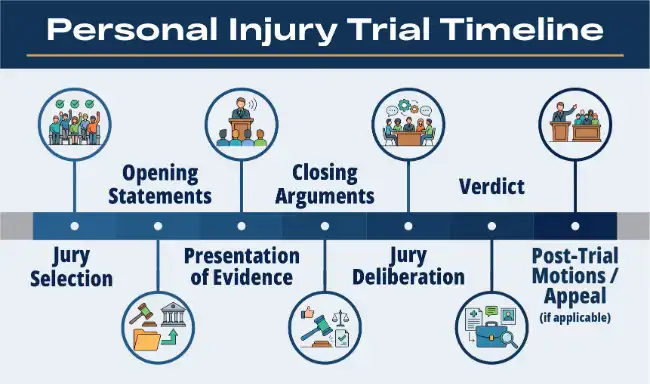
The key stages of a trial typically include:
- Jury Selection: Attorneys for both sides question potential jurors to help select an impartial jury.
- Opening Statements: Each side presents an overview of its case and explains what it expects the evidence will show.
- Presentation of Evidence: Both parties present witness testimony, medical records, expert opinions, photographs, and other evidence in support of their positions.
- Closing Arguments: Each attorney summarizes the evidence and explains why the jury should rule in their client’s favor.
- Jury Instructions and Deliberation: The judge instructs the jury on the applicable California law, and the jurors deliberate before reaching a verdict.
- Verdict: If the jury finds the defendant liable, it may award damages supported by the evidence. Depending on the circumstances, either party may have the right to appeal the judgment on legal grounds.
After a favorable verdict, payment may not be immediate. The defendant may file post-trial motions or an appeal, which can delay enforcement or collection of the judgment. The timing of payment may also depend on insurance processing, lien resolution, and whether the defendant has sufficient assets or coverage to satisfy the judgment.
Frequently Asked Questions About California Personal Injury Trials
Going to trial raises practical questions that settlements never force you to think about. Understanding how testimony works, how long the process takes, and what your medical records mean in court helps you walk in prepared. Having clear answers to these questions makes the trial process less intimidating.
Will I Have To Testify In Court During A Personal Injury Trial?
You may need to testify, particularly when your firsthand account is important to proving how the accident occurred or how the injuries affected your life. Whether you testify depends on the disputed issues, available evidence, and your attorney’s trial strategy.
Can My Case Still Settle After A Trial Starts?
Yes. Settlements can happen at nearly any stage of a trial. Negotiations do not stop just because proceedings have started.
Can Rejecting A Settlement Offer Affect Trial Costs?
Yes. In California, either party may make a formal settlement offer under Code of Civil Procedure Section 998. If a party rejects a qualifying offer and then fails to obtain a more favorable result at trial, the court may impose certain cost consequences. Depending on who made the offer and the trial result, these consequences may include losing the right to recover some post-offer costs or being required to pay certain costs, including potentially expert-witness fees. A personal injury lawyer can evaluate any offers you receive to help you decide whether proceeding to trial is worth the financial risk.
Decide Whether To Take Your Case To Trial With Arash Law
It can be challenging to decide whether a settlement or a trial will give you the best shot at pursuing full compensation after a personal injury accident. Your choice should be based on the facts, the evidence, and what the liable parties are willing to offer.
Arash Law can weigh those factors and make sure no option is left on the table. If AK Law represents you, our attorneys will evaluate every option, whether at the negotiating table or in front of a jury, and help you pursue the best possible outcome. We work on a contingency fee basis, so you don’t pay attorney’s fees unless we win or settle your case.
Call (888) 488-1391 to schedule a free initial consultation. An attorney will review the facts of your case, explain your options in plain language, and help you decide which path makes the most sense for your situation.