TL;DR: Under California’s pure comparative negligence law, you can pursue compensation even if you’re partially at fault in a car accident. Your percentage of fault reduces your recovery, so a 20% fault finding cuts your potential award by 20%. Missing the 2-year deadline to file a personal injury lawsuit can bar recovery entirely, regardless of fault split.
Highlights:
- Document the scene immediately with photos of vehicles, road conditions, and injuries, and collect witness names, before evidence disappears.
- Avoid apologizing or admitting fault at the scene, and do not give recorded statements to the other driver’s insurance adjuster.
- Seek medical attention the same day, even if you feel fine, since some injuries, like soft tissue damage, don’t show symptoms right away.
- File an SR-1 form with the California DMV within 10 days if required.
- Dispute insurer fault findings through evidence or legal review.
- Meet California’s filing deadlines: generally 2 years for personal injury lawsuits and 3 years for property damage cases, or your case may be dismissed.
Tip: Stick to factual statements about what you observed, and let your attorney handle all discussions with insurance companies to protect your claim.
Table of Contents
If both parties are at fault in a car accident, California’s pure comparative negligence rule allows each driver to seek compensation. However, a court can assign both of them a percentage of fault that reduces their recovery.
Car accidents are rarely one-sided. Many crashes involve more than one driver making a mistake. Finding out you may share some blame can feel like your options are gone, but that is not how California law works.
How Pure Comparative Negligence Applies To Car Crashes In California
California Civil Code §1714 states that a person who acts negligently or carelessly is responsible for the harm they cause. Building on that, California courts adopted pure comparative negligence, which lets you seek compensation even if you share some of the blame. A judge assigns your exact share of fault, which can cut your recovery.
Here is what pure comparative negligence means in practice:
- Recovery May Still Be Possible: You can pursue compensation even if you are up to 99% at fault.
- Your Fault Reduces Your Award: A 20% fault finding reduces your compensation by 20%; a 60% finding reduces it by 60%.
- The Math Is Simple: Say you have $100,000 in damages, meaning the full financial value of your injuries and losses, and you are 20% at fault. You could recover up to $80,000 because the other party is responsible for the remaining 80% of your damages.
Because fault is a percentage, the number assigned to you directly affects your payout. An insurer may assign a fault percentage during its investigation, but that initial figure is not final and may not align with the evidence.
Many victims seek free advice from a car accident lawyer to understand what compensation may be available for their situation. You can similarly consult an attorney to learn what your options are if you contributed to the crash.
How Insurance Companies Determine And Assign Fault
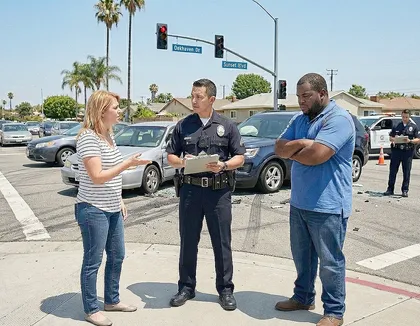
A police officer documents the facts of a crash. However, an insurance adjuster assigns a fault percentage to each party, and those are very different roles. Adjusters work for the insurer, not for you, so the fault percentage they assign is their opening number, not a final ruling.
Adjusters draw from several sources when making initial fault assessments:
- Police Report: Officers note traffic violations, driver statements, and road conditions. Adjusters treat the report as a starting point.
- Witness Statements: Other drivers, passengers, and bystanders can provide details that physical evidence cannot.
- Vehicle Damage: The location and depth of dents and scrapes show the angle and force of impact.
- Photos and Video: Dashcam clips, surveillance footage, and crash-scene photos help show what happened.
After a car accident, one thing claims adjusters may look for is proof of negligence per se. The definition of this legal doctrine under California Evidence Code §669 often encompasses traffic law violations. If a driver breaks a traffic law and causes a crash that the law was designed to prevent, they can be presumed negligent. That means they failed to use reasonable care to avoid harming others. The burden then shifts to that driver to prove they were not at fault.
Adjusters know this doctrine, and it is one of the things they may use to shift more of the blame onto you, especially if you received a traffic citation after the crash. However, their fault assessments are not final. You can dispute it through your own investigation or arbitration, a private hearing outside of court. A car accident lawyer can review the findings and help you push back on a number that does not seem right.
Many people who decide, “I need a personal injury lawyer,” reach that point after receiving an unfair percentage of fault. One of the things a car accident lawyer can do is gather stronger evidence and challenge the insurer’s fault assessment. That proof can help you challenge a fault allocation that does not match the facts.
Here are a few examples of cases we handled where the right evidence helped us secure settlements for our clients:
- The police’s initial findings placed the fault on our client for rolling through a stop sign. However, our car accident lawyers were able to obtain black box data from the other vehicle. It helped prove that the other driver caused the accident by speeding. As a result, our client received $3 million in compensation.
- One of our clients, who was not carrying a driver’s license at the time, got hit by another vehicle while making a left turn. In cases like this, inexperience is one of the most common arguments that insurers may raise to shift blame for an accident. However, we had witness statements to back up our client’s version of events, allowing us to obtain $1 million on her behalf.
Though results like these don’t guarantee similar outcomes for your case, they illustrate what our lawyers do to prepare claims when fault is likely to be disputed.
Steps To Protect Your Claim After A Car Accident
Evidence from car accidents disappears fast. Skid marks fade, witnesses scatter, and dashcam footage gets overwritten within days. What you do in the first hours and days after a crash either gives you evidence to fight back or leaves gaps an adjuster will fill in against you. Acting quickly and carefully helps you stay in control.
- Stop, Exchange Information, and Notify the Authorities: California law requires you to stop at the scene and exchange information with the other party. You must share:
- Your name and address.
- Your driver’s license information.
- Your vehicle registration information.
You must also file an SR-1 report with the California DMV within 10 days if the crash caused:
- An injury or death.
- More than $1,000 in property damage.
Missing this deadline may result in a driver’s license suspension.
- Do Not Apologize or Give a Recorded Statement: Do not say anything that sounds like an admission of fault, including “I’m sorry” or “I didn’t see you.” Similarly, do not give a recorded statement to the other driver’s insurance adjuster. Even casual comments can increase your fault percentage.
- Document the Scene Immediately: Collect as much evidence as you safely can, including:
- Photos of all vehicles.
- Photos of any visible injuries.
- Road conditions, skid marks, and traffic signs.
- Witness names and contact information.
Back up any dashcam footage right away because many systems overwrite recordings within 24 to 72 hours.
- Seek Medical Attention That Same Day: See a doctor or chiropractor as soon as possible, even if you feel fine. Many injuries, especially soft tissue damage to the neck and back, do not cause obvious pain right away. A delay gives insurance adjusters grounds to argue that the crash did not cause your injuries.
California Deadlines For Shared Fault Car Accidents
California law sets strict deadlines for filing a claim after a crash, and those deadlines apply no matter how fault is divided. Personal injury, property damage, and government entity cases each have different filing windows.
The table below summarizes the key deadlines:
| Type of Claim | Deadline |
|---|---|
| Personal Injury | You generally have 2 years from the date of the injury to file a personal injury lawsuit (California Code of Civil Procedure §335.1). |
| Property Damage | You typically have 3 years from the date of the injury to seek compensation for property damage (California Code of Civil Procedure §338). |
| Government Entity | You generally must submit an administrative claim to the agency within 6 months of the crash (California Government Code §911.2). Suing becomes possible in two situations, as per California Government Code §945.6:
|
Missing a filing deadline may prevent you from pursuing compensation, even if the evidence strongly supports your car accident claim. If an uninsured driver was involved, additional procedural requirements may apply. A car accident lawyer can help identify the deadlines that apply to your case.
Frequently Asked Questions About Car Accident Cases
Shared fault situations raise many practical questions. California law provides a framework, but applying it to your specific situation depends on the facts of the crash. The answers below explain common questions about shared fault, insurance coverage, settlement offers, and other issues that may affect your claim.
What Happens In A 50/50 Car Accident?
When both drivers share equal fault, each driver’s insurance company is generally responsible for 50% of the other driver’s damages. In other words, your share of fault will reduce your compensation by 50%. The same percentage reduces the other driver’s compensation.
Will My Insurance Rates Increase If I Am Partially At Fault?
Not necessarily. If you share fault for a car accident, your insurance rates may increase. The impact depends on your percentage of fault, your insurer’s rating rules, and your policy. A lower fault percentage does not always lead to a rate increase.
If you have questions about your situation, lawyers who handle car accident claims can explain how California law may apply. They can also review your insurance policy and discuss how a fault finding could affect your premiums.
What If The Other Driver Has No Insurance In A Shared Fault Situation?
If the other driver has no insurance and both of you share fault, you may still recover compensation for the other driver’s share of your damages. If you have uninsured motorist (UM) coverage, it may cover that portion of your losses, subject to your policy limits, the percentage of fault a court assigns you, and California law. Without UM coverage, recovering compensation may be more difficult, especially if the other driver has few or no assets.
Discuss Your Shared Fault Car Accident Case With Our Lawyers
Sharing fault does not mean you lose your right to seek compensation. If the insurance company assigned you too much blame or offered less than your claim is worth, our car accident lawyers can review the evidence and explain your legal options. Our team at Arash Law, also known as AK Law, works to challenge unfair fault determinations and pursue the compensation California law allows.
If you are wondering, “Do lawyers only get paid if they win?” the answer is yes. We handle car accident cases on a contingency fee basis, so you pay no attorney’s fees unless we recover compensation for you.
Call us today at (888) 488-1391 for a free initial consultation and discuss what your shared-fault car accident case may be worth.