TL;DR: Roundabouts are among the safest intersection types. They slow traffic, reduce conflict points, and prevent many high-speed head-on and right-angle crashes. Collisions may still happen, but they are usually less severe. If you were injured, you need strong proof to show who is at fault. If you want to file a claim against a government entity, you must do it within 6 months of the accident. Otherwise, you could lose your chance to seek compensation.
Highlights:
- Roundabouts slow traffic, reduce conflict points, and prevent many high-speed head-on and right-angle crashes.
- In California, vehicles already inside a roundabout have the right-of-way. Always yield before entering and wait for a safe gap.
- In roundabout crashes, the driver often at fault is the one who broke right-of-way rules.
- If a government entity’s poor intersection design caused your crash, file a claim within six months under California Government Code § 911.2.
- Collect evidence right away: photos of skid marks, vehicle damage, traffic camera footage, and witness statements.
- Never stop, reverse, or pass vehicles inside a roundabout. Continue circulating until you reach your exit.
- At a multilane roundabout, choose the lane indicated by the posted signs and pavement arrows.
Tip: After a roundabout crash, photograph the scene and collect witness contact information before leaving, since early evidence preservation is critical to proving fault.
Table of Contents
Modern roundabouts are generally considered among the safest intersection designs, especially for reducing fatal and serious injury crashes. Roundabouts help drivers move in the same direction around a central island. This design stops cars from crossing lanes at high speeds. It lowers conflict points and reduces the risk of serious head-on, left-turn, and right-angle crashes. Minor collisions can still happen, but they tend to be less serious. This is because vehicles are generally moving at lower speeds.
Why Are Roundabouts Among The Safest Intersections?
Modern roundabouts are some of the safest intersection designs. They make drivers slow down and move in the same direction. Unlike traditional intersections, roundabouts eliminate high-speed crossings and left turns into oncoming traffic. However, lower-speed sideswipes and rear-end collisions can still happen.
Here is what makes the design safer:
- Lower Vehicle Speeds: Curved entrances force drivers to slow down before entering. Lower-speed crashes are less likely to cause severe or fatal injuries.
- Fewer Conflict Points: A typical four-way intersection has many spots where vehicles can cross, merge, or turn into each other’s paths. Roundabouts greatly reduce these potential points of conflict.
- Fewer Severe Crashes: Cars move in the same direction. This cuts the chances of high-speed head-on, left-turn, and right-angle crashes.
- Yield-Controlled Entry: Drivers must slow down, yield to circulating traffic, and enter only when there is a safe distance between vehicles.
- Safer Pedestrian Crossings: Pedestrians usually cross shorter distances. They also face traffic moving in one direction at a time. People with visual disabilities may face extra challenges at busy multilane roundabouts.
To illustrate, here’s a comparison of different types of intersections found on California roads:
| Intersection Type | Common Crash Risk | Safety Consideration |
|---|---|---|
| Modern roundabout | Failure-to-yield and sideswipe crashes | Lower speeds and fewer conflict points help reduce fatal and serious injury crashes. |
| Traffic signal | Red-light, left-turn, and right-angle crashes | Signals control busy intersections, but violations can cause severe crashes. |
| All-way stop | Failure to stop or follow right-of-way rules | Can work well at suitable locations, but safety depends heavily on driver compliance. |
| Two-way stop | Vehicles entering or crossing faster traffic | Limited visibility or unsafe gap selection can increase the risk of crashes. |
| Uncontrolled intersection | Failure to yield and crossing crashes | Usually found on low-volume roads and requires drivers to follow California right-of-way laws. |
According to the Federal Highway Administration (FHWA), replacing a two-way stop-controlled intersection with a roundabout can reduce fatal and injury crashes by about 82%. Replacing a signalized intersection can reduce them by about 78%.
Do Roundabouts Prevent All Crashes?
Roundabouts do not necessarily prevent every collision. Drivers may still sideswipe another vehicle or fail to yield while entering. However, because traffic moves more slowly and at less dangerous angles, crashes that occur are generally less severe. U.S. studies have found reductions of approximately 72% to 80% in injury crashes after conventional intersections were converted to roundabouts.
Right-Of-Way Rules For Roundabouts
Drivers approaching a California roundabout should slow down and yield to vehicles already circulating. They should enter only when there is a safe gap and must follow posted signs, lane arrows, and pavement markings.
- Yield Before Entering: Traffic already circulating generally proceeds first.
- Choose a Lane Before Entering: Follow signs and arrows for the intended exit.
- Remain in the Marked Lane: Avoid unnecessary lane changes inside the roundabout.
- Travel Counterclockwise: Never turn left directly into the circle.
- Continue If You Miss the Exit: Go around again rather than stopping or reversing.
- Yield to Pedestrians: Check crosswalks when entering and exiting.
When drivers ignore these yield rules, they enter the path of circulating vehicles. These violations cause crashes that could have been avoided.
Who Is At Fault For A Roundabout Accident In California?
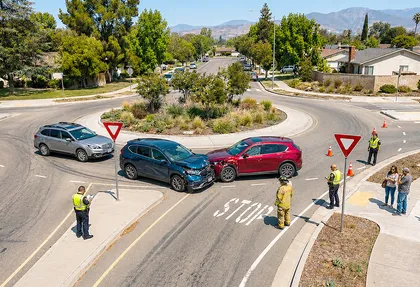
In most roundabout crashes, fault comes down to one question: which driver broke the right-of-way rules? A driver’s behavior behind the wheel determines legal responsibility. California follows a pure comparative negligence rule. This means fault can be shared, and your percentage of fault reduces any compensation you may recover.
Fault most often falls on a driver who commits one of these errors:
- Failure to Yield: Not giving way to vehicles already circling inside. California Vehicle Code (CVC) § 21803 states that a driver approaching a yield sign must yield to vehicles in the intersection or close enough to cause an immediate hazard.
- Improper Lane Change: Switching lanes in the circle without checking for other drivers. Under CVC § 22107, a driver must ensure a lane change is safe and signal if it affects another vehicle.
- Cutting Across Traffic: Turning left against traffic or leaving from the wrong lane is not allowed. CVC §§ 22107 and 21461 ban unsafe lane changes and require compliance with traffic signs, signals, and pavement markings.
- Speeding: Going too fast to navigate the curve safely. CVC § 22350 requires drivers to use a reasonable and safe speed based on traffic, visibility, weather, and road conditions.
Other contributing factors may include human errors, which remain among the leading causes of intersection accidents. Common examples include distracted driving and following too closely. Although modern roundabouts are designed to improve traffic flow and reduce severe crashes, these driver behaviors can still increase the risk of collisions.
To prove fault, useful evidence may include:
- Photographs of vehicle positions and damage.
- Dashcam or surveillance footage.
- Witness contact information.
- The police report.
- Traffic signs and pavement markings.
- Records of when and where medical care was received.
Drivers should also take photos of the roundabout entrances, lane arrows, yield signs, crosswalks, and any blocked views.
Proving liability in a roundabout crash takes real investigation. Intersection accident attorneys can gather evidence and identify potentially liable parties. If you are thinking, “I need a personal injury lawyer,” acting quickly matters because key evidence can be lost permanently before a case is ever filed.
Road Design And Issues That May Contribute To Roundabout Crashes
While many roundabout crashes are linked to driver behavior, the design, layout, or condition of the roadway can also play a role. Certain infrastructure-related issues may reduce safety or make navigating the roundabout more challenging.
Possible issues are:
- Missing signs
- Confusing lane markings
- Broken traffic devices
- Obstructed visibility
- Poor lighting
- Dangerous designs
When a California city, county, or state agency owns or controls the road, it may share responsibility only if the condition created a substantial risk of injury and contributed to the crash. The injured person must also generally show that the public entity created the condition or knew, or should have known, about it in time to address it. California Government Code §§ 830 and 835 govern these dangerous-condition claims.
How Long Do You Have To File A Roundabout Accident Lawsuit?
In California, you usually have two years to file personal injury lawsuits against private drivers or businesses. This deadline starts from the date of your injury. If a city, county, state agency, or public entity caused the dangerous roundabout, a shorter deadline might apply.
A claim involving personal injury or property damage generally must be presented to the public entity within six months. Filing this government claim is usually required before filing a lawsuit.
Other deadlines might apply. These include:
- The deadline to sue after a government claim is rejected.
- Deadlines for property damage or uninsured motorist claims.
- Special rules for minors or those unable to act.
Steps To Take After A Roundabout Accident
After a roundabout accident, focus on your health first. Document what happened and keep any information that may help show who is at fault. Roundabout crashes often lead to arguments about right-of-way or lane use. So, what you do afterward is very important.
- If possible, move your vehicle out of the roundabout and away from moving traffic. Turn on your hazard lights and remain near the scene.
- Check yourself, your passengers, and others involved. Call 911 if anyone is injured, if traffic is blocked, or if the scene is still dangerous.
- Collect each driver’s name, contact information, driver’s license number, license plate number, and insurance details.
- Document the vehicle damage, final vehicle positions, lane markings, yield signs, entrances, exits, crosswalks, debris, and surrounding conditions.
- Ask anyone who saw the accident for their name and contact information. Witnesses may help explain which driver entered first, changed lanes, or failed to yield.
- Check for dashcams, traffic cameras, nearby businesses, homes, or vehicles that may have recorded the crash. Request that the footage be preserved as soon as possible.
- Do not apologize, speculate, or say that you caused the accident. Provide the facts, but allow the evidence to determine responsibility.
- Get evaluated if you feel pain, dizziness, stiffness, numbness, or any other symptoms. Some injuries may not become noticeable immediately.
- Notify your insurance company and provide accurate information. Avoid guessing about the fault or the extent of your injuries.
- Save photographs, videos, medical records, repair estimates, towing bills, receipts, insurance communications, and proof of missed work.
In California, you must also file an SR-1 report with the Department of Motor Vehicles (DMV) within 10 days if:
- Anyone was injured or killed.
- Property damage exceeded $1,000.
This report is required even when another driver caused the crash and does not replace a police report. To protect your health and keep evidence safe, consider these steps. The evidence you gather can help resolve disputes about yielding, lane changes, and improper exits.
Frequently Asked Questions About Intersection Accidents
The answers below offer basic details about intersection accidents, safety tips, and legal matters.
What Type Of Intersection Has More Severe Accidents?
Rural intersections without traffic signals can lead to serious crashes, especially at high speeds. The FHWA reports that over 80% of rural intersection fatalities happen at unsignalized intersections. These spots often feature high-speed approaches, raising crash severity. Right-angle collisions are particularly dangerous. One vehicle can hit another from the side if a driver doesn’t stop or yield.
What Driving Maneuver Causes Intersection Crashes?
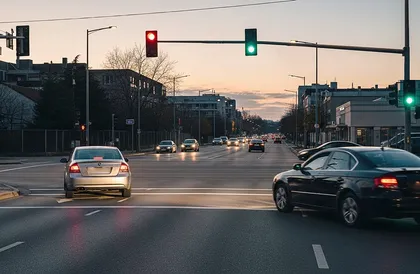
Left turns are among the most hazardous intersection movements. Left turns require drivers to cross opposing traffic. That requires judging the speed and gap of approaching vehicles, and getting it wrong often leads to a serious crash. CVC § 21801 requires drivers making a left turn to yield to oncoming vehicles that are close enough to make the turn unsafe. They should wait until it is safe to turn.
Are Roundabouts And Traffic Circles The Same?
Not every circular intersection is a modern roundabout. Modern roundabouts have curved approaches. They allow lower entry speeds and use yield-at-entry controls. Traffic flows counterclockwise around a central island. Older traffic circles and rotaries may be larger, allow faster entry speeds, or use different right-of-way rules. These design differences can affect both safety and how drivers are expected to enter and exit.
Do Pedestrians Have The Right-Of-Way At A Roundabout?
Yes. Pedestrians in a marked crosswalk have the right-of-way (the legal right to go before vehicles) at a roundabout. Drivers must yield to them before entering or leaving the circle.
What Should You Do If You Miss Your Exit In A Roundabout?
Keep going around until your exit appears. Do not stop or reverse inside a roundabout. Both actions are dangerous and can cause crashes with other drivers who do not expect them.
Are Single-Lane Roundabouts Safer Than Multilane Roundabouts?
Single-lane roundabouts are easier for drivers. Every vehicle uses one lane. Multilane roundabouts handle more traffic but add risks. These include lane selection, merging, and sideswipes. Drivers must pick the right lane before entering. They should follow the pavement arrows and signs and not change lanes at the last moment.
Can You Sue A City For A Poorly Designed Intersection?
You may be able to file a claim if a dangerous intersection design contributed to your crash. You must still prove the legal requirements for holding the city responsible. In California, a government claim involving personal injury generally must be presented within six months. Missing that deadline may affect your right to seek compensation.
Get Help From Arash Law After An Intersection Accident In California
A roundabout accident may involve disputed right-of-way, unsafe lane changes, several drivers, or a dangerous road condition. An intersection accident attorney can look at the evidence, find who might be at fault, and explain the deadlines you need to know.
Our case results reflect the compensation we have recovered for injured clients in a variety of collision claims. Every case is unique. Past results don’t guarantee the same outcome. Still, these examples highlight the types of cases our attorneys have managed.
- $17,900,000 Auto Injury: Our attorneys secured a unanimous verdict for two clients despite LA County’s attempt to shift blame. One suffered a fractured tibia and permanent mild brain injury. The other needed therapy for a knee sprain. The jury decided the case in 90 minutes.
- $12,000,000 Auto Vs. Pedestrian: A vehicle struck our 74-year-old client while crossing the street. The injuries required extensive treatment and a long recovery. The case resolved as jury selection was about to begin.
- $6,000,000 Car Accident: An impaired driver crossed double yellow lines and caused a head-on crash, which took the life of our client’s wife. Despite disputes over liability and coverage, we recovered the full available policy limits.
Arash Law, also known as AK Law, offers free initial consultations. Call (888) 488-1391 to discuss your situation. Our injury law firm handles cases on a contingency fee basis. This means you only pay attorney’s fees if we win compensation for you.