Table of Contents

After a motorcycle accident in San Francisco, your priority is to get medical care, then document the scene and report the crash. The steps you take in the first hours matter. They affect not just your health but also the evidence specific to San Francisco’s roads, which can disappear quickly.
San Francisco’s streets present motorcycle crash factors specific to this city’s geography and infrastructure. Cable car tracks running through busy intersections, steep grades that compress stopping distances, and San Francisco Municipal Transportation Agency (SFMTA)-operated traffic cameras on major corridors all shape both how crashes happen here and what evidence exists to prove fault. According to the SFMTA’s 2017–2022 San Francisco Traffic Crashes Report, certain corridors are documented as having elevated injury-collision rates, including corridors where motorcycle riders appear in the vulnerable-road-user data.
What makes a San Francisco motorcycle injury claim especially complex is the mix of potential parties that may share responsibility. The driver who hit you, the City and County of San Francisco, a construction contractor, or a private property owner could each be involved. Each may trigger a different deadline, a different filing requirement, and a different agency procedure. Getting those details right from the start is what separates a protected claim from one that expires before it ever gets filed.
Contact Arash Law at (415) 969-7799 for a free consultation about your San Francisco motorcycle accident claim.
Five Things San Francisco Motorcyclists Need To Know After A Crash
Every motorcycle crash has its own facts, but five decision points come up in nearly every San Francisco case. Understanding them now can protect your claim before a misstep costs you.
-
Your case will be filed at the Civic Center Courthouse. Personal injury lawsuits arising from San Francisco motorcycle crashes are filed in the San Francisco Superior Court’s civil division at the Civic Center Courthouse. Knowing your venue matters when evaluating which attorneys regularly practice there and how local court procedures work.
Why It Matters: An attorney unfamiliar with San Francisco Superior Court procedures may cost you time and strategic position early in the case.
-
San Francisco’s motorcycle fatality data shows a serious local trend. Motorcycle fatal crashes in San Francisco increased 214% from the 2017–2019 period to the 2020–2022 period, and motorcyclists comprised 23% of all San Francisco fatal crashes during 2020–2022, according to the SFMTA 2017–2022 Traffic Crashes Report. These figures cover the pandemic comparison period, not a single year.
Why It Matters: This trend demonstrates the severity of motorcycle crashes here and underscores why severe crash injuries require experienced legal representation.
- Cable car tracks, steep grades, and SFMTA intersections create SF-specific hazards. Cable car tracks embedded in city streets, steep grades, and SFMTA-documented high-crash corridors create motorcycle hazards unique to San Francisco. The cause of your crash may point to a road defect or agency failure, not just another driver, which changes who you sue and what deadline applies.
-
Choose a firm that understands San Francisco’s public-entity rules. If the City and County of San Francisco, or any other public entity, contributed to your crash, strict pre-lawsuit government-claim deadlines apply, significantly shorter than the standard timeline for private-party cases. Missing the government-claim deadline generally bars a lawsuit against that public entity. Limited statutory exceptions exist, but they are narrow and require a separate petition.
Why It Matters: See the Important Deadlines section for the exact timeframes and requirements.
- Multiple deadlines apply to your San Francisco motorcycle claim. Multiple deadlines run simultaneously after a San Francisco motorcycle crash. California law requires you to file DMV Form SR-1 within 10 days of a qualifying crash—injury, death, or significant property damage. Each deadline is independent, and the consequences differ: missing the SR-1 window can affect your driving privileges, while missing the lawsuit deadline can bar your right to compensation.
Immediate Steps To Take After A San Francisco Motorcycle Accident
The first few minutes after a motorcycle accident can affect both your health and your ability to pursue a personal injury claim. Prioritize your safety, seek medical care, report the crash, and preserve as much evidence as possible. Taking these steps early can help protect your well-being and support any future insurance claim or lawsuit.
Step 1: Stop And Move To A Safe Place
California law requires every driver involved in a collision to stop immediately. If you can move safely without worsening your injuries, get out of the path of traffic. Move to a sidewalk, the shoulder of the road, a median, or another protected area.
Do not move anyone who may have a neck or spinal injury unless they face immediate danger (an approaching vehicle or fire, for example). Leave your motorcycle in place if moving it is unsafe. Responding SFPD officers or California Highway Patrol (CHP) personnel will tell you when it can be moved.
Step 2: Call 911
Call 911 immediately if the crash caused injuries, blocked traffic, or involved a driver who fled the scene. Ask for both law enforcement and medical assistance. SFPD handles most crashes within city limits, including on state-designated routes that run along city streets, such as Van Ness Avenue and 19th Avenue; CHP’s role is generally limited to freeway segments running through San Francisco, such as US-101 and I-280.
Before you leave the scene, write down the responding officer’s name, badge number, and report or incident number. California Vehicle Code § 20008 generally requires the driver to make a written report of an injury or fatality crash within 24 hours to the California Highway Patrol or, if the crash occurred within a city, to CHP or the city police department. Confirm the applicable requirements with your attorney or the responding agency. For non-emergency situations, contact SFPD through their official website at sanfranciscopolice.org.
Step 3: Check For Injuries And Accept Medical Care
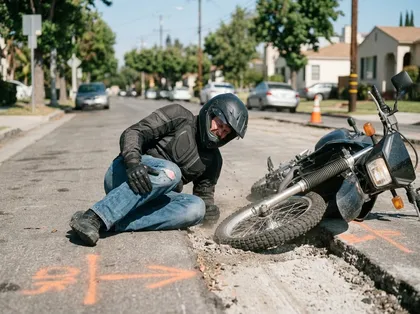
Motorcycle accidents cause serious injuries even at low speeds, and adrenaline frequently masks pain in the immediate aftermath. Get medical attention immediately if you notice any of the following:
- Loss of consciousness or confusion.
- Memory problems or disorientation.
- Headache or dizziness.
- Neck, back, or shoulder pain.
- Numbness or weakness in any limb.
- Abdominal or chest pain.
- Difficulty breathing.
- Heavy bleeding.
- Difficulty walking or moving.
Unless your helmet interferes with breathing or emergency responders instruct otherwise, leave it in place after a serious impact. Removing it improperly can worsen a neck injury.
If emergency responders recommend ambulance transport, accept it. Zuckerberg San Francisco General Hospital and Trauma Center is one of San Francisco’s major emergency and trauma facilities, providing emergency, inpatient, diagnostic, and behavioral health services for adults and children. Even if you do not need emergency transport, see a doctor the same day. Tell your provider exactly when and how the crash happened, and describe every symptom, including ones that seem minor. Medical records that document the timing and mechanism of your injuries are among the most important pieces of evidence in a motorcycle injury claim.
Step 4: Exchange Information
Get the following information from every driver involved in the crash:
- Full name and current address.
- Phone number.
- Driver’s license number.
- Vehicle registration information and license plate number.
- Insurance company name and policy number.
- Name of the vehicle’s registered owner.
California DMV guidance requires drivers to exchange their license, registration, insurance information, and address after a collision. Do not rely on a photograph of the insurance card alone. Confirm that the card matches the vehicle and the driver who was actually involved.
Step 5: Document The Scene
Gather evidence only when it is safe to do so. Do not position yourself in moving traffic. Take wide-angle and close-up photographs or videos showing:
- The motorcycle and all other vehicles involved.
- Visible damage to all vehicles.
- Vehicle positions relative to lane markings.
- License plates.
- Skid marks and debris.
- Traffic signals, signs, and lane markings.
- Construction zones or barriers.
- Potholes, broken pavement, or uneven surfaces.
- Cable car or Muni streetcar tracks.
- Steep grades or limited sightlines.
- Weather and lighting conditions.
- Visible injuries.
- Damage to your helmet and riding gear.
Also, scan the surrounding area for cameras. SFMTA operates traffic cameras at many intersections throughout the city. Nearby businesses, Muni vehicles, rideshare vehicles, and private buildings may have surveillance systems that captured the crash. SFMTA camera footage may be overwritten quickly. Retention periods vary by system and have not been confirmed directly with the agency, so send a preservation demand as soon as possible after the crash. Confirm the agency’s current retention policy before relying on a specific window. Write down the addresses or descriptions of every camera location you can identify so a demand can go out before the footage is gone.
Step 6: Get Witness Information
Witnesses can leave before police arrive, especially in busy areas of San Francisco, where pedestrians, cyclists, transit riders, delivery workers, and other drivers are constantly moving through. Ask anyone who saw the crash for:
- Name.
- Phone number.
- Email address.
- A brief, in-their-own-words description of what they saw.
Independent witness accounts matter most when drivers dispute speed, lane position, traffic signal status, or who made an unsafe move. Collect contact information without pressuring anyone or suggesting what they should say.
Step 7: Do Not Admit Fault Or Guess At What Happened
Stay calm and give the police accurate, factual information. Do not speculate about what happened or what you may have done wrong. Avoid statements like:
- “It was my fault.”
- “I didn’t see the car.”
- “I was probably going too fast.”
- “I’m fine.”
- “The bike looks okay.”
You may not yet know all the contributing causes. Another driver may have violated a traffic law. A road defect, such as a pothole on a city-managed street, an improperly maintained cable car track crossing, or a poorly marked construction zone, may have played a role. An insurer may present an apology or an offhand comment as an admission of fault. Focus on exchanging information and reporting only what you directly observed.
Step 8: Preserve Your Motorcycle, Helmet, And Riding Gear
Physical evidence from the crash can be irreplaceable. Before any repairs, cleaning, or disposal, preserve and photograph:
- Your motorcycle.
- Your helmet.
- Your jacket, gloves, boots, and pants.
- Damaged accessories.
- Camera or phone footage from the ride.
- GPS data or any onboard motorcycle data.
Damage patterns on your helmet and clothing can show where your body struck the vehicle or road and at what angle. If a tow truck removes your motorcycle from the crash scene, ask the driver where it will be stored, keep the towing and storage receipts, and photograph the bike before allowing any inspection or repair.
Keep in mind that some deadlines begin running from the date of the crash itself, regardless of when you hire an attorney.
What To Do In The Days After Your Crash
The days following a San Francisco motorcycle accident are when claims get protected or quietly undermined. Medical choices, insurance communications, and record-keeping decisions made in this window often determine what you can recover.
Step 1: Follow Your Medical Treatment Plan
Attend every follow-up appointment and tell your provider about new symptoms or any changes in your condition. Whether you received initial care at Zuckerberg San Francisco General Hospital and Trauma Center, another San Francisco hospital, or an urgent care clinic, keep copies of:
- Emergency room records and admission notes.
- Doctor’s notes and progress records.
- Test results and imaging reports.
- Prescriptions and medication records.
- Physical therapy records.
- Medical bills and explanation-of-benefits statements.
- Transportation receipts to and from appointments.
Do not stop treatment because an insurance adjuster asks whether you are feeling better. Make medical decisions with your providers, not with insurance company timelines. Unexplained gaps in treatment give insurers an opening to argue your injuries were minor or unrelated to the crash.
Step 2: File Your California DMV SR-1 Form
You, your insurance representative, or your attorney must file a Report of Traffic Accident Occurring in California (Form SR-1) within 10 days of the crash when:
- Anyone was injured, regardless of severity.
- Anyone was killed.
- Property damage to any one person’s property exceeded $1,000.
A damaged motorcycle almost always exceeds the $1,000 threshold. The SR-1 is required regardless of who caused the crash, and it applies to qualifying motorcycle accidents throughout California. Filing a police report and notifying your insurer does not satisfy this obligation. You must file the SR-1 separately. Failure to file when required can lead to suspension of your driving privileges.
Step 3: Notify Your Insurance Company
Report the collision to your insurer within the timeframe your policy requires. Provide the basic facts: date and time, vehicles involved, police report number, the other driver’s information, and the San Francisco street or intersection where the crash occurred. Do not speculate about fault, speed, or the full extent of your injuries.
Review your policy for coverage that may apply, including:
- Collision coverage.
- Medical payments coverage.
- Uninsured motorist coverage.
- Underinsured motorist coverage.
- Towing and rental reimbursement.
- Coverage for custom motorcycle equipment.
If the crash involved a hit-and-run driver or an uninsured motorist, special policy requirements may apply. Report the incident to SFPD promptly and review your policy’s notice requirements before making any coverage request.
Step 4: Be Careful When Speaking With The Other Driver’s Insurer
The at-fault driver’s insurance company may contact you within days of the crash. The adjuster may ask for a recorded statement or broad authorization to access your medical records. You are generally not required to assist the opposing insurer in building its case. Get legal advice before:
- Giving a recorded statement.
- Signing a medical records authorization.
- Accepting any settlement offer.
- Signing a release of claims.
- Consenting to a vehicle inspection.
- Discussing your prognosis or future medical needs.
A quick settlement offer rarely reflects your full damages, including future medical care, lost income, or permanent limitations. Once you sign a full release, you cannot request additional compensation, even if new injuries or complications emerge later.
Step 5: Stay Off Social Media
Do not post photographs, videos, location check-ins, or updates about the crash or your recovery. Insurers and defense attorneys routinely review public social media content. A photo from a social event, a comment about feeling better, or any image showing physical activity can be taken out of context and used to minimize your claim. Ask friends and family not to tag you in any posts about the accident or your health.
Step 6: Build A Complete Accident File
Create both a physical folder and a digital backup for everything related to the crash. Keeping records organized makes the claims and litigation process far less stressful. Include:
- Police report information and the SFPD or CHP report number.
- All photographs and videos of the scene, injuries, and vehicle damage.
- Witness names and contact details.
- Medical records, bills, and prescription receipts.
- Repair estimates and invoices.
- Towing and storage receipts.
- Insurance correspondence and claim documents.
- Pay stubs and documentation of missed work.
- Notes from every phone call with insurers, providers, or anyone involved in the claim.
- A written account of the crash, completed while your memory is fresh.
In your written account, include the specific San Francisco street or intersection, the direction you were traveling, traffic conditions, lane positions, signal status, and everything you observed before the impact. Note any steep grade, cable car track crossing, pothole, construction zone, or other road condition that may have contributed. Also, keep a daily log of pain, sleep problems, physical limitations, missed activities, and how your injuries affect your daily routine. This record supports a future damages calculation.
Step 7: Consult A San Francisco Motorcycle Accident Attorney
Consulting a San Francisco motorcycle accident attorney can help you understand what steps to take next, including investigation, preservation demands, and communications with insurance companies. An attorney can identify all parties that may share responsibility, so you are not navigating that alone.
Depending on the facts of your case, an attorney can:
- Obtain the SFPD or CHP crash report and request SFMTA camera footage before it is overwritten.
- Send preservation demands to SFMTA, private businesses, and any other party that may hold footage or records.
- Identify whether a road defect, traffic signal failure, or government agency contributed to the crash.
- Work with accident reconstruction and medical experts when needed.
- Calculate the full value of your current and future damages, including lost income and permanent limitations.
- Negotiate with insurance companies for a fair settlement.
- File a lawsuit in the San Francisco Superior Court if the settlement fails or critical deadlines approach.
You may be facing medical bills, lost wages, and unanswered questions about who is responsible. Arash Law offers free consultations for victims of motorcycle accidents in San Francisco. Call at (415) 969-7799 to speak with our team today.
How California Motorcycle Laws Affect A San Francisco Claim
California’s traffic laws establish a baseline for fault analysis in every motorcycle crash. A traffic violation does not automatically decide who caused the accident or what you can recover. The facts of your specific crash, the road conditions in San Francisco, and the comparative fault rules that California courts apply all shape the outcome.
Helmet Law
California Vehicle Code section 27803 requires every motorcycle rider and passenger to wear an approved safety helmet. Not wearing a helmet does not mean the rider caused the crash. However, if the opposing party argues that your head or facial injuries would have been less severe with a helmet, a court may reduce your compensation for those specific injuries. The crash itself may still be entirely the other driver’s fault.
Lane Splitting
California Vehicle Code section 21658.1 defines lane splitting as riding a motorcycle between rows of vehicles moving in the same direction on a roadway. Lane splitting is legal in California, but it does not protect you from a finding of comparative fault. A court or insurer may examine your speed relative to surrounding traffic, whether the lane split was reasonable under the conditions, and whether another driver made an unsafe move, such as an abrupt lane change, that caused the collision. Both parties may share fault.
San Francisco-Specific Traffic Conditions
San Francisco’s traffic infrastructure includes conditions that directly shape motorcycle crash risk and fault analysis. Cable car tracks embedded in city streets can catch a motorcycle wheel and cause a fall even when no other vehicle is involved, a road-condition claim that may point to the City and County of San Francisco rather than another driver. Steep grades on streets like Divisadero affect stopping distances in ways that are specific to this geography. Construction zones along major SFMTA corridors can shift lane markings and create irregular pavement with limited advance notice.
Pure Comparative Fault Under California Law
The California Supreme Court adopted the pure comparative negligence rule in Li v. Yellow Cab Co. of California, 13 Cal. 3d 804 (1975). Under this rule, more than one party may share responsibility for the same crash. Your percentage of fault reduces your compensation, but you can still recover even if you are found partially responsible. Insurers often raise lane-splitting conduct or helmet use early in the claims process to assign comparative fault and reduce a payout. San Francisco car accident lawyers at our firm, who also represent motorcycle crash victims, can challenge unsupported allegations of fault with evidence from the scene, witness accounts, and expert analysis.
Important Deadlines For San Francisco Motorcycle Accident Claims
Missing a deadline in a motorcycle accident case can eliminate your right to seek compensation, not just delay it. In San Francisco, multiple deadlines can run simultaneously in motorcycle accident claims, depending on who caused the crash.
If the City, County of San Francisco, or another public entity contributed to the crash through a road defect, a faulty traffic signal, or negligent maintenance of cable car tracks, you must file a government claim with the appropriate agency before you can file a lawsuit. Public-entity claims carry substantially shorter pre-lawsuit deadlines than private-party cases, and both can run simultaneously. See the table below for each key deadline and the governing legal authority.
The table below shows the key deadlines for motorcycle accident claims in California. Legal citations are grouped in the note below the table.
| Type of Matter | General Deadline | Notes |
|---|---|---|
| DMV Form SR-1 (accident report) | 10 days after a qualifying collision | Required if there was injury, death, or property damage of $1,000 or more to any one person |
| Injury or fatality report to law enforcement | Within 24 hours after the crash | California Vehicle Code § 20008 requires the driver to make or cause to be made a written report to the CHP or, for a crash within a city, to either the CHP or the city police department. |
| Personal injury lawsuit against a private party | Two years from the date of injury | Standard California personal injury deadline |
| Government claim against the City or County of San Francisco | Six months from the date of injury | Must be filed before any lawsuit against a public entity can proceed |
| Lawsuit after the government entity rejects the claim in writing | Six months from the date the rejection notice was mailed | Runs from the mailing date, not the date you receive it |
| Lawsuit if the government entity does not respond | Generally, you have up to two years from the date of the injury (Gov. Code § 945.6(a)(2)); confirm with an attorney for your specific facts. | If the entity does not respond within 45 days, the claim is deemed rejected by operation of law. The two-year window under § 945.6(a)(2) may apply, but tolling rules and claim-specific facts can affect this deadline; consult an attorney promptly. |
Legal Basis: California Vehicle Code section 16000 for the SR-1 reporting requirement; California Vehicle Code section 20008 for law enforcement reporting; California Code of Civil Procedure section 335.1 for the personal injury statute of limitations; California Government Code section 911.2 for the six-month government-claim deadline; California Government Code section 945.6(a)(1) for the six-month window after written rejection; and California Government Code section 945.6(a)(2) for the extended window when no response is received.
Minors injured in motorcycle crashes may be subject to different tolling rules that extend certain deadlines. An attorney can identify which deadlines apply to your specific claim.
Personal injury attorneys serving San Francisco at our firm can identify which deadlines apply to your case, including any government-claim requirements that shorten the standard window.
What Arash Law Has Recovered For Injury Clients
Results in personal injury cases depend on the facts, the severity of your injuries, and the parties involved. The recoveries below are representative of results our firm has achieved and are not guarantees of what your case will produce.
Our results reflect the kinds of disputes that arise in serious injury cases: fault contested by police reports, road-defect denials by government agencies, and insurer disputes over the value of long-term injuries.
| Recovery | How Arash Law Helped |
|---|---|
| $5,000,000 | The police report placed our severely injured client at fault. He also faced allegations of speeding and driving under the influence, along with Proposition 213 issues, because he lacked motorcycle insurance. Our team showed that the truck driver violated his training and company policies and made a dangerous turn that contributed to the crash. |
| $1,550,000 | Our team secured a settlement for a motorcycle rider who suffered spinal and wrist injuries in a rideshare accident. |
| $1,450,000 | Our client suffered fractured ribs and head trauma after hitting uneven pavement during construction. The contractors and city denied liability. Our team pursued the case through the first day of trial, when it settled. |
Past results do not guarantee future outcomes. Each case depends on its unique facts and circumstances, and different facts may lead to different results. These are representative results from Arash Law’s California practice and were not all obtained in San Francisco.
How To Evaluate A San Francisco Motorcycle Accident Lawyer
Choosing a lawyer after a motorcycle crash is a practical decision, not just a professional one. San Francisco motorcycle cases can involve contested lane-splitting facts, road-defect claims against the city, and insurance layers that include rideshare, commercial vehicle, and uninsured motorist coverage. The right attorney handles all of those tracks simultaneously.
Watch for these green-flag behaviors when evaluating attorneys:
- Transparent about government-claim requirements. An attorney who does not immediately ask whether a public entity may have contributed to your crash is missing a potentially critical issue from day one.
- Specifically about evidence preservation in San Francisco. SFMTA camera footage and private surveillance video can be overwritten quickly. Retention periods vary by system and have not been confirmed directly with the agency. A firm that moves quickly on preservation demands protects evidence that a slower firm fails to preserve.
- Willing to explain the comparative fault risk. If your lane-splitting conduct or helmet use might affect your recovery, your attorney should tell you that directly, not minimize it.
- Clear on the fee structure. Our firm handles motorcycle accident cases on a contingency fee basis, consistent with the requirement under California Business and Professions Code § 6147 that contingency fee agreements be in writing. You will know the terms before any work begins.
Avoid firms that promise a specific outcome or settlement amount before reviewing the facts of your case. Outcomes depend on evidence, insurance coverage, and the specific defendants involved, none of which a responsible attorney can predict at an initial consultation.
How To Verify An Attorney’s Track Record
Before hiring any San Francisco motorcycle accident attorney, take a few concrete verification steps:
- Check State Bar licensing. Confirm that the attorney is licensed and in good standing at the California State Bar website (calbar.ca.gov). You can search by name or bar number.
- Request county court records. Cases filed in San Francisco Superior Court are a matter of public record. Ask whether the firm has litigated motorcycle accident cases there, and whether any went to trial.
- Ask SF-specific questions. Ask how many government-claim cases the firm has filed against the City or County of San Francisco. Ask whether the firm has handled lane-splitting disputes and how those were resolved. Ask whether the firm has worked with accident reconstruction experts on crashes involving cable car tracks or steep-grade intersections.
- Verify the contingency agreement. California law requires the fee agreement to be in writing. If an attorney wants you to commit without a written agreement, that is a red flag, regardless of how the conversation goes.
Our reviewing attorney is licensed with the California State Bar and can be confirmed at calbar.ca.gov under bar number #249405.
Common San Francisco Motorcycle Accident Scenarios
San Francisco’s geography, traffic patterns, and road infrastructure shape the motorcycle accident scenarios that arise most often here. Each scenario below reflects the city’s specific conditions and the legal issues they trigger.
Left-Turn Collision At A Signalized Market Street Intersection
Market Street runs through the heart of San Francisco and is among the corridors documented in the SFMTA 2017–2022 Traffic Crashes Report for injury-collision concentration. A driver turning left across oncoming traffic may fail to yield to a motorcyclist traveling straight through, a common collision type at signalized intersections citywide. Fault often depends on who had the green light, the relative speeds of the vehicles, and whether the turning driver stopped at the limit line before proceeding.
Questions to ask your attorney:
- Was there a traffic camera at this intersection?
- Does SFMTA’s footage show the signal state at the moment of impact?
Cable Car Track Crossing Fall With No Other Vehicle Involved
Muni’s embedded rail tracks cross multiple streets throughout the city, and a motorcycle tire can drop into the track groove at an angle, causing a sudden loss of control. If no other vehicle was directly involved, the claim may run against the City or County of San Francisco for negligent track maintenance or inadequate warning signage. The six-month government-claim deadline applies before any lawsuit can be filed.
Questions to ask your attorney:
- Was the track surface recently inspected?
- Has the responsible agency received prior complaints about this crossing?
Van Ness Avenue Or Hayes Street Intersection Crash
Van Ness Avenue and Hayes Street are among the intersections with elevated motorcycle-involved injury crash counts documented in the SFMTA 2017–2022 Traffic Crashes Report, with seven motorcycle injury crashes recorded at that intersection according to the report’s vulnerable-modes data. These are wide, heavily traveled corridors where lane changes, bus activity, and signal timing create frequent conflict points for motorcyclists.
Questions to ask your attorney:
- Did a commercial vehicle, Muni bus, or ride-share driver cause the collision?
- Were there multiple contributing parties?
Fell Street / Oak Street / JFK Drive Corridor Crash
The JFK Drive and Fell/Oak/Stanyan corridor recorded eight motorcycle-involved injury crashes in the SFMTA 2017–2022 Traffic Crashes Report, one of the city’s elevated-risk zones for motorcyclists. Cyclists, pedestrians, and vehicles merge through this area, and construction near the Panhandle creates shifting lane configurations.
Questions to ask your attorney:
- Did a vehicle encroaching cause the crash into a cyclist lane that also served motorcycle travel?
- Is there a construction company or city contractor that may share liability?
Rideshare Vehicle Collision In A Busy San Francisco Corridor
Rideshare pickups and drop-offs are common throughout busy San Francisco commercial and transit corridors, where double-parking, sudden door openings, and abrupt pull-outs create hazards for motorcyclists. A rideshare-related crash may involve the driver’s personal insurer, the rideshare company’s commercial coverage, or both, depending on whether the app was active and whether the driver was carrying a passenger.
Questions to ask your attorney:
- Was the app active at the time of the crash?
- Which insurance layer applies?
Dooring On A Narrow SF Street
San Francisco’s narrow residential streets create dooring risk when parked-car occupants open their doors into the path of a passing motorcycle. California law prohibits opening a vehicle door in a way that interferes with moving traffic, but liability may be contested if the motorcyclist was lane splitting at the time. The pure comparative fault rule means both parties may share responsibility, and the allocation depends heavily on speed, lane position, and witness accounts.
Questions to ask your attorney:
- Were there any witnesses who could describe the motorcycle’s speed and lane position before the door opened?
Pothole Or Road-Defect Crash On A City-Managed Street
San Francisco’s road maintenance obligations extend to motorcyclists who sustain injuries caused by known road defects. A pothole, a failed patch on a repaved street, or a displaced maintenance hole cover can cause a rider to lose control without any other vehicle involvement. A claim against the city requires a government tort claim filed with the Controller’s Office Claims Division within six months of the crash. Photographs of the defect taken immediately after the crash are critical, as road crews may repair the condition quickly.
Questions to ask your attorney:
- Is there a prior complaint or maintenance record for this road segment that shows the city had notice?
Evidence That Supports A San Francisco Motorcycle Accident Claim
Strong claims depend on evidence gathered quickly. San Francisco’s infrastructure creates specific evidence sources that are time-sensitive and worth knowing before you need them.
| Evidence Type | Why It Matters | Retention or Action | Who Controls It |
|---|---|---|---|
| SFPD or CHP crash report | Establishes the official account of the crash, parties involved, and any citations issued. | Request your SFPD crash report through the SFPD online portal as soon as it is available. | San Francisco Police Department |
| Some SFMTA traffic camera footage | It may show signal status, vehicle positions, and the sequence of events at the moment of impact. | Send a written preservation demand to SFMTA immediately; footage may be overwritten quickly on some systems. Confirm the current SFMTA retention policy before relying on a specific window. | SFMTA |
| Private surveillance and dashcam footage | Businesses along the collision corridor and dashcam-equipped vehicles may have captured the crash. | Send preservation demands to building owners and businesses along the route; request dashcam footage from rideshare apps if applicable. | Private owners and rideshare companies |
| Motorcycle, helmet, and riding gear | Damage patterns show the force, the direction of impact, and where the rider’s body struck the vehicle or the road. | Delay all repairs, cleaning, and disposal; photograph before any inspection or handling. | You and your repair shop |
| Scene photographs and video | Capture road conditions, vehicle positions, skid marks, debris, and San Francisco-specific hazards, such as track crossings and grade crossings. | Take photos and videos immediately; back up original files to cloud storage. | You and witnesses |
| Witness statements | Independent accounts of speed, signal status, and driver behavior are often decisive when parties disagree. | Collect contact information at the scene; a follow-up written or recorded statement is best. | Individual witnesses |
| Medical records from treating facilities | Connect the injuries to the crash date and document the full extent of physical harm. | Request copies from every treating facility, including Zuckerberg San Francisco General Hospital and Trauma Center, if applicable. | Treating hospitals and providers |
| DMV SR-1 filing record | Confirms you met the 10-day reporting obligation and preserves your driving privileges. | File within 10 days; retain date-stamped copy. | California DMV |
Filing A Government Claim After A San Francisco Motorcycle Accident
If the city or county of San Francisco, or another public entity, may have contributed to your crash through a road defect, a signal malfunction, or inadequate maintenance of cable car tracks or pavement, you must file a government tort claim before you can file a lawsuit.
The deadline under California Government Code § 911.2 runs from the date of the injury, not from when you first realize the city may be responsible. If you are still treating for your injuries when you figure out that a road defect contributed to the crash, the deadline may already be close. Contact an attorney as soon as you suspect a public entity was involved.
For claims against the City and County of San Francisco, the City currently directs claimants to submit the claim to the Controller’s Office Claims Division. An attorney can help determine the correct entity to which to present the claim and confirm the current filing procedures. Contact the San Francisco City Attorney’s Office directly to confirm the current submission form and address.
After you file:
- If the public entity denies your claim in writing, you have six months from the mailing date of the rejection notice to file a lawsuit.
- If the public entity does not respond within 45 days, it will be deemed to have rejected the claim by operation of law, and different lawsuit-filing windows may apply.
These rules interact with each other and with the two-year private-party statute of limitations. An attorney who handles public-entity claims in San Francisco can map out the exact timeline for your case.
Frequently Asked Questions About San Francisco Motorcycle Accidents
San Francisco motorcycle crashes raise questions that go beyond the basics. The city’s traffic infrastructure, public transit system, and geography all create issues that don’t arise in most other California motorcycle cases. The answers below cover common questions injured riders in San Francisco often have after a crash.
What Should I Do If The Driver Who Hit Me Fled The Scene?
Stay at the scene, call 911, and gather witness contact information immediately. Report the crash to SFPD so they can create an incident report; you will often need this report to access your uninsured motorist coverage. If police cannot identify the driver, your uninsured motorist coverage may pay for your medical expenses and other losses if you meet the policy requirements. San Francisco hit-and-run accident attorneys at our firm can review your coverage, identify available evidence, including SFMTA or private footage, and explain your options for pursuing compensation.
Can I Still Recover Compensation If I Was Not Wearing A Helmet?
Yes. California’s comparative fault rules allow you to recover even if you share some responsibility. Your compensation is reduced by your percentage of fault, but not eliminated. A court may find that not wearing a helmet worsened your head or facial injuries and reduce that portion of your damages accordingly, but the crash itself may still be entirely the other driver’s fault.
Does Lane Splitting Automatically Mean I Am At Fault?
No. Lane splitting is legal in California, and being in a lane split at the time of a crash does not mean you caused it. Fault depends on the full circumstances: your speed relative to surrounding traffic, whether the lane split was reasonable under the conditions, and whether another driver made an unsafe move, such as changing lanes without signaling. Both parties may share fault, and the allocation depends heavily on the evidence.
What If A Pothole Or Faulty Cable Car Track Caused My Crash?
You may have a claim against the City or County of San Francisco, depending on which entity manages the road or the track where the defect occurred. California’s Government Claims Act requires you to file a government tort claim within six months of the injury before any lawsuit can proceed. Photographs of the defect are critical; road crews may repair the condition quickly. An attorney can help you identify the responsible entity, obtain maintenance records, and file the required government claim before the deadline passes.
Should I Give The Other Driver’s Insurer A Recorded Statement?
Get legal advice before agreeing to any recorded statement. The opposing insurer’s adjuster is not your advocate. Their goal is to resolve your claim for as little as possible. Recorded statements can be used to highlight perceived inconsistencies, to establish that your injuries seemed minor in the immediate aftermath, or to shift partial fault onto you. Contact our firm before providing any statement. San Francisco accident lawyers at our firm can advise you on how to protect your claim at that stage.
Get Help From Arash Law After Your San Francisco Motorcycle Accident
San Francisco motorcycle crashes move fast, and so do the deadlines. SFMTA camera retention varies by system, so that footage can disappear quickly. Government-claim windows have strict cutoffs, and insurers move quickly to close claims before you know the full extent of your injuries.
Our attorneys can investigate the crash, send preservation demands before footage is overwritten, identify all parties that may share responsibility, including public entities subject to government-claim rules, and handle all insurance communications while you recover.
Arash Law represents motorcycle injury clients on a contingency fee basis in qualifying cases. Any contingency fee agreement must be in writing under California Business and Professions Code § 6147, and attorney fees are paid only from any recovery obtained under that agreement. If there is no recovery, no attorney fees are owed under the agreement.
Call Arash Law at (415) 969-7799 or our 24-hour line at (888) 488-1391 for a free consultation. Tell us what happened, and we can walk you through your options and whether we can help. Arash Law: MAKE THEM PAY, CALL AK.
About This Page
This guide was prepared by the attorneys and research staff at Arash Law to help motorcycle accident victims in San Francisco understand their rights and the steps that protect a personal injury claim. The information draws on the SFMTA’s 2017–2022 San Francisco Traffic Crashes Report, which documents motorcycle fatality trends and the city’s highest-collision intersections, as well as California court self-help resources and official agency websites, including the San Francisco Police Department, the California DMV, and the San Francisco Superior Court.
The SFMTA 2017–2022 Traffic Crashes Report is cited as the source for San Francisco intersection and motorcycle crash data. The motorcycle fatality trends (214% increase in fatalities, 23% decrease in injuries) and named-intersection injury-crash counts cited in this guide (JFK Drive/Oak/Fell/Stanyan: 8 crashes; Hayes Street and Van Ness Avenue: 7 crashes) are drawn from Part 4, Vulnerable Modes, and Appendix B of the SFMTA report and reflect the 2017–2022 period. These figures should not be read as representative of any single year or of current conditions.
This page was last reviewed by Arash Khorsandi, Esq., in August 2026 and reflects California law as of that date. Laws, agency procedures, and deadlines may change — consult an attorney for advice specific to your situation.
Sources
- SFMTA — 2017–2022 San Francisco Traffic Crashes Report (Ricardo Olea, City Traffic Engineer, May 8, 2023): https://sfmta.com/sites/default/files/reports-and-documents/2023/05/sanfranciscocollisionsreport2017_2022.pdf
- San Francisco Superior Court — Civic Center Courthouse location and address: https://sf.courts.ca.gov/location/civic-center-courthouse
- San Francisco Superior Court — Locations and Contact Information: https://sf.courts.ca.gov/general-information/locations-contact-information
- San Francisco Police Department — Request Copy of Police Incident Report: https://www.sanfranciscopolice.org/get-service/request-copy-police-incident-report
- Zuckerberg San Francisco General Hospital and Trauma Center: https://www.zuckerbergsanfranciscogeneral.org/
- California DMV — Accident Reporting / Form SR-1: https://www.dmv.ca.gov/portal/dmv-virtual-office/accident-reporting/
- California Courts Self-Help — Statute of Limitations (CCP § 335.1): https://selfhelp.courts.ca.gov/civil-lawsuit/statute-limitations
- California Courts Self-Help — Government Claims: https://selfhelp.courts.ca.gov/civil-lawsuit/government-claim
Disclaimer
This page is for general informational purposes only and does not constitute legal advice. Reading this page does not create an attorney-client relationship between you and Arash Law or any of its attorneys. The information on this page is not a substitute for advice from a licensed attorney who has reviewed the specific facts of your situation. Laws change, and the application of the law varies based on individual circumstances. Past results described on this page do not guarantee a similar outcome in your case. If you have been injured in a motorcycle accident, consult a qualified personal injury attorney to understand your rights and options.