TL;DR: A driver who has a green light can still be at fault for hitting a pedestrian in a San Francisco crosswalk. A green signal allows the driver to proceed, but it does not automatically give the driver priority over a pedestrian who is lawfully crossing. Fault depends on the driver’s actions, the pedestrian’s right-of-way, and evidence such as signal timing, video, witness statements, and the police report.
In San Francisco, a driver with a green light can still be responsible for hitting a pedestrian lawfully in a crosswalk. The green signal allows the driver to proceed, but it does not automatically eliminate the driver’s duty to yield or exercise reasonable care around pedestrians.
The driver’s green light is only one part of the fault analysis. California’s pure comparative negligence rule means the driver may argue that the pedestrian also contributed to the crash. The signal phase, pedestrian’s location, turning movement, visibility, and other evidence can help determine each party’s share of responsibility.
If you were struck in a San Francisco crosswalk, call Arash Law at (415) 969-7799 for a free case evaluation. You pay nothing unless we recover on your behalf.
Table of Contents

I Was Crossing on a Green Light When a Driver Hit Me. How Is Fault Determined?
Fault depends on the traffic signals that applied to both the driver and the pedestrian, whether the pedestrian was lawfully within the crosswalk, and whether either person acted negligently. A driver may have a green traffic light and still be responsible for hitting a pedestrian if the driver failed to yield or exercise reasonable care.
Investigators may review the driver’s movement, the pedestrian signal, the pedestrian’s entry into the crosswalk, visibility, witness statements, video, and signal timing. California’s comparative negligence rule also allows fault to be divided if both the driver and pedestrian contributed to the collision.
Five Things to Know When a Driver With a Green Light Hits a Pedestrian
Every San Francisco pedestrian crash involves decisions that affect your claim’s outcome. Here are the five facts that matter most:
- Local court venue matters. If San Francisco is the proper venue, the Civil Division of the Superior Court of California, County of San Francisco, handles personal injury cases.
- High Injury Network data adds context. A documented High Injury Network designation may provide relevant background when roadway conditions or a public entity are part of the claim.
- Turning movements affect fault. Whether the driver turned left or right can shape the liability analysis and determine which evidence should be preserved.
- Video evidence can disappear quickly. Identify and preserve available transit, business, building, or other footage as soon as possible.
- Public-entity claims have shorter deadlines. A claim involving a Muni vehicle, a city vehicle, or a dangerous public property condition may trigger a six-month government-claim deadline.
How Right-of-Way Works When a Driver Has a Green Light
California Vehicle Code § 21950 requires drivers to yield the right-of-way to pedestrians crossing within marked or unmarked crosswalks. A green traffic signal permits the driver to proceed, but it does not automatically resolve the right-of-way question when a pedestrian is lawfully within the crosswalk. Drivers must exercise due care and yield when required before continuing through the intersection.
Vehicle Code § 21451 directly addresses green traffic signals. A driver facing a circular green light may proceed, but must still yield to pedestrians lawfully within the intersection or an adjacent crosswalk.
California also treats unmarked corner crossings as legally valid crosswalks. If you were crossing at a corner without painted lines but in alignment with the sidewalk, you had the same right-of-way as if the crosswalk were marked.
In 2024, San Francisco approved and began implementing a major expansion of “No Turn on Red” restrictions in the downtown core.
A driver’s green signal does not necessarily create an unrestricted right to turn through a crosswalk. A driver making a permitted turn must still watch for pedestrians lawfully using the adjacent crosswalk and yield when required. Traffic-control signs, signal phases, and the driver’s turning movement may all become relevant when determining fault.
Proving you had the right-of-way is the first step in showing that the driver breached their duty of care, meaning the legal obligation to exercise reasonable caution to avoid harming others. When a driver ignores that duty, the breach becomes the foundation of your claim.
What the Data Shows About San Francisco Pedestrian Safety
Turning vehicles can create conflicts with pedestrians at San Francisco intersections because drivers may divide their attention between other traffic and people in the crosswalk. Whether the driver turned left or right, what the pedestrian signal showed, and when the pedestrian entered the crosswalk can all affect the fault analysis.
San Francisco’s 2022 High Injury Network covers about 12% of city street miles and captured approximately 68% of severe and fatal traffic injuries in the 2017–2021data used to develop the network. That designation may provide useful context, particularly if a roadway condition or the City’s responsibility is at issue. A designation alone does not establish that the City is liable.
Liability and Shared Fault in San Francisco Crosswalk Crashes
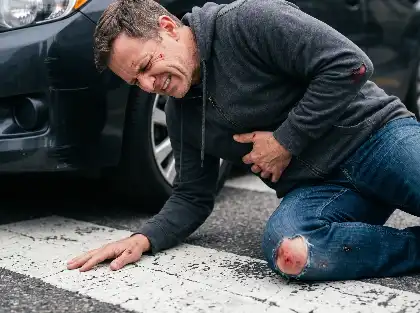
California’s pure comparative negligence rule, established by the California Supreme Court in Li v. Yellow Cab Co., 13 Cal.3d 804 (1975), means your share of fault reduces the amount you can recover but does not eliminate recovery. Even if a driver or their insurer argues you were partly responsible, that argument does not automatically end your claim. A pedestrian who was 20% at fault can still recover 80% of their damages. The insurer’s initial fault assignment is not final.
A driver may also be responsible when another traffic violation contributes to the collision. For example, a driver with a green light who turns across a crosswalk may still be negligent if they fail to yield to a pedestrian lawfully crossing. Investigators may examine the turn, sightlines, signal timing, witness statements, video, and the pedestrian’s location.
After a San Francisco pedestrian crash, an insurer may argue that you share some responsibility. The available evidence helps determine whether that argument is supported and how fault should be allocated.
When a driver had a green light, an insurer may raise one of the following arguments to claim that the pedestrian shares some responsibility:
- Stepped off the curb too close to the vehicle. If you moved into the path of an approaching vehicle so suddenly that the driver had no time to stop, the insurer may argue that the driver could not have avoided the collision.
- Walking while distracted. An insurer may argue that crossing while using your phone or failing to watch for traffic shows you failed to exercise reasonable care for your own safety.
- Entering the crosswalk after the steady signal. Under California Vehicle Code § 21456, a pedestrian may begin crossing during a flashing “Don’t Walk” countdown only if they can complete the crossing before the steady signal appears. If you entered after the steady ‘Don’t Walk’ signal appeared, rather than during the countdown, an insurer may use that to argue you were partly at fault.
None of these arguments automatically ends your claim. Camera footage, signal-phase data, police reports, and witness statements can help determine whether the argument is supported. Pedestrian accident lawyers can help you identify and preserve that evidence so your account is supported by proof, not just your word against the driver’s.
Can I Still File a Claim If the Driver Had a Green Light?
Yes. You may still have a personal injury claim if a driver hit you while the light was green. A green signal does not automatically make the driver free from fault. The analysis depends on whether you were lawfully within the crosswalk, whether the driver was turning, whether the driver yielded when required, and whether either party acted negligently.
Evidence That Matters When a Driver Had a Green Light
Without third-party proof, a crosswalk crash becomes your account against the driver’s. Evidence, not who files a claim or speaks with the insurer first, determines fault. In San Francisco, the city’s own camera and data infrastructure, including SFMTA intersection cameras, signal-phase data, and Muni onboard footage, creates an evidence environment specific to this city. Act quickly to preserve that evidence before it disappears.
The evidence that matters most when a driver had a green light and struck a pedestrian includes:
- SFPD collision report. SFPD officers respond to and document serious pedestrian crashes. The report records vehicle positions, traffic controls in place, witness identities, and any citations issued. Obtain this report directly from the San Francisco Police Department; call 311 to confirm the current records request process.
- SFMTA or other City camera footage. Depending on the intersection and camera system, recorded footage may exist that helps show vehicle movements or the circumstances surrounding the crash. Availability, access, and retention vary, so promptly identify potentially relevant footage.
- Muni onboard camera footage. Muni buses and light rail vehicles carry onboard cameras. If a Muni vehicle was near the crash, its onboard footage may provide independent evidence of how the collision occurred. Promptly sending a preservation demand gives the best chance of securing this footage before retention periods expire.
- Traffic signal phase data. SFMTA’s Traffic Engineering Division controls signal timing at San Francisco intersections. Signal records may help establish whether the driver had a green light and what pedestrian signal was displayed around the time of the crash. Their availability and retention vary, but this information can be important when the parties dispute right-of-way.
- Eyewitness statements. Bystanders, passengers in nearby vehicles, and employees in adjacent businesses may have seen the crash. Their accounts, gathered promptly before memories fade and contact information is lost, can independently corroborate the physical evidence.
- Photographs and video from the scene. Images of the crosswalk markings, the signal heads, the vehicle’s final position, and your injuries capture details that change as the scene is cleared and your injuries heal. Take these, or ask someone to, as soon as possible after the crash.
Preserving and presenting the right evidence can significantly strengthen a pedestrian injury claim. The results below reflect what Arash Law has achieved for clients across California.
What Arash Law Has Recovered for Pedestrian Accident Clients
Arash Law has recovered over $1 billion for clients across California, including pedestrians seriously injured in crosswalk and street crashes. The case results below are representative of the firm’s history of pedestrian accident settlements in California.
$10,000,000 — Pedestrian Accident: The client was seriously injured after being struck and run over by a speeding vehicle. The firm helped secure a substantial recovery while also connecting him with experienced medical providers who supported his treatment and rehabilitation. The resolution gave the client and his family financial relief and a sense of closure after a difficult recovery process.
The case results shown are from Arash Law’s own case history and client reviews. Past results do not guarantee a similar outcome. Every case depends on its unique facts and circumstances. This page is for general informational purposes only and does not constitute legal advice. Reading this page does not create an attorney-client relationship.
If you were injured in a San Francisco pedestrian crash, Arash Law can review the evidence, insurance coverage, and filing deadlines during a free initial consultation. Call (415) 969-7799 or (888) 488-1391.
Insurance, Damages, and Compensation After a San Francisco Pedestrian Crash
A pedestrian injury in San Francisco can bring immediate financial pressure on top of physical pain. Medical bills arrive before you can return to work, and income stops when you need it most. A successful claim may allow you to recover compensation for several categories of loss.
A pedestrian accident claim can cover:
- Medical costs, past and future. Emergency care at San Francisco area hospitals, such as Zuckerberg San Francisco General Hospital, widely recognized as San Francisco’s primary trauma center, or UCSF Medical Center, as well as follow-up treatment, surgery, physical therapy, and any future care your injuries require.
- Lost wages and future lost earnings. If your injuries prevent you from returning to work, whether temporarily or permanently, you may recover the income you lost and the income you will lose.
- Pain and suffering. Compensation for the physical pain of your injuries and the emotional distress, anxiety, and disruption to daily life that follow a serious crash.
Potential insurance sources may include:
- Driver liability insurance. The at-fault driver’s bodily injury coverage may provide compensation up to the available policy limits.
- Uninsured motorist coverage. UM coverage may apply in some hit-and-run or uninsured-driver cases.
- Underinsured motorist coverage. UIM coverage may apply when the responsible driver’s liability limits are not enough to cover the insured person’s losses.
Whether a particular policy applies depends on its terms and the facts of the crash.
The firm handles pedestrian accident cases on a contingency fee basis, meaning you owe no fees unless your case results in a recovery. California Business & Professions Code § 6147 requires a written contract that sets out the fee terms. Arash Law will explain those terms clearly before any representation begins.
Filing Deadlines and Government Claims in San Francisco
Different filing deadlines may apply after a pedestrian crash in San Francisco, depending on who may be responsible. Claims against private parties generally follow a different timeline from claims involving a city, county, state agency, or other public entity.
- Private parties (two years). Under CCP § 335.1, an injured person generally has two years from the date of injury to file a personal injury lawsuit against a private defendant.
- Government entities (six months). Under Gov. Code § 911.2, a personal injury claim against a city, county, or state entity generally must be presented within six months after the claim accrues.
- Minors (special rules apply). CCP § 352 may toll the ordinary civil statute of limitations while an injured person is under 18. That tolling rule does not apply to claims governed by the Government Claims Act, so a minor’s claim against a public entity may still require action within six months.
If San Francisco is the proper venue, personal injury lawsuits are generally handled through the Civil Division of the Superior Court of California, County of San Francisco. The Civic Center Courthouse is located at 400 McAllister Street.
Before filing a lawsuit, government claims require an additional step. If a public entity may be responsible, the injured person generally must first present a claim to that entity within the applicable six-month period. Missing that deadline can affect the right to sue, although limited late-claim procedures may be available in some situations.
The public entity’s response can also determine the next filing deadline. If the entity sends a legally sufficient written rejection, Gov. Code § 945.6 generally gives the claimant six months from the date the notice is personally delivered or mailed to file suit. If the entity does not provide the required written notice, the lawsuit period is generally two years from the date the claim accrued.
How to File a Government Tort Claim in San Francisco
If SFMTA or the City and County of San Francisco may be responsible for the crash, you generally must present a government claim before filing a lawsuit. The City currently instructs claimants to submit the completed claim form and supporting documentation in person or by mail to the Controller’s Office, Claims Division, 1390 Market Street, 7th Floor, San Francisco, CA 94102-5408.
If the six-month claim deadline has already passed, California law allows a late-claim application in certain circumstances. Under Gov. Code § 911.4, that application generally must be made within a reasonable time not exceeding one year after the claim accrued. Different rules can apply depending on why the original deadline was missed.
Key Steps to Protect Your Claim
What you do after being struck by a driver who had a green light can affect the strength of your claim. Getting medical care, saving evidence, documenting your recovery, and avoiding statements that could be used against you can help protect your rights. These steps matter while insurers and your attorney, if you have one, evaluate fault, coverage, and deadlines.
- Get medical care and keep every appointment. Go to every follow-up visit and follow your treatment plan. Missing visits give insurers a basis to argue your injuries were not serious. Each appointment creates a medical record that documents your condition over time.
- Keep a daily journal. Write down your pain level, what you could not do, and how you slept. Note any anxiety, fear, or sadness. This journal becomes direct evidence of your pain and suffering, which includes the physical pain and emotional distress your injuries caused.
- Stay off social media. Do not post about the crash, your injuries, or your recovery. Insurance companies may review publicly available social media and may use relevant posts to challenge statements about your injuries or recovery.
- Decline recorded statements to the at-fault driver’s insurer. California law does not require you to give a recorded statement to the other driver’s insurance company. Speak with an attorney before making any recorded statement. The insurer can use what you say to reduce your recovery.
- Preserve evidence of the signals and crosswalk. Request the SFPD collision report, save photos or video of the intersection, and identify nearby cameras or witnesses that may help establish the driver’s traffic signal, the pedestrian signal, and the driver’s movement before the collision.
- Check whether the location is on the High Injury Network. Use SFMTA’s public map to determine whether the crash location is on a documented High Injury Network corridor. That designation may provide relevant context if roadway conditions are part of the claim.
FAQs About Pedestrian Crashes When Drivers Have a Green Light in San Francisco
San Francisco pedestrian crashes can raise questions about right-of-way, shared fault, insurance coverage, and what happens when a driver leaves the scene. The answers often depend on the specific facts and evidence available.
What If I Started Crossing When the Countdown Had Already Begun?
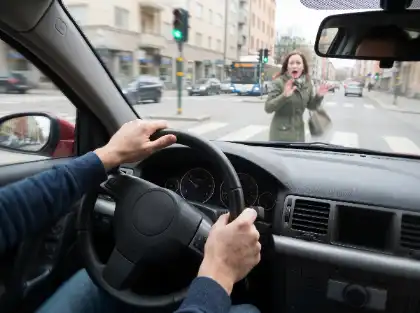
You may still be able to recover compensation. California Vehicle Code § 21456 allows a pedestrian to begin crossing during a flashing countdown if the pedestrian can reach the opposite side before the steady signal appears. Entering after the steady “Don’t Walk” signal may support a comparative-fault argument, but it does not automatically eliminate the claim. Any pedestrian fault can reduce compensation by the assigned percentage.
Can I Still Recover Compensation If the Driver Fled the Scene?
Yes. A hit-and-run does not necessarily prevent you from recovering compensation. If the driver remains unidentified, uninsured motorist coverage may provide another source of recovery. For an unknown-driver UM claim, California law generally requires physical contact with the unidentified vehicle, a police report within 24 hours, and a sworn statement to the insurer within 30 days after that report. The insured must also preserve the UM claim within the applicable statutory period.
Do I Need to Present a Government Claim If a Muni Bus Was Involved?
Yes. If SFMTA or the City and County of San Francisco may be responsible, you generally must present a government claim before filing a lawsuit.
Get Help from Arash Law After a San Francisco Pedestrian Crash
Insurance companies move quickly after a pedestrian crash. While you focus on getting medical care, their adjusters gather evidence, pull camera footage, and contact witnesses. Injured pedestrians in San Francisco can count on Arash Law attorneys to counter those tactics and pursue compensation under California law.
If you choose to work with Arash Law, an attorney can take on those tasks directly: sending preservation demands to SFMTA, requesting SFPD collision reports, advising on government-claim compliance if the City or SFMTA is involved, and building an evidence plan for your case. There are no attorney fees unless we recover on your behalf.
For a free case evaluation, call Arash Law at (415) 969-7799 or (888) 488-1391. Hablamos español. You pay no attorney fees unless there is a recovery.
About This Guide
This page covers San Francisco pedestrian right-of-way law and related legal topics as of September 2026. It is intended for general informational purposes only and does not constitute legal advice. Full citations are in the Sources section below.
Sources
- California Vehicle Code § 21950: Pedestrian Right-of-Way at Crosswalks. California Legislative Information. https://leginfo.legislature.ca.gov/faces/codes_displaySection.xhtml?sectionNum=21950.&lawCode=VEH
- California Vehicle Code § 21451: Circular Green Signal and Driver Duty to Yield to Pedestrians. California Legislative Information. https://leginfo.legislature.ca.gov/faces/codes_displaySection.xhtml?sectionNum=21451.&lawCode=VEH
- California Vehicle Code § 21456: Pedestrian Signal Indications. California Legislative Information. https://leginfo.legislature.ca.gov/faces/codes_displaySection.xhtml?sectionNum=21456.&lawCode=VEH
- California Vehicle Code § 275: Definition of Crosswalk. California Legislative Information. https://leginfo.legislature.ca.gov/faces/codes_displaySection.xhtml?sectionNum=275.&lawCode=VEH
- California Code of Civil Procedure § 335.1: Two-Year Personal Injury Statute of Limitations. California Legislative Information. https://leginfo.legislature.ca.gov/faces/codes_displaySection.xhtml?sectionNum=335.1.&lawCode=CCP
- California Government Code § 911.2: Government Tort Claim Deadline. California Legislative Information. https://leginfo.legislature.ca.gov/faces/codes_displaySection.xhtml?sectionNum=911.2.&lawCode=GOV
- SFMTA Streets Division / Vision Zero SF: 2023–2024 San Francisco Traffic Crashes Report (August 20, 2025, City Traffic Engineer Ricardo Olea). https://visionzerosf.org/wp-content/uploads/2025/08/san-francisco-collisions-report-2023_2024.pdf
- Vision Zero SF: Maps and Data (High Injury Network). https://visionzerosf.org/maps-data
- Superior Court of California, County of San Francisco: Civic Center Courthouse (400 McAllister Street, San Francisco, CA 94102). https://sf.courts.ca.gov/location/civic-center-courthouse
- Superior Court of California, County of San Francisco: Civil Division. https://sf.courts.ca.gov/divisions/civil
- Li v. Yellow Cab Co., 13 Cal.3d 804 (1975): California Pure Comparative Negligence Rule. California Supreme Court.
- Arash Law: Case Results. https://arashlaw.com/case-results/
- California Business & Professions Code § 6147: Contingency Fee Contracts. California Legislative Information. https://leginfo.legislature.ca.gov/faces/codes_displaySection.xhtml?sectionNum=6147.&lawCode=BPC
- California Government Code § 910: Government Tort Claim Presentation Requirements (General). California Legislative Information. https://leginfo.legislature.ca.gov/faces/codes_displaySection.xhtml?sectionNum=910.&lawCode=GOV
- California Government Code § 912.4: Government Tort Claim, Action on Claim. California Legislative Information. https://leginfo.legislature.ca.gov/faces/codes_displaySection.xhtml?sectionNum=912.4.&lawCode=GOV
- California Government Code § 945.4: Government Tort Claim, Requirement to Present Claim Before Suit. California Legislative Information. https://leginfo.legislature.ca.gov/faces/codes_displaySection.xhtml?sectionNum=945.4.&lawCode=GOV
- California Government Code § 945.6: Government Tort Claim, Statute of Limitations After Rejection. California Legislative Information. https://leginfo.legislature.ca.gov/faces/codes_displaySection.xhtml?sectionNum=945.6.&lawCode=GOV
Disclaimer
This page is for general informational purposes only and does not constitute legal advice. Reading this page does not create an attorney-client relationship between you and Arash Law or any of its attorneys. Every case is different; the law and the facts of your situation determine your rights and options. Past case results described on this page do not guarantee a similar outcome in any other case. If you have been injured in a pedestrian accident in San Francisco, consult a licensed California attorney about your specific situation.