TL;DR: Drivers frequently run stop signs, creating predictable intersection crashes. In one 2022 study, nearly 80% of drivers failed to comply with stop signs fully. Under California law, motorists like these are generally liable for the accidents they cause. Still, fault may be shared with employers, vehicle owners, or government entities if a stop sign was missing or blocked. Injury victims usually have 2 years to file a personal injury lawsuit. Government claims have shorter deadlines.
Highlights
- Call emergency services and make sure the area is safe.
- Take clear photos of the vehicles, stop signs, and intersection.
- Get names and contact details from any witnesses.
- Ask for a copy of the police report and note any violations mentioned.
- Save any dashcam footage and nearby security camera video as soon as possible.
- Get medical care and keep records of all treatment.
- Track accident-related costs like repairs, medical bills, and missed work.
Tip: Stick to the facts when describing the crash so details stay accurate.
Table of Contents
Stop sign violations are more common than many people realize. Both drivers and cyclists sometimes fail to come to a complete stop, though the frequency varies by location, traffic conditions, and how violations are measured. A significant number of drivers do not fully stop at stop signs. Observational studies suggest that rolling stops and complete failures to stop are common at intersections across the United States. Stop signs are about as basic as traffic controls get, yet driver behavior often doesn’t match the rule.
Every day, California drivers approach stop signs and choose not to stop. Some roll through slowly. Others blow past without braking at all. The frequency of this behavior may surprise you, but if you were hit by a driver who ran a stop sign, you already know how real the danger is.
When a driver fails to stop and strikes your vehicle, you may be left dealing with severe injuries, medical bills, and the frustration of a crash caused by someone else’s negligence. Stop sign violations aren’t minor errors. Ignoring a stop sign violates California traffic law, and the harm to people in the intersection can be severe.
Data transparency: No single study reports how often drivers or cyclists run stop signs in California or the U.S. Most research focuses on specific intersections or areas. So, these findings shouldn’t be seen as statewide or nationwide violation rates. Stop-sign compliance can vary based on factors such as enforcement, intersection design, visibility, traffic volume, and location. However, observational studies still provide useful insight because they measure real-world behavior. Crash data also show that failure to obey traffic signs is a recurring factor in intersection collisions.
The Startling Statistics On Stop Sign Violations
A 2022 Journal of Safety Research study using the Strategic Highway Research Program 2 (SHRP2) Naturalistic Driving Study found that drivers came to a complete stop at all-way stop-controlled intersections only 20.2% of the time. In other words, nearly 8 in 10 drivers failed to make a complete stop in the observed situations. Rather than fully stopping, many drivers slowed to a rolling stop before proceeding through the intersection.
California crash data backs this up. A 2025 UC Berkeley SafeTREC study of statewide crash records found that violations of traffic signals and signs, including stop signs, were the fourth most common primary factor of serious and fatal bicycle accidents in California in 2023. They were responsible for 13.8% of the 1,331 accidents that year.
These two studies look at the problem from different angles. The SHRP2 research directly observed driver behavior at intersections nationwide. The SafeTREC analysis focuses on California crash reports. It’s also worth noting that the SafeTREC figure is bicycle-specific, not a measure of how often drivers in cars run stop signs. Moreover, it captures only violations serious enough to cause an injury or a fatal crash, not the much larger pool of rolling stops that never cause a collision. Even so, both point in the same way: stop sign and signal noncompliance is a persistent, measurable problem.
Why Drivers Run Stop Signs
Stop sign violations usually come from routine driving behavior rather than deliberate risk-taking. Common contributing factors include:
- Familiarity with Intersections: Drivers tend to slow down rather than stop at intersections they use frequently.
- Low Traffic Conditions: When roads appear empty, drivers may assume stopping is unnecessary.
- Habit Formation: Rolling stops can become automatic over time, especially in residential areas.
- Distraction: Phone use, in-car systems, and external distractions reduce full attention at intersections.
These factors combine to make stop sign violations more common than many drivers realize.
Why Cyclists Fail To Stop At Stop Signs
Cyclists often fail to come to a complete stop for reasons different from those of drivers. Research suggests these behaviors are usually influenced by how cyclists assess risk, maintain momentum, and navigate intersections rather than by intentional recklessness. Common contributing factors include:
- Maintaining Momentum: Stopping a bicycle takes more effort. This makes it harder to speed up again. Researchers have identified preserving momentum as one of the primary reasons cyclists prefer to slow and yield rather than stop completely.
- Low Traffic Conditions: Cyclists often do a rolling stop when they see no cars or pedestrians at an intersection. Riders typically yield and proceed only when they perceive the crossing is safe.
- Visibility and Sight Lines: Cyclists often base their decision on whether they have a clear view of approaching traffic. Riders commonly adjust their behavior according to visibility, available gaps in traffic, and the presence of conflicting road users.
- Intersection Design: Quiet residential streets, intersections with low traffic volumes, and locations with good sight distance are associated with higher rates of rolling stops because cyclists perceive less conflict with cross traffic.
How Quickly Can A Rolling Stop Become Dangerous?
A rolling stop is an illegal driving maneuver in which a vehicle slows significantly at a stop sign or red light but does not come to a complete stop with the tires fully at rest. At intersections, even the low-speed movement of a rolling stop carries real risk. A vehicle traveling at 55 mph can require approximately 300 feet to stop, depending on factors such as road conditions, reaction time, and braking ability. At that speed, a driver may not have enough time to react to a pedestrian, cyclist, or another vehicle entering the intersection.
The danger increases because rolling stops cut down decision time. Drivers are often still scanning the road while the vehicle is already moving forward. The same principle applies to cyclists who roll through stop signs. Although bicycles travel more slowly than most motor vehicles, failing to stop can leave less time to identify cross traffic, pedestrians, or turning vehicles before entering the intersection.
A rolling stop does not always result in a crash, but it can create risk when other road users are present or when conditions leave little time to react. The danger often depends on the circumstances surrounding the intersection and the people involved.
Where Stop Sign Violations Most Often Occur

Stop sign violations are more likely in specific areas and under certain conditions, such as:
- Residential intersections with low enforcement presence.
- Wide intersections with limited visibility.
- Areas with predictable traffic patterns.
- Times of day with light traffic flow.
These environments reduce perceived risk, which can increase noncompliance.
What Does California Law Require At A Stop Sign?
This guide to California’s right-of-way laws notes that, under the state’s Vehicle Code, every driver must come to a complete stop at a stop sign. Rolling through a stop sign at a low speed, sometimes called a “California roll,” can still violate the law because California requires drivers to come to a complete stop before proceeding. A slow roll through an intersection is not considered a full stop. A violation occurs when a driver fails to come to a complete stop before proceeding through the intersection.
The same general rule applies to cyclists. California law requires people riding bicycles to come to a complete stop at stop signs, and in 2021, Governor Gavin Newsom vetoed legislation that would have allowed cyclists to treat stop signs as yield signs. As a result, rolling stops by cyclists are generally not permitted under California law.
Under California Vehicle Code § 22450(a), a complete stop is required at stop signs in the following situations:
- At the limit line.
- Before the crosswalk, if there isn’t a limit line.
- At the entrance of the intersection, if neither is present.
The law requires drivers to follow the stopping order based on the markings at the intersection. Stopping past the limit line isn’t compliant, even if the car has come to a complete rest.
A driver who fails to make a complete stop has broken more than a traffic rule. That failure breaches the legal duty they owe to others on the road. If a violation of this law results in injuries and losses, it can affect fault assessments in a civil case.
Who Is Liable When A Stop Sign Violation Causes An Accident?
In a typical negligence case, an injured person must show that the other driver failed to act as a reasonably careful person would have under similar circumstances, and that the failure caused the injury. California law may simplify this process when the driver violates a traffic law.
Under California Evidence Code Section 669, breaking a safety law, such as failing to stop at a stop sign under Vehicle Code Section 22450, may result in negligence per se. This creates a legal presumption that the driver was negligent when certain requirements are met.
The driver who ran the stop sign is generally at fault. In many cases, other parties may share blame depending on the facts.
Other parties who may share fault include:
- The Driver’s Employer: If the driver was working at the time of the crash, their employer may be held responsible for the resulting damages. Employers can be held legally responsible for their workers’ on-the-job conduct.
- The Vehicle Owner: If the owner allowed an unsafe driver to use their car, they may be found partially at fault under the doctrine of negligent entrustment. This is a legal rule that holds owners responsible when they permit a driver they knew was unsafe to use their vehicle.
- A Government Entity: If the stop sign was missing, blocked, or in poor condition, the city, county, or Caltrans may share fault for not maintaining safe road conditions.
California follows a pure comparative negligence rule. That means you may still be able to seek compensation for your losses even if you played a small role in the crash. For example, if you were speeding or distracted by your phone when the crash occurred, you may still be able to pursue compensation. However, a court can reduce your potential recovery by your share of the fault.
Strong medical documentation matters when calculating damages. Treatment from a chiropractor, physician, or other qualified provider can help document your symptoms, diagnosis, and treatment after the crash.
Intersection accident attorneys can help explain how liability may apply to the facts of the case. That guidance often clarifies how responsibility is evaluated and how those details may shape the direction of a claim.
Frequently Asked Questions About Stop Sign Accidents
Intersection crashes often leave victims with more questions than answers. You may be looking for free advice from accident lawyers to clarify how stop sign compliance affects fault in a specific crash. The moments and days after a crash can feel overwhelming and hard to navigate, whether you are dealing with injuries, insurance calls, or a driver who tells a different story. Each answer below stands on its own, so you can go straight to the question that fits your situation.
Does A Rolling Stop Count As Running A Stop Sign In California?
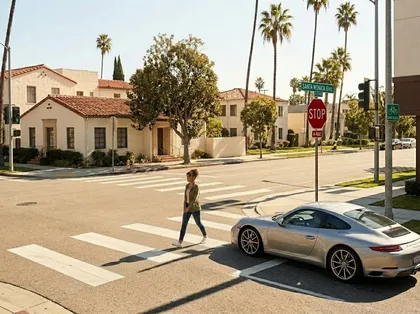
Yes. California law requires every driver to come to a complete stop before proceeding through a stop sign. That means zero movement. Rolling through at any speed, even 1 mph, breaks this law.
How Much Is A Ticket For Running A Stop Sign In California?
The base fine for a stop sign violation is $35, but with state and county penalty assessments, the total is typically over $200 and varies by jurisdiction. To find the precise amount for a specific ticket, check the website of your local county Superior Court.
How Many Points Is Running A Stop Sign In California?
Running a stop sign adds one point to your driving record under the California Department of Motor Vehicles (DMV) point system. Accumulating too many points within a set period can lead to a Negligent Operator designation, which may result in a DMV hearing and, if unresolved, a possible license suspension.
In many cases, drivers may qualify for traffic school. When completed, traffic school can prevent the point from being reported to insurance for rating purposes, although the violation remains on the DMV record.
Can I Sue The City If A Missing Stop Sign Caused My Accident?
You may be able to file a claim against a city or other public agency if:
- A stop sign was missing, blocked, or improperly maintained.
- That condition played a role in a crash.
- The public agency knew or should have known about the problem but did not fix it.
California Government Code Sections 905 and 945.4 generally require a written government claim before suing a public entity, and Government Code § 911.2 requires most injury claims to be presented within six months of accrual. The agency then reviews the claim and may approve it, deny it, or take no action. If the claim is denied or not resolved, you may file a lawsuit in court.
Who Goes First At A Four-Way Stop In California?
The first driver to come to a complete stop goes first. If two vehicles stop at the same time, the driver on the right goes first. A driver turning left must also yield to opposing traffic close enough to create a hazard. Drivers must yield to pedestrians crossing within a marked or unmarked crosswalk.
What Should I Do If The At-Fault Driver Denies Running The Stop Sign?
A denial from the other driver does not end your claim. Save any dashcam footage from your vehicle, identify nearby businesses that may have surveillance footage, and collect names and contact details of witnesses who saw the crash. A police report that documents the stop sign violation can also support your claim when insurers review the evidence.
When the other driver continues to dispute fault, many victims start to realize: I need a personal injury lawyer. An attorney can help gather additional evidence. They can obtain traffic camera footage, witness statements, and crash reconstruction analysis to help build a clearer picture of what happened.
Reach Out To An Experienced Lawyer For Your Intersection Accident
Stop signs are designed to create predictable movement at intersections. The data shows that many drivers still treat them as optional in practice, which helps explain why intersection crashes remain common.
If you were hurt at an intersection, you need an attorney who understands how to build this kind of case.
Arash Law focuses on intersection crashes, including cases where fault depends on proving the other driver failed to stop. Our team has handled cases involving traffic signal timing, sight-line issues, and disputed stop sign compliance. We can investigate the crash, work with crash reconstruction experts, and seek to identify every source of liability in your case.
You may be wondering: “Do lawyers only get paid if they win?” At our firm, the answer is yes. AK Law doesn’t charge upfront fees or hourly charges. You pay nothing in attorney’s fees unless we recover compensation for you.
Call us at (888) 488-1391 to schedule your free case review.