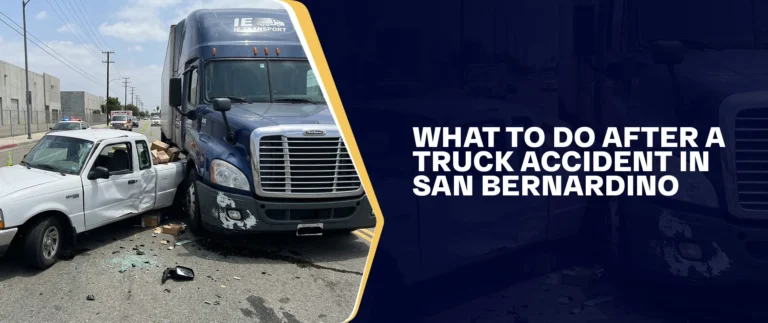
TL;DR: 2018 Minnesota Chauffeur of the Year Arthur “Art” Stoen drove 4.4 million miles over 55 years without a truck accident. Truck accidents can cause severe injuries on congested or icy roads, which makes a clean safety record critical as traffic risks continue.
Highlights:
- Leave extra following distance – trucks need far longer to stop.
- Avoid cutting in front of semis or braking suddenly.
- Stay out of big-rig blind spots, especially alongside trailers.
- Slow down for curves, exits, and slippery or congested road conditions.
- Give trucks room when lanes shift or traffic suddenly stops.
- If injured, get medical care and ask for a police report.
- Talk to a California truck accident lawyer before signing anything.
Tip: If it’s safe, photograph the truck, trailer, and any DOT numbers, then stick to facts (avoid guessing) when speaking with insurers.
Table of Contents
California Driver’s Handbook On Commercial Truck Accidents: Legalities, Statistics, Causes, Prevention, & The Need For A Lawyer
Due to their massive size and weight, accidents involving large commercial trucks present serious hazards on California roads. The trucking industry fuels our economy, and as consumer demand continues to grow, so does the demand for truck drivers and the number of trucks on our roads. The trucking industry is bustling and deadline-driven, placing considerable pressure on truckers to log ever more miles in increasingly shorter periods of time.
This often means that these professional drivers are working under extreme pressure and time constraints that can leave them exhausted, stressed, and more prone to serious accidents. Truck crashes often result in significant damage, and if you’ve been injured in one, consider consulting a California truck accident attorney.
The Trucks On Our California Roads
The commercial trucks that we share our roadways with include a wide variety of vehicles that are specifically designed to handle unique facets of the trucking industry:
-
Tractor-Trailers — Tractor-trailers are also known as big rigs, 18-wheelers, and semi-trucks (or semis). Although the word “semi-truck” refers to the actual truck cab that contains the truck’s engine, we’ve come to call the combination of semi-trucks and their trailers “semis.” These are the most common types of commercial trucks that we see on our highways, and they are massive.
To break things down further, the trailers attached to semi-trucks come in several varieties, including flatbed trailers that are used to transport cargo that doesn’t fit well in conventional semi-trailers, tanker trailers that are used to transport liquids and gases, livestock haulers that transport livestock, and refrigerated trailers (also known as reefers) that are used to transport cargo that requires controlled temperatures, including refrigerated and frozen food items, medicines, alcohol, cosmetics, and more.
- Delivery Trucks — Semis transport consumer products across our nation’s roadways, and delivery trucks deliver them to our doors. These medium-weight trucks carry all-important packages from carrier services like UPS, FedEx, and the U.S. Postal Service. The rise of online shopping has only increased the number of deliveries that take place each day in our neighborhoods.
- Passenger Buses — Passenger buses – including transit buses, commercial bus lines, charter buses, and tour buses – ferry large numbers of people to predetermined destinations.
- Working Trucks — There are also a variety of trucks on our roadways that do specific jobs, and they include heavyweights like dump trucks, cement trucks, furniture trucks, and the like.
Truck Industry Statistics In The U.S.

In its 2018 Pocket Guide to Large Truck and Bus Statistics, the Federal Motor Carrier Safety Administration (FMCSA) shares several sobering statistics related to the trucking industry:
- The number of vehicle miles traveled (VMT) by large trucks and buses in the United States has been consistently rising since 2013. Large trucks account for 9.1 percent of VMT, and buses account for 0.5 percent of VMT.
- The weight of truck freight has also consistently risen since 2013.
- In 2016, there were 34,439 fatal roadway crashes in the U.S., and nearly 12 percent of those involved at least one large truck or bus.
- In 2016, there were 7,242,000 nonfatal traffic accidents, and 7.4% of those involved at least one large truck or bus.
In other words, the trucking industry is growing, and while trucks and buses, combined, make up about 9.6 percent of total VMT in the U.S., they are involved in 12 percent of all vehicle fatalities. Truck accidents in California happen, and they can be fatal. In fact, California was second only to Texas for the sheer number of large-truck fatalities in both 2015 and 2016.
Data On Truck-Related Injuries & Fatalities
Every traffic accident is dangerous, but when the accident involves a commercial truck, the danger is amplified by the sheer size and weight of the vehicle. Trucking is a hazardous profession, but it’s often the occupants of the other vehicles involved in truck accidents who are the most vulnerable to severe injury. As such, FMCSA shares statistics regarding 2016 Commercial Motor Vehicle-Related Fatalities by the Numbers:
- There were 34,439 deadly crashes that led to 37,461 fatalities.
- Approximately 4,079 of these fatal traffic accidents involved a large truck or bus, and these accidents led to 4,564 fatalities. These numbers had risen 6 percent and 5 percent (respectively) since 2015.
- Occupants of large trucks account for 16 percent of all fatalities resulting from traffic accidents that involve large trucks and buses.
These statistics illustrate that commercial truck accidents are not only deadly but also far more likely to kill the non-trucker motorists involved. If you were injured in such an incident, a lawyer who handles truck crash cases in California can help you pursue compensation.
Truck-Driver Error Causes A Significant Number Of Serious Accidents
According to FMCSA, the vast majority of truck accidents are caused by truck driver error. Again, the trucking industry is desperately trying to keep up with demand, which often puts truck drivers under considerable pressure to perform. Nevertheless, truck drivers are professional drivers who are held to much stricter standards than non-commercial drivers. The critical reasons behind driver error are broken down into four major categories:
Non-Performance
Non-performance refers to the trucker’s failure to adequately perform his or her driving duties. Such non-performance can be caused by the trucker falling asleep at the wheel, by the trucker being affected by a physical impairment, or by the trucker being disabled by a health condition such as a heart attack or seizure.
Recognition
Recognition refers to the truck driver’s failure to adequately recognize and respond to the driving situation at hand. This failure can be caused by inattention, by distraction from something either inside or outside the truck, or by any other inadequacy of observation.
Decision
Decision refers to the driver’s failure to make good decisions related to the driving conditions present. Such decisions can include speeding (in general or in relation to the road’s condition), misjudging the speed that other vehicles are traveling at, and following other vehicles too closely.
Performance
Problems with performance often involve overperformance, including panicking behind the wheel, overcompensating for a driving error, or exerting poor directional control of the rig. Within these basic categories of truck-driver error are any number of associated factors that can play significant roles in resulting accidents.
FMCSA identifies the top 10 associated factors when it comes to large commercial trucks and their drivers:
- Brake problems
- An interruption in traffic flow, including congestion or a prior crash on the road ahead.
- The effects of prescription medications
- Traveling too fast in relation to the road’s condition.
- Being unfamiliar with the road
- Encountering problems with the roadway
- Being required to stop by a traffic control device or a crosswalk prior to the crash.
- Taking over-the-counter medications
- Implementing inadequate surveillance of the road and traffic.
- Driver fatigue is also a significant contributing factor.
All told, there are myriad combinations of basic truck driver errors combined with associated factors, and they all pose significant safety risks.
The Most Common Tractor-Trailer Accidents In California
Every commercial truck accident is unique, with its own specific set of circumstances, but there are several kinds of severe accidents that occur frequently:
Rollover Accidents
As the name implies, rollover accidents involving massive commercial trucks present substantial safety concerns. Tractor-trailers, with their high centers of gravity, are prone to rolling when the conditions are right. Rollovers are classified as either tripped crashes, in which the vehicle flips when it hits an obstacle like a curb or another vehicle, or un-tripped crashes, in which the vehicle’s momentum, in combination with another factor like losing traction, unsafe driving, speeding, and encountering slippery roadways, causes it to roll.
When a truck rolls over, it is often caused by driver error, such as:
- Failing to adequately slow down for curves, turns, and exits.
- Changing lanes too suddenly
- Driving at a speed that fails to take traffic and the road’s condition into careful consideration.
- Hitting a hazard or obstacle
- Pulling a trailer with a load that is distributed unsafely and, therefore, shifts (this can be attributable to the trucker, the trucking company, and the loading crew).
- Driving while distracted, impaired, or fatigued
It’s important to recognize that when a semi rolls over, nearby motorists are at significant risk, and these accidents can lead to multi-vehicle pileups.
Jackknife Accidents
Semi-trucks are made up of two connected parts – the large cab that contains the engine and the massive trailer that follows behind and is connected via an articulated joint that allows the two parts to maneuver both separately and in tandem. This articulation is imperative for ease of safe movement on the road, but it also leaves these vehicles vulnerable to jackknife accidents. A jackknife accident occurs when the semi’s coupling device allows the trailer to fold in on its cab, much like the closing action of a jackknife’s blade.
Such accidents are naturally terrifying, and they’re often caused by truck driver error:
- Failing to take the condition of the road and the effects of inclement weather into careful account.
- Being distracted by anything inside or outside the truck that isn’t related to driving safely.
- Speeding in relation to the posted speed limit or in relation to the conditions of the roadway.
- Taking turns or steep curves too quickly
- Pulling improperly loaded cargoes, which, again, may not be attributable to the trucker alone.
Speeding, cutting steep curves too closely, and ignoring the effects of weather conditions on the road are the factors most closely associated with deadly jackknife accidents.
Underride Accidents
Underride accidents are terrifying accidents that involve another vehicle sliding under a large truck – either from the back or from the side. The Insurance Institute for Highway Safety (IIHS) has studied underride accidents and their impact on car accident fatalities. Giving 18-wheelers plenty of space on the road and always avoiding the massive blind spots that truckers experience on the sides of their rigs can help you steer clear of exceptionally dangerous underride accidents.
The IIHS finds that if tractor-trailers were equipped with durable side guards, it could potentially reduce the risk of serious and/or fatal side underride accidents by almost 75%. Many safety groups have been advocating for mandatory safety guards for years, but the trucking industry has so far successfully resisted this outcry by citing the additional weight, the added expense, and the potential difficulty of maintaining the physical integrity of the commercial truck while supporting the addition. It’s worth noting that after the fatal accident involving Hollywood actress Jayne Mansfield in 1967, rear safety guards known as “Mansfield bars” were legally mandated.
Rear-End Collisions
Semis are many, many times heavier and larger than the vehicles that we drive, and as such, they require much longer stopping distances. FMCSA reports that a fully loaded semi-truck that’s traveling at highway speeds on good roads can take the length of nearly two football fields (placed end to end) to come to a full, safe stop. Inclement weather, poor road conditions, improperly loaded freight, overweight hauls, and driver errors, such as speeding, can significantly increase this stopping distance. As such, rear-end collisions involving trucks striking other motor vehicles on the road are a common form of truck accident. This type of accident can be prevented by:
- Take into account trucks’ increased stopping distances.
- Avoid cutting in front of commercial trucks.
- Steer clear of the large blind spots around big rigs.
- Yield the right-of-way to semi-trucks due to their size and limited maneuverability.
- Do not attempt to outmaneuver a semi-truck, as it is dangerous and ill-advised.
Injured In A Truck Accident? Contact A California Truck Accident Attorney
If a truck accident has left you or your loved one seriously injured, you may be facing a difficult situation. Our dedicated California truck accident lawyers at Arash Law have the experience and skills to advocate on your behalf. We can help you pursue compensation for your injuries and losses. Our team also includes car accident lawyers who can handle a wide range of injury cases. Call us at (888) 488-1391 or complete our “Do I Have A Case?” form for a free initial consultation with one of our lawyers who handle truck accident cases.