TL;DR: Failure to yield or otherwise respect another road user’s right-of-way is the leading cause found in our analysis of Altadena intersection crashes from 2021 through 2025. Of 408 intersection crash records, 217, or about 53%, fell into a failure-to-yield or right-of-way category. Red-light violations, unsafe turns, stop-sign violations, unsafe speed, impaired driving, and pedestrian right-of-way violations also appeared in the records.
Our analysis of 408 Altadena-area intersection crash records from the California Crash Reporting System (CCRS) from 2021 through 2025 shows that the most common causes of intersection accidents in Altadena include:
- Failure to yield
- Red-light violations
- Unsafe turns
- Stop-sign violations
- Unsafe speed
- Impaired driving
Altadena’s serious crash data shows a similar pattern. A February 2023 Public Works study found that right-angle intersection crashes made up 21% of Altadena’s fatal and severe-injury crashes from 2013 through 2022. Intersection pedestrian crashes represented 15%, while left-turn intersection crashes represented 8%. These are collision types, not causes, but they show how often serious Altadena crashes involve conflicts between vehicles or pedestrians moving through the same intersection.
Five Things That Matter Most After An Altadena Intersection Crash
- Failure to yield is the most common cause of local crashes. It accounted for 217 of the 408 intersection crashes in our 2021-2025 analysis, or about 53%.
- Altadena’s serious crashes show the same pattern of conflict. Right-angle intersection crashes accounted for the largest share of fatal and severe injury collisions in the 2013-2022 Public Works study.
- Broadside is a crash type, not a cause. The real cause may be a failure to yield, a red-light violation, a stop-sign violation, or an unsafe turn.
- Local procedure can affect the case. An Altadena injury lawsuit may be assigned to the Pasadena Courthouse. Meanwhile, a roadway-condition claim can trigger Los Angeles County’s separate government claim deadline.
- The right lawyer should investigate more than the police report. Intersection cases can require video, signal records, sight-distance evidence, vehicle data, roadway records, comparative-fault analysis, and experience with public-entity claims.
Table of Contents

The Local Details That Shape An Altadena Intersection Crash Claim
An intersection crash in Altadena can involve more than figuring out who caused it. Because Altadena is an unincorporated part of Los Angeles County, local agencies, roadway ownership, court procedures, and government claim rules may all affect what happens next and how an injury claim is handled.
Where Your Case Will Actually Be Filed
Altadena is an unincorporated area governed by Los Angeles County. A personal injury case arising from an Altadena crash is filed in the Los Angeles Superior Court system. The court states that tort cases may be assigned according to where the accident or injury occurred. Its filing materials map Altadena ZIP Code 91001 to the Pasadena Courthouse.
| Court / Entity | Physical Address | Jurisdiction and Handling |
|---|---|---|
| Los Angeles County Superior Court – Pasadena Courthouse | 300 E. Walnut St., Pasadena, CA 91101 | Unlimited Civil Jurisdiction for claims over $35,000 |
| Los Angeles County Superior Court – Pasadena Courthouse | 300 E. Walnut St., Pasadena, CA 91101 | Limited Civil Jurisdiction for disputes up to $35,000 |
| Los Angeles County Board of Supervisors Claims Section | 500 W. Temple St., Rm. 383, Los Angeles, CA 90012 | Administrative injury and property claims against the County |
The exact filing location may depend on the type of civil case and the facts establishing venue. Always check the court’s current Filing Court Locator before filing.
What Local Data Says About Causes of Altadena Intersection Accidents
The Los Angeles County Department of Public Works published a traffic safety report in February 2023. This follows Supervisor Kathryn Barger’s January 2023 Board motion. The report analyzed fatal and severe injury collisions in Altadena between 2013 and 2022.
Within the said period, Altadena had 67 severe injury crashes and six fatal crashes on County-maintained roadways.
- Right-angle intersection crashes(15)
- Intersection pedestrian crashes (11)
- Intersection left-turn crashes (6)
The separate analysis of CCRS crash reports from 2021 to 2025 found the following common recorded causes of crashes at Altadena intersections.
| Top 5 Recorded Causes, 2021-2025 | Crashes | Percentage |
|---|---|---|
| Failure to yield/right-of-way | 217 | 53.2% |
| Red-light violations | 48 | 11.8% |
| Unsafe/improper turns or movements | 47 | 11.5% |
| Stop-sign violations | 36 | 8.8% |
| Unsafe speed | 16 | 3.9% |
The 408 extracted records contained 268 reported injuries and two fatalities. Four 2025 records had blank injury and fatality fields, so those totals reflect the information available in the crash files.
Understanding the leading cause of intersection accidents can also help explain how fault may be established after a collision. A traffic violation does not automatically establish a personal injury claim, but it can become important evidence when investigators, insurers, or a jury determine who acted negligently and whether that conduct caused the crash.
Here are some of the common causes of intersection accidents in Altadena:
#1 – Failure To Yield Or Respect The Right-Of-Way
Failure to yield is the most common recorded cause in the newer Altadena data. It appeared in 217 of 408 intersection crash records.
These crashes can happen when a driver turns across approaching traffic, enters an intersection too soon, or fails to give another road user the right of way. Vehicle Code section 21801 requires a driver making a left turn or U-turn to yield to approaching vehicles that are close enough to create a hazard until the turn can be completed with reasonable safety.
In a personal injury claim, evidence of a failure to yield may help show that a driver acted negligently. Useful evidence can include:
- Dashcam or surveillance footage
- Witness statements
- Vehicle damage and impact points
- Skid marks and vehicle positions
- Traffic signal or roadway evidence
California also allows fault to be divided between everyone who contributed to a crash. Even if one driver failed to yield, the other driver’s speed or actions may still affect the final determination of fault.
#2 – Running Red Lights
Red-light violations appeared in 48 Altadena intersection crashes. They were especially visible at locations such as Altadena Drive and New York Drive, Altadena Drive and Fair Oaks Avenue, and Altadena Drive and Lincoln Avenue.
Vehicle Code section 21453 requires a driver facing a steady circular red light to stop at the appropriate limit line, crosswalk, or intersection. Even a permitted turn on red requires yielding to pedestrians and vehicles that create an immediate hazard.
In an injury claim, the main dispute may be whether the driver actually entered the intersection against the red light. Evidence may include:
- Traffic signal timing records
- Nearby surveillance footage
- Dashcam video
- Witness statements
- Vehicle data and impact locations
If a red-light violation caused the crash, the injured person may seek compensation for losses such as medical expenses, lost income, and pain and suffering.
#3 – Unsafe Turns And Other Movements
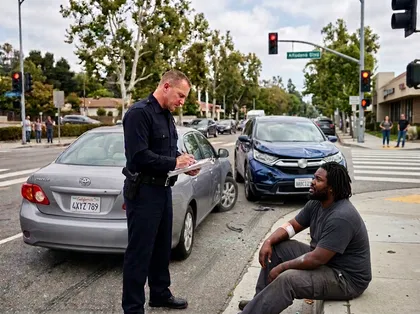
Unsafe or improper turns and movements appeared in 47 crashes. These can occur when a driver changes direction, pulls into traffic, or turns before the movement can be completed safely.
Vehicle Code section 22107 prohibits a driver from turning or moving right or left until the movement can be made with reasonable safety. A signal is also required when another vehicle may be affected.
For a personal injury claim, important questions may include:
- Did the driver check for approaching vehicles, pedestrians, or cyclists?
- Was a turn signal used?
- Were sightlines blocked?
- Where did the vehicles make contact?
- Was there a video showing how the maneuver occurred?
These details can help determine whether the turn was unsafe and whether more than one person shares responsibility for the crash.
#4 – Stop-Sign Violations
Stop-sign violations appeared in 36 crashes. Rolling through a stop or entering before cross traffic clears can create a direct right-angle conflict.
One fatal example occurred at Olive Avenue and Ventura Street on August 26, 2023. The CCRS record lists a violation of Vehicle Code section 22450(a) and one death. Vehicle Code section 22450 requires a driver to stop at the limit line, crosswalk, or entrance to the intersecting roadway, depending on the intersection markings.
In a personal injury case, investigators may need to determine:
- Whether the driver came to a complete stop
- Where the vehicle stopped
- Which vehicle entered the intersection first
- Whether the other driver was traveling at an unsafe speed
- Whether video or witnesses can confirm what happened
The presence of a stop sign alone does not always settle the dispute over fault. The available evidence must show how each driver approached and entered the intersection.
#4 – Speeding
Unsafe speed appeared as the primary recorded factor in 16 intersection crashes. Public Works also identified speeding as a concern during its Altadena corridor evaluations.
California’s basic speed law requires drivers to travel at a speed that is reasonable for traffic, weather, visibility, roadway width, and surface conditions. A driver can therefore be traveling too fast for an intersection even when driving below the posted speed limit.
Speed can matter to a personal injury claim in two ways:
- It can help establish who caused the crash.
- It can affect how severe the collision and resulting injuries were.
Evidence used to evaluate speed may include:
- Event Data Recorder information
- Skid marks
- Surveillance or dashcam footage
- Vehicle damage
- Crash reconstruction evidence
Speed can also affect comparative fault. For example, a driver who had the right-of-way could still share responsibility if unsafe speed contributed to the collision.
#5 – Failure To Yield To Pedestrians
Pedestrian conflicts are less frequent than vehicle-to-vehicle crashes but can have severe consequences. The newer analysis identified 11 pedestrian right-of-way violations.
The 2013-2022 Altadena data reinforces that concern. Intersection pedestrian crashes accounted for 11 of 73 fatal or severe-injury crashes during that period, including three fatal crashes. Vehicle Code section 21950 requires drivers to yield to pedestrians in marked and unmarked crosswalks at intersections and also requires pedestrians to use reasonable care.
In a pedestrian injury claim, important evidence may show:
- Whether the pedestrian was in a marked or unmarked crosswalk
- Whether the driver had enough time to see and react
- The lighting and visibility at the intersection
- The vehicle’s speed
- Whether witnesses or video captured the collision
A pedestrian may still pursue compensation even if an insurer argues that the pedestrian was partly responsible. Under California’s comparative-fault rules, any proven share of fault may reduce the amount recovered rather than automatically prevent recovery.
How The Local Practice Environment Operates
In our experience, an Altadena intersection case can require more than deciding which driver had the green light or stop sign. The California Highway Patrol (CHP) Altadena Area office, located at 2130 Windsor Avenue, patrols Altadena and the surrounding areas. Meanwhile, roadway condition evidence may be held by Los Angeles County Public Works or another agency, depending on the location.
When a commercial truck is involved, employer and commercial vehicle records may add another layer of evidence. Altadena truck accident lawyers must secure commercial security video from Lake Avenue storefronts, obtain black-box data from vehicle Event Data Recorders (EDRs), and work with roadway engineers who understand Los Angeles County design standards.
Consult Arash Law About Your Next Steps After An Intersection Accident
Have questions about your Altadena intersection crash claim? Arash Law offers free consultations and handles every case on a contingency basis. You pay nothing unless we recover compensation on your behalf. Call (888) 488-1391 or reach us online today.
What Arash Law Has Recovered In Intersection And Pedestrian Cases
Arash Law has recovered over $1 billion for injured clients in California. The Arash Law case results below are representative of the types of cases our intersection accident attorneys handle. They are not specific to Altadena, but they reflect the firm’s experience with intersection collisions, pedestrian injury claims, and cases involving government-entity defendants.
$2,100,000 — Stop Sign vs. Police Cruiser: Our client stopped at a two-way stop sign before entering the intersection, where a police cruiser traveling about 70 mph struck his vehicle and caused serious injuries. Claims involving police departments can be complex and heavily disputed. After several years of litigation, we secured a $2.1 million settlement for our client.
$1,750,000 — Auto vs. Pedestrian at Hazardous Intersection: An uninsured driver struck our client while our client was crossing a dangerous intersection. We pursued a case against the city for its failure to address the intersection’s risks, revealing a troubling history of accidents that helped us secure justice for our client.
Past results do not guarantee a similar outcome. The results shown depend on the unique facts of each case. Different facts will produce different results.
Evidence That Can Support Your Altadena Intersection Claim
At Altadena intersections, evidence comes from multiple sources, and several types have strict timelines for disappearance.
| Issue | Evidence To Preserve | Who May Control It |
|---|---|---|
| Right-of-way dispute | Dashcam, witnesses, collision photos, vehicle positions | Drivers, witnesses, law enforcement |
| Red-light crash | Signal timing records, video, witness statements | Public agency, nearby businesses, and residents |
| Unsafe turn | EDR data, dashcam, damage patterns | Vehicle owner, insurer, repair facility |
| Pedestrian crash | Crosswalk photos, lighting evidence, surveillance video | Businesses, homeowners, and public agencies |
| Roadway condition | Maintenance records, complaints, prior crash data, and design plans | Los Angeles County or another road owner |
Private surveillance video may be overwritten, and physical roadway conditions may change. For suspected public road issues, record requests, and claim deadlines, early attention may also be needed.
Filing Deadlines For Altadena Intersection Accident Claims
Altadena’s unincorporated status creates two parallel deadline tracks depending on who you are suing. Missing either one can eliminate part or all of your claim.
-
You have two years from the date of your crash to file a personal injury lawsuit under Code of Civil Procedure section 335.1. The two-year clock generally begins on the date of the collision.
Special tolling rules, rules that pause or delay the deadline clock, may extend some deadlines for minors. A parent or guardian should consult an attorney as soon as possible, because some procedural steps have fixed timelines regardless of the claimant’s age.
-
Before you can file a lawsuit against the County on a claim subject to the Government Claims Act, you generally must first present a written claim. Under Government Code section 911.2, claims for death, personal injury, or injury to personal property must generally be presented within six months after the accident. Claims relating to other causes of action generally must be presented within one year.
The deadline to file suit is governed by Government Code section 945.6. If the County gives written notice of rejection in accordance with Government Code section 913, a lawsuit generally must be filed no later than six months after that notice is personally delivered or deposited in the mail. If no written notice is given under section 913, the lawsuit generally must be filed within two years after the cause of action accrues. Other exceptions may apply, so consult an attorney promptly.
How To File A Claim Against Los Angeles County For An Altadena Roadway
Altadena has no city government because it is unincorporated. When an alleged dangerous condition involves a Los Angeles County-controlled roadway, the County instructs claimants to present a signed written claim to the Executive Officer-Clerk of the Board of Supervisors.
Los Angeles County Claims Unit
Executive Officer, Board of Supervisors
Attention: Claims
500 W. Temple Street, Room 383
Los Angeles, CA 90012
Claims Unit: (213) 974-1440
The County states that claims may be mailed or delivered to that office. A roadway claim should not be confused with the ordinary insurance claim process. If the six-month deadline has already passed, California’s late-claim statutes require separate analysis rather than simply filing the original claim late.
Frequently Asked Questions About The Common Causes Of Intersection Accidents In Altadena
After an accident at an Altadena intersection, you probably have questions about what this means for you as an injured victim. The answers below cover common questions people have after an Altadena intersection crash, including the procedural and evidentiary issues that arise in this unincorporated community.
Who Is At Fault In A Left-Turn Intersection Accident?
In California, a left-turning driver generally must yield to oncoming traffic under Vehicle Code section 21801(a). However, the turning driver is not automatically fully at fault.
Fault may be shared if the other driver:
- Ran a red light.
- Drove at an unsafe or excessive speed.
- Failed to use reasonable care.
Road conditions may also matter. For example, obstructed sightlines, overgrown vegetation, or poor lighting could support a public-entity claim if the legal requirements for a dangerous roadway condition are met.
If I Had A Green Light, Could I Still Be Partially At Fault?
Yes, in California, even if you have a green light, you can still be found partially at fault in an accident. A green light allows you to proceed, but you must also demonstrate that you were driving reasonably given the circumstances.
If evidence indicates that you were not driving safely or attentively at the time of the accident, this could impact your compensation. It’s crucial to document the scene and any relevant conditions immediately after the crash to support your claim.
What If I’m Partially Responsible For The Intersection Crash?
If you are partially responsible for a crash at an intersection, you can still seek damages in California. This is because California follows pure comparative negligence rules. This means that your award will be lowered based on how much fault you have.
For example, if a jury decides you were 45% at fault for the crash and the other driver was 55% at fault, you can still recover 55% of your damages.
To dispute unfair fault assignment, it’s important to gather strong evidence, records of signal timing from LA County Public Works, and any video footage from nearby cameras. This evidence can help you show the true circumstances of the crash.
What If The Driver Who Hit Me Has No Insurance?
If you carry Uninsured Motorist or Underinsured Motorist (UM/UIM) coverage on your own auto policy, you may file a claim with your insurer for medical expenses and other damages up to your policy limits.
As of January 1, 2025, California’s minimum liability limits increased to:
- $30,000 per person
- $60,000 per occurrence for bodily injury
- $15,000 for property damage
Many drivers carry only the minimum, which may fall far short of your actual losses. Without UM/UIM coverage, recovering from an uninsured driver requires a lawsuit against that individual, which may be difficult to collect if the driver has no assets.
Can Altadena Road Conditions Contribute To A Crash?
Yes. Roadway conditions can contribute even when a driver’s violation is also involved.
Public Works evaluated Holliston Avenue, Fair Oaks Avenue, and Mendocino Street after local traffic safety concerns. Its Altadena study specifically considered speeding, limited street lighting, lack of sidewalks or a defined pedestrian path, vegetation that restricted visibility, and missing marked crosswalks.
These findings reflect recognized local safety concerns. They do not prove that a particular road condition caused a specific crash.
Government Code section 835 may apply if a dangerous condition on public property results in injury. To establish a claim, the injured person must demonstrate the following elements:
- The property was in a dangerous condition at the time of the injury.
- The dangerous condition proximately caused the injury.
- The condition created a reasonably foreseeable risk of the type of injury that occurred.
- Either a public employee’s negligent or wrongful act or omission created the dangerous condition, or the public entity had actual or constructive notice of the condition long enough to take protective measures.
Can Poor Visibility Cause An Altadena Intersection Accident?
Yes. Reduced visibility can prevent drivers from seeing traffic or pedestrians soon enough to react.
Public Works specifically identified vegetation-related visibility limits and restricted lighting as concerns evaluated along Altadena road corridors. The proposed responses included high-visibility crosswalks at stop-controlled intersections, reflective signs and pavement markings, edge striping, visibility improvements near intersections, and sidewalk feasibility studies.
Schedule Your Altadena Intersection Crash Case Review With Arash Law
An Altadena intersection case can involve the CHP collision file, private video, vehicle data, and Los Angeles County roadway records. Identifying those sources early can help show why the crash happened and which parties may be legally responsible.
Arash Law has years of experience representing injured clients across California, including cases involving county-entity defendants, pedestrian injuries, and intersection collisions where the physical evidence was at risk of being lost. Our attorneys handle every case on a contingency fee basis. You pay no attorney fees unless we recover compensation for you. If you would like to communicate in a language other than English, please inform our office when you contact us.
Call Arash Law today at (888) 488-1391 for a free consultation. Make Them Pay, Call AK.
About This Guide
This guide uses the 2021-2025 CCRS Altadena intersection extraction, which contains 408 data-derived Altadena-area intersection records, together with the Los Angeles County Department of Public Works February 23, 2023, Review of Pedestrian and Traffic Safety in Altadena. The Public Works report analyzed fatal and severe-injury crashes from 2013 through 2022 and evaluated Holliston Avenue, Fair Oaks Avenue, and Mendocino Street.
Local procedural information was checked against the Los Angeles Superior Court, the Los Angeles County Board of Supervisors Claims Unit, the California Highway Patrol Altadena Area office, California statutes, and the State Bar of California. Because the two crash datasets cover different periods and use different selection criteria, their figures are presented separately rather than combined into one crash rate.
Sources
California Crash Reporting System (CCRS) — 2021-2025 Altadena Intersection Crash Data
Los Angeles County Department of Public Works — Report on Review of Pedestrian and Traffic Safety in Altadena (February 23, 2023)
California Highway Patrol — Altadena Area
https://www.chp.ca.gov/find-an-office/southern-division/575-altadena/
Los Angeles County Board of Supervisors — Claims for Damages
Los Angeles County Superior Court — Northeast District, Pasadena
California Vehicle Code § 21453 — Red Traffic Signals
https://leginfo.legislature.ca.gov/faces/codes_displaySection.xhtml?lawCode=VEH§ionNum=21453
California Vehicle Code § 21801 — Left Turns and U-Turns
https://leginfo.legislature.ca.gov/faces/codes_displaySection.xhtml?lawCode=VEH§ionNum=21801
California Vehicle Code § 21950 — Pedestrian Right-of-Way
https://leginfo.legislature.ca.gov/faces/codes_displaySection.xhtml?lawCode=VEH§ionNum=21950
California Vehicle Code § 22107 — Turning and Movement Requirements
https://leginfo.legislature.ca.gov/faces/codes_displaySection.xhtml?lawCode=VEH§ionNum=22107
California Vehicle Code § 22350 — Basic Speed Law
https://leginfo.legislature.ca.gov/faces/codes_displaySection.xhtml?lawCode=VEH§ionNum=22350
California Vehicle Code § 22450 — Stop Signs
https://leginfo.legislature.ca.gov/faces/codes_displaySection.xhtml?lawCode=VEH§ionNum=22450
California Code of Civil Procedure § 335.1 — Personal Injury Statute of Limitations
https://leginfo.legislature.ca.gov/faces/codes_displaySection.xhtml?lawCode=CCP§ionNum=335.1
California Government Code § 835 — Dangerous Condition of Public Property
https://leginfo.legislature.ca.gov/faces/codes_displaySection.xhtml?lawCode=GOV§ionNum=835
California Government Code § 911.2 — Government Claim Deadline
https://leginfo.legislature.ca.gov/faces/codes_displaySection.xhtml?lawCode=GOV§ionNum=911.2
California Government Code § 945.6 — Deadline After Government Claim Rejection
https://leginfo.legislature.ca.gov/faces/codes_displaySection.xhtml?lawCode=GOV§ionNum=945.6
Arash Law — Case Results
The information on this page is for general informational purposes only. It does not constitute legal advice and does not create an attorney-client relationship. Every case is different, and the outcome of any legal matter depends on its unique facts and circumstances. Past results do not guarantee similar outcomes. A licensed California attorney can advise you on your specific situation.