TL;DR: There is no official percentage that tells you the odds of winning a personal injury lawsuit. It depends on proving fault, causation, and documented damages, not on a fixed percentage. Injured drivers, workers, and visitors face lower chances when evidence is missing, or treatment gaps weaken proof, and missing California’s 2-year filing deadline can permanently block compensation for medical bills and lost wages.
Highlights:
- Request and keep copies of police, incident, or workplace reports.
- Preserve evidence early – save damaged items, clothing, and vehicle data.
- Send a written request to preserve any surveillance or dashcam footage.
- Write down a same-day timeline of symptoms, events, and witness names.
- Keep a weekly log of limitations, missed work, and out-of-pocket expenses.
- Confirm available insurance coverage and policy limits before negotiating amounts.
- Calendar deadlines: 2 years to sue in many CA cases; 6 months for public-entity claims.
Tip: If an adjuster calls, ask for questions in writing and save the full communication record.
Table of Contents
California does not provide an official percentage indicating the odds of winning a personal injury lawsuit. It depends on fault, evidence, and documented losses. There is no reliable percentage that applies to every injured person.
A 2009 Bureau of Justice report concluded that plaintiffs, or the injured party, won around 51.6% of tort trials, including trials for personal injury lawsuits, in 2005. However, there is no comparable data available for California.
That’s because many personal injury disputes are resolved through settlement before a judge or jury reaches a verdict. Cases that proceed to trial often involve disputed liability, causation, or damages, making them unrepresentative of all personal injury lawsuits. As a result, no published statistic can accurately predict an individual plaintiff’s chances of success.
However, a lawsuit is more likely to succeed when you can clearly show that someone else acted carelessly or wrongfully, their actions caused your injury, and you suffered measurable losses.
Data Transparency Note: This blog relies on data from the 2009 Bureau of Justice Bulletin “Tort Bench and Jury Trials in State Courts, 2005.” The bulletin provides the most recently available data on tort trials handled in state courts. It is not specific to California and should not be interpreted as providing a definitive personal injury lawsuit success rate. This blog will be updated as newer data on the odds of winning a personal injury lawsuit becomes available.
What Does Winning A Personal Injury Lawsuit Mean?
After a lawsuit is filed, a favorable outcome may include:
- A settlement that was reached during the lawsuit.
- A judgment after a bench trial.
- A jury verdict.
Winning does not always require a trial. Many lawsuits settle after both sides exchange evidence, evaluate the damages, and negotiate the case.
However, receiving an offer does not automatically mean the lawsuit was successful. The injured person and their lawyer should compare the offer with the strength of the evidence, the value of the damages, the legal costs, and the risks of continuing the case.
Furthermore, a personal injury lawsuit can result in two distinct outcomes. First, the injured person must prove that the defendant is legally responsible. Second, the person must prove the amount of compensation with evidence. Some plaintiffs may succeed on liability but recover less than expected due to shared fault, limited insurance coverage, disputed treatment, or other case-specific issues.
For that reason, a favorable outcome generally means recovering compensation that reflects the injuries and losses supported by the evidence.
Key Factors That Influence The Odds Of Winning Your Injury Lawsuit
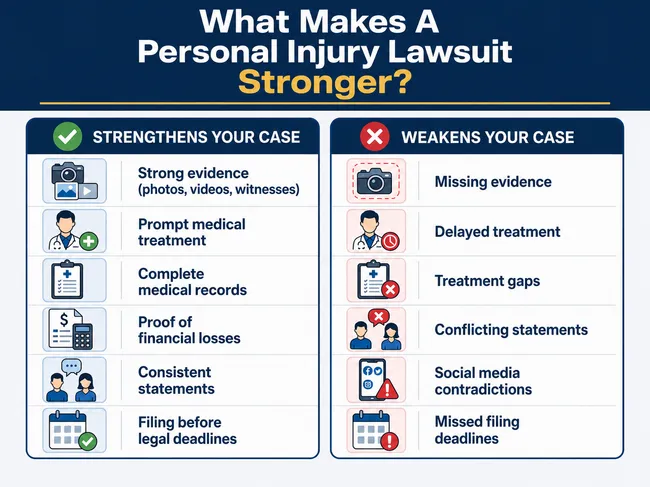
No single factor guarantees winning your personal injury lawsuit, but some factors may affect the odds of winning it, for example:
Clear evidence of fault can strengthen a case. According to the California Evidence Code § 140, evidence refers to photos, videos, witness statements, writings, and other sensory material used to demonstrate the existence or nonexistence of a fact.
However, each lawsuit demands distinct legal arguments and defenses, which can make some cases more complex than others. For example, cases involving public entities, professional negligence, defective products, or technically complex causation may require additional proof and expert testimony.
Incident reports, vehicle data, safety records, and damaged property may help show how the incident occurred and who was responsible. Because this evidence can disappear or change, it should be preserved as soon as possible.
Prompt and consistent medical care can also help establish a connection between the incident and the injuries. Medical records may document when symptoms began, how they progressed, what treatment was provided, and whether the injuries caused lasting limitations. Unexplained treatment gaps or inconsistent descriptions of the injury may lead the defense to dispute causation or severity.
The plaintiff must also provide reliable proof of damages. Medical bills, wage records, receipts, repair estimates, treatment recommendations, and documentation of daily limitations may support the requested compensation amount.
During litigation, defense counsel may use missing records, treatment gaps, inconsistent statements, prior injuries, or conflicting evidence to dispute fault. They may argue that the incident did not cause the claimed injuries, challenge their severity, or contend that the requested damages are excessive.
Additionally, the case may be weakened by missing evidence, unavailable witnesses, inconsistent statements, delayed treatment, or online posts that contradict the injuries or account of the incident.
Failing to meet the filing deadline can bar your lawsuit. According to the statute of limitations for personal injuries in California, you generally have two years to file. Different deadlines and exceptions may apply depending on the circumstances.
In California, you generally have two years from the injury date to file a personal injury lawsuit. Different deadlines may apply in some cases. For example, an injury involving a public entity typically requires you to present a government claim within six months before filing a lawsuit.
What Must You Prove To Win A California Personal Injury Lawsuit?
Many California personal injury lawsuits are based on negligence. The injured person generally must establish four elements:
- Duty of Care: The other party had a legal duty to use reasonable care.
- Breach of Duty: You must show that the defendant failed to meet the required standard of care.
- Causation: The breach was a substantial factor in causing your injury. The harm must come from that failure, not from an unrelated cause.
- Damages: You suffered real losses as a result of the injury. These may include medical bills, lost income, physical pain, and emotional suffering.
In most civil cases, the plaintiff must prove the required facts are more likely true than not true. An injury lawyer can help a victim understand what it takes to prove their case.
Can You Win If You Were Partly At Fault?
Yes. California follows a pure comparative negligence system. According to the U.S. Department of Justice’s Bureau of Justice Statistics, awards were reduced for contributory or comparative negligence in 14.7% of sampled 2005 tort trials. In which a plaintiff received an initial monetary damages award, and the relevant award data were available. The figure is national, dated, and not specific to California’s pure comparative negligence system. As it is not recent data specific to California, it should not be interpreted as providing a definitive personal injury lawsuit success rate.
The California Supreme Court adopted this rule in Li v. Yellow Cab Co. (1975) 13 Cal. 3d 804. The rule allows you to recover damages even when you share responsibility for the incident. However, the court reduces your award by your percentage of fault.
Suppose a jury decides:
- Your total damages equal $200,000.
- You were 30% responsible.
- The defendant was 70% responsible.
- The court would generally reduce your recovery by 30%, leaving $140,000.
A personal injury lawyer can gather evidence, challenge an unfair fault percentage, question witnesses, use expert analysis, and present a clearer account of how the incident happened.
Is There An Average Win Rate For Personal Injury Cases?
There is no reliable average win rate for personal injury cases in California. However, the national data from the Bureau of Justice Statistics offer some context on plaintiff-won trials by case type.
The following table includes case types commonly handled by personal injury firms:
| Case Type | Number of Trials | Trials With Plaintiff Winners |
|---|---|---|
| Animal attack | 125 | 75.2% |
| Automobile accident | 8,844 | 64.3% |
| Asbestos product liability | 82 | 54.9% |
| Intentional tort | 609 | 51.6% |
| Conversion | 296 | 48.3 |
| Other/unknown tort | 606 | 41.1 |
| Premises liability | 1,827 | 38.4% |
| Other product liability | 265 | 19.6% |
About 90% of the tort trials in the study went before juries. However, trials accounted for only about 4% of all tort case dispositions in jurisdictions that reported both trial and nontrial outcomes.
These figures describe national trial results from 2005. They do not include most settlements, do not establish a current California win rate, and cannot predict the outcome of a particular personal injury claim or lawsuit.
Source: U.S. Department of Justice, Bureau of Justice Statistics, Tort Bench and Jury Trials in State Courts, 2005, Table 4, “Percent of tort trials with plaintiff winners in state courts, by case and trial type, 2005.”
In addition, Table 5 of the BJS report provides estimated numbers of tort trials with plaintiff award winners. These figures are trial counts, not plaintiff win rates or award amounts:
| Case Type | All Trial Types | Jury Trials | Bench Trials |
|---|---|---|---|
| Asbestos product liability | 47 | 44 | 3 |
| Other product liability | 52 | 49 | 2 |
| Premises liability | 666 | 608 | 44 |
| Other/unknown tort | 305 | 205 | 98 |
| Intentional tort | 428 | 313 | 99 |
| Animal attack | 108 | 87 | 20 |
| Automobile accident | 5,965 | 5,339 | 506 |
Note: Award data were available for 99.5% of tort jury and bench trials. The number of plaintiffs awarded damages may be different from the number of plaintiffs who successfully litigated the case. This difference is primarily due to excluding plaintiff winners who receive no award because of award reductions and to the inclusion of 805 bifurcated damage trials with plaintiff award winners. The table also excludes the 330 bifurcated trials in which the plaintiff litigated only the liability claim.
Source: U.S. Department of Justice, Bureau of Justice Statistics, Tort Bench and Jury Trials in State Courts, 2005, Table 5, “Plaintiff award winners in tort trials in state courts, by case and trial type, 2005.”
Does Hiring A Lawyer Improve The Odds?
A lawyer cannot guarantee that the jury will rule in your favor. However, legal representation may strengthen a case by preserving evidence, identifying all responsible parties, documenting long-term losses, and preparing for disputed issues.
A personal injury attorney may help evaluate or pursue a lawsuit. A lawyer may also help by:
- Preserving video, physical evidence, and witness testimony.
- Identifying and addressing weaknesses in the evidence.
- Consulting medical, financial, or accident experts.
- Calculating future medical costs and lost earnings.
- Meeting filing deadlines.
- Developing legal arguments to prove liability and damages.
- Preparing the case for trial.
The value of this work often becomes clearer in complex cases. For instance, Arash Law has obtained results in matters involving disputed fault, permanent injuries, public entities, and premises liability.
| Case Result | How Legal Work Affected the Case |
|---|---|
| $41.95 million | Our lawyers represented a husband and wife who were attacked by a man with an unsecured baseball bat inside a Walmart store. We presented the evidence that led the jury to find Walmart 50% liable for the incident. The judgment against Walmart exceeded $30 million. |
| $17.9 million | Our attorneys litigated the case for years while Los Angeles County tried to shift responsibility. We presented evidence that one client suffered a fractured tibia and a mild but permanent brain injury, while the other suffered a sprained knee that required physical therapy. The jury returned a unanimous $17.9 million verdict after about 90 minutes of deliberation. |
| $1.4 million | Our attorneys fought the case in court for two years on behalf of a 34-year-old client with neck and back injuries. We argued for compensation that reflected the client’s lifetime medical needs and secured a $1.4 million result. |
These outcomes involved different facts, injuries, and legal issues. They do not guarantee similar results. However, they show how detailed investigation, long-term damage calculations, and trial preparation can influence the outcome of a personal injury case.
Frequently Asked Questions About Personal Injury Lawsuits
A personal injury lawsuit can raise important questions about deadlines, proof, fault, and potential recovery. The answers below explain what may affect your chances of winning after you file a case in court.
Can I Lose Even If The Other Person Was Clearly At Fault?
Yes. A clear fault can strengthen your lawsuit, but it does not guarantee that you will recover compensation. You must also show that the incident caused your injuries and that those injuries led to measurable losses. Missing medical evidence, incomplete records, filing mistakes, or missed deadlines can weaken your case.
Are Certain Personal Injury Lawsuits Easier To Win Than Others?
Some personal injury lawsuits may be easier to prove when the evidence clearly shows who caused the incident. For example, a car accident lawsuit involving red-light footage, rear-end damage, reliable witnesses, or documented police observations may present fewer disputes over fault.
However, a clear fault does not guarantee a win. The defendant may still dispute whether the crash caused the injuries, whether the treatment was necessary, or how much compensation the plaintiff should receive. Every lawsuit depends on the evidence supporting fault, causation, and damages.
Does A Serious Injury Guarantee A Large Lawsuit Recovery?
No. A serious, well-documented injury may support greater damages, but it does not guarantee a large recovery. The outcome also depends on fault, medical evidence, long-term losses, available insurance, and the defendant’s assets.
Get Legal Guidance For Your Personal Injury Lawsuit
Your evidence has a shelf life, and so does your right to file a lawsuit. California’s statute of limitations gives you a limited window to act, and once a deadline passes, the lawsuit may be barred. Only limited exceptions can preserve some cases.
Arash Law (also referred to as AK Law) offers confidential case evaluations. You can speak with the firm to learn about your legal options and the terms that may apply. The firm typically charges no upfront legal fees to start a personal injury case. We collect an attorney’s fee only if it recovers compensation for you.
Call us at (888) 488-1391 today. The sooner you reach out, the sooner an attorney can help preserve evidence, identify potentially responsible parties, and determine which deadlines may apply.