TL;DR: Liability for a pedestrian sidewalk slip in California falls on whoever controlled the spot or created the hazard, especially if they knew it was there. If the city may be at fault, a government claim must be filed within 6 months. For liable private parties, you have two years to file an injury lawsuit.
Key Facts
- California Government Code §835 allows liability against a public entity when a dangerous condition of its property causes injury and a public employee’s negligence created it, or the entity had actual or constructive notice with enough time to fix it.
- California Government Code §830.2 states that a condition is not legally dangerous if the risk is minor or trivial, meaning no reasonable person would view it as a substantial risk when using the property with due care.
- California Streets and Highways Code § 5610 places sidewalk maintenance obligations on many adjoining property owners, but the article notes that this repair duty alone does not necessarily make the owner liable to an injured pedestrian.
- Government Code §945.6 generally gives a claimant six months to file a lawsuit after a public entity provides written notice rejecting the claim in accordance with Government Code §913.
Table of Contents
When you slip on a public sidewalk and suffer injuries, California looks at who owned or controlled the area, who created the hazard, who was responsible for maintaining it, and whether the responsible party knew or should have known about the dangerous condition. The responsible party may be a local government, the property owner next to the sidewalk, or both.
More than one party may share liability. For example, a city may control the sidewalk while a property owner, contractor, or utility company created the particular defect that caused the fall.
Potentially Liable Parties In A Public Sidewalk Slip-And-Fall Case
If you slip on a public sidewalk in California and sustain injuries, the liable party may be a city or other public entity, an adjacent property owner, a business, a contractor, a utility company, or another party that created or controlled the dangerous condition. In some cases, more than one party may share responsibility.
A City Or Other Public Entity
A city or another public agency may be responsible if it owns or controls the sidewalk and the requirements of California Government Code §835 are met.
An injured person generally must show that:
- The property was in a dangerous condition.
- The dangerous condition caused the injury.
- The condition created a reasonably foreseeable risk of that type of injury.
- A public employee caused the condition through negligence or a wrongful act. Alternatively, the public entity knew about the condition or should have known, giving them time to address it.
Simply falling on a public sidewalk does not automatically make a public entity liable.
An Adjacent Homeowner Or Property Owner
A property owner is not automatically responsible just because the sidewalk borders their property. California Streets and Highways Code § 5610 places certain sidewalk maintenance obligations on many adjoining property owners. However, that repair duty alone does not necessarily make the owner liable to an injured pedestrian.
An owner may be responsible if, for example, they:
- Created or contributed to the dangerous condition.
- Controlled or used the area in a way that contributed to the hazard.
- Altered the sidewalk for their own purposes.
- Had a duty under an applicable local ordinance.
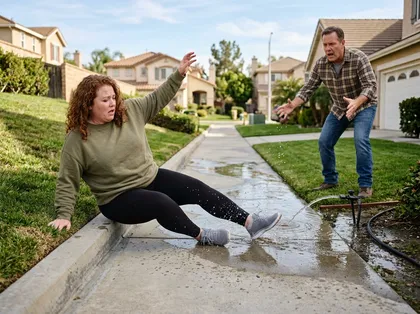
For example, liability may be investigated if a property owner’s sprinkler or irrigation system leaks onto the sidewalk, creating a wet and slippery surface that causes someone to fall.
A Business Or Commercial Property Occupant
A store, restaurant, or other business is not automatically liable simply because a fall happened on the public sidewalk outside its premises.
However, a business may be responsible if it created the hazard, exercised control over the area, or made special use of the sidewalk. Examples may include:
- Outdoor dining furniture that blocks the walking path.
- Merchandise or displays placed on the sidewalk.
- Equipment, mats, cords, or debris that created a hazard.
- Alterations made for customer access.
- Work performed on or near the sidewalk.
Applicable local ordinances may also affect whether a commercial property owner or tenant has maintenance or liability obligations.
Contractors, Utility Companies, And Other Parties
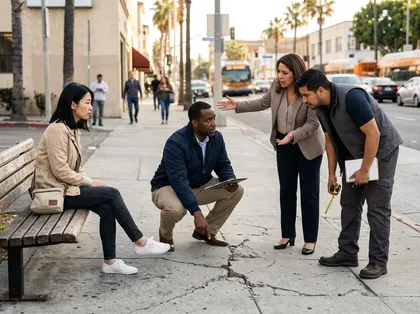
A contractor, utility company, or similar third party may be liable if its work created or worsened the dangerous condition. Permits, work orders, construction records, and repair records can help identify who performed work at the location and whether that work contributed to the accident.
Contractors or utility companies can be liable in certain situations. These can include the following examples:
- A utility trench that was poorly patched after underground work.
- Uneven pavement left after construction.
- A section of the sidewalk was removed and not restored safely.
- Construction debris is left in the pedestrian path.
- Temporary equipment or materials creating a tripping hazard.
Depending on the location and circumstances, other parties may also be liable, such as:
- A property management company that is responsible for maintenance.
- A landscaping company whose work damaged or obstructed the sidewalk.
- A tenant that created or controlled the hazard.
- A developer or construction company that is responsible for defective work.
- Another private party placed an obstruction or created a dangerous condition.
More than one party may be responsible for the same hazard. For example, a city may control the sidewalk while a utility company performs defective repair work, or an adjacent owner created the condition that caused the fall.
Identifying the liable party is the first step. You still need to show that the responsible party was negligent, meaning they failed to take reasonable care to prevent harm. Sidewalk accident lawyers can help you tackle that next challenge.
How Can Local Sidewalk Ordinances Change Who Is Liable?
State law does not tell the entire story. Local ordinances can assign additional sidewalk maintenance duties or, in some cities, affect whether an adjacent property owner may be liable to an injured pedestrian.
California Streets and Highways Code § 5610 requires many owners next to public sidewalks to keep those areas in good repair. However, a duty to repair does not always determine who owes damages to an injured pedestrian. Some cities adopt additional rules that expressly create liability. San José provides a clear example of how these local rules can work.
For example, San Jose Municipal Code § 14.16.2200 requires certain adjacent property owners to maintain and repair sidewalk areas. Section 14.16.2205 goes further by creating a duty to members of the public. Under that provision, an owner may be liable when a failure to maintain the sidewalk safely results in injury or property damage.
Local rules can vary, so check the ordinance in effect where the accident occurred. Don’t assume that the same liability rule applies everywhere in California.
Evidence You Can Use To Prove Liability In A Sidewalk Accident
Identifying a potentially responsible party is only the first step. You also need evidence showing that the party was legally responsible for the dangerous condition and that the condition caused your injury.
Under state law (Gov. Code §835), a public agency can be responsible when a dangerous condition exists and either a public employee created it, or the agency had actual or constructive notice with enough time to fix it.
For private parties, liability may depend on evidence showing that the defendant created the hazard, controlled the area, knew or should have known about the condition, or had another legal duty to address it.
Useful evidence may include:
- Photos or a video of the sidewalk defect.
- Measurements of a raised or sunken section.
- Prior complaints about the condition.
- Inspection and maintenance records.
- Repair requests.
- Work permits and contractor records.
- Witness statements.
- Surveillance footage.
- Evidence showing how long the condition existed.
- Records identifying who owned or controlled the location.
California law does not make a public entity responsible for every minor sidewalk imperfection. Government Code § 830.2 states that a condition isn’t legally dangerous if the risk is minor or trivial. If no reasonable person sees it as a substantial risk while using the property carefully, it’s not considered dangerous. This is commonly referred to as the trivial defect doctrine or trivial defect rule.
How long the defect existed can help prove notice, but time alone does not decide the issue. Slip-and-fall lawyers rely on prior complaints, inspection records, and the defect’s obviousness to determine if the case is valid.
What Should You Do After A Sidewalk Accident?
Sidewalk conditions can change quickly after a fall. Preserving evidence early is important. Repairs can happen, debris can be cleared, and surveillance footage might be overwritten.
- Photograph the hazard. Take close-up and wider photographs showing the exact location, the surrounding sidewalk, the lighting, and anything that may have affected visibility. Include an object for scale when possible.
- Document the location. Record the address, nearby businesses or residences, intersection, and any identifying landmarks.
- Report the accident. Notify the appropriate city department, property owner, or business, and keep a record of the report. Remember that reporting an accident is not the same as properly presenting a government claim.
- Get medical care. Seek appropriate evaluation and treatment, and describe how the fall occurred.
- Preserve evidence. Keep damaged shoes or clothing, photographs, receipts, medical records, correspondence, and other documents related to the accident.
- Identify witnesses. Obtain contact information from anyone who witnessed the fall or was aware of the sidewalk condition.
Different injuries can result from a fall. Knowing what you can do after such an incident can help you gather the information and evidence you may need if you decide to file a claim.
What Are The Deadlines For A Sidewalk Fall Claim In California?
Sidewalk fall deadlines can be much shorter than many people expect, especially when a city or other public entity may be involved. The time limit depends on who may be responsible for the accident.
- City or Other Public Entity: You generally have six months from the date of injury to present a government claim under Government Code § 911.2. After a written rejection, you generally have six months from the rejection notice to file a lawsuit under Government Code §945.6.
- Private Party: You generally have two years from the date of injury to file a personal injury lawsuit under Code of Civil Procedure § 335.1.
A government claim is not the same as simply reporting the accident to the city. It must include the required information about the incident and your injuries.
If you miss the six-month deadline for government claims, there may be late-claim options. However, these come with their own rules and deadlines. Because a sidewalk accident may involve a city, property owner, contractor, utility company, or another party, identifying who may be liable early is important to avoid missing the correct deadline.
Injuries And Losses From A Sidewalk Slip-And-Fall
A sidewalk fall can cause injuries ranging from sprains and torn ligaments to broken bones, head injuries, and neck or back injuries. The severity of those injuries can directly affect the value of a personal injury claim.
Common injuries may include:
- Wrist, arm, ankle, or hip fractures.
- Sprains and torn ligaments.
- Knee and shoulder injuries.
- Cuts and facial injuries.
- Concussions and other traumatic brain injuries.
- Neck and back injuries.
There is no fixed dollar amount for a California sidewalk accident claim. Its value depends on factors such as the severity and duration of the injuries, the medical treatment required, time missed from work, any lasting effect on earning ability, the strength of the liability evidence, and whether the injured person shares responsibility for the accident.
Depending on the facts, compensation may include:
- Medical Expenses: Past and reasonably necessary future accident-related care.
- Lost Income: Wages or other earnings lost because of the injuries.
- Loss of Earning Capacity: Reduced ability to earn income in the future.
- Out-of-Pocket Expenses: Accident-related costs such as prescriptions, mobility aids, or other necessary expenses.
- Pain and Suffering: Compensation for physical pain and other non-economic effects of the injury.
Medical records and other documentation can help connect these injuries and losses to the fall. However, suffering serious injuries or financial losses does not automatically establish a right to compensation. You must also prove that the dangerous sidewalk condition caused your injuries and that legal liability exists. That is why determining liability is essential to evaluating a sidewalk accident claim.
Real Sidewalk And Premises Liability Case Results
Past case results can show how unsafe property conditions may lead to significant injuries and financial losses. While every sidewalk and premises liability case depends on its own facts, the following results reflect recoveries Arash Law has obtained for clients injured in falls and other accidents involving dangerous property conditions.
- Premises Liability Recovery: $3,500,000. Poor lighting on a property led to a fall that caused a spinal injury. We fought to hold the property accountable and obtain compensation for our client.
- Slip-and-Fall Recovery: $3,000,000. Video footage of a fall helped secure this compensation and bring closure for our client after a slip-and-fall accident.
- Golf Course Recovery: $2,000,000. We secured this settlement in an accident involving premises liability due to unsafe property conditions.
Case Results Disclaimer: Every case is different, and past results do not guarantee a similar outcome. Results depend on the facts, injuries, available insurance, applicable law, and other circumstances. See more of our case results here.
Frequently Asked Questions About Sidewalk Accidents
Sidewalk accident cases raise many concerns, and it is normal to feel uncertain about your rights. The answers below address some questions people have about these types of accidents.
Can I Sue If I Was Partly At Fault For The Fall?
Yes. California uses a rule called pure comparative negligence. Under this rule, your compensation is reduced by your share of the fault, but you can still recover something. If you were 20% at fault, you could still receive 80% of your losses.
Who Pays For My Medical Bills After A Sidewalk Fall?
Your own health insurance often pays first as you receive treatment. A later claim can seek reimbursement of reasonable, accident-related medical expenses from the responsible party, depending on liability and available coverage.
Do I Need To Find Out Who Owns The Sidewalk Before Filing?
You may not know at the scene who owns or controls the sidewalk, and that should be looked into quickly, given the short government claim deadline. An attorney can review property and city records to identify who may be responsible.
What If I Fell On A Sidewalk In A Residential Neighborhood?
The same rules apply. A nearby homeowner is not automatically liable just because their property borders the sidewalk. Liability still depends on who created or controlled the hazard.
Can I Still Claim If There Were No Witnesses To My Fall?
Yes. A witness is not required, though your claim still needs evidence of the hazard, the responsible party’s legal responsibility for it, and your resulting injuries. Photos, medical records, and other documentation can help support your claim.
Hurt In A Public Sidewalk Fall? Arash Law Offers Legal Support
A slip on a public sidewalk in California can lead to injuries. Arash Law can investigate your sidewalk accident and help determine who may be responsible. Through an injury claim, you can pursue compensation for medical bills, lost wages, and other losses.
Our sidewalk accident lawyers handle injury cases on a contingency fee basis. You don’t pay upfront, and you only pay attorney’s fees if we win your case. Call (888) 488-1391 today for a free consultation. The sooner you reach out, the easier it is to gather the evidence your case needs.