TL;DR: There is no single #1 cause of every motorcycle accident. In fatal two-vehicle motorcycle crashes, the most common configuration in NHTSA’s 2023 data involved another vehicle turning left while the motorcycle was going straight, passing, or overtaking, accounting for 46% of those crashes. Single-vehicle crashes show different patterns, with speeding and alcohol impairment appearing frequently in fatal-crash data. The specific cause of any motorcycle accident depends on the vehicles involved, the conduct of the rider and other drivers, roadway conditions, and the available evidence.
The answer to “What is the #1 cause of motorcycle accidents?” depends on the type of crash being measured. NHTSA’s 2023 Motorcycles Traffic Safety Facts reported that 46% of fatal two-vehicle crashes involving a motorcycle occurred when the other vehicle was turning left while the motorcycle was going straight, passing, or overtaking. This makes left-turn conflicts the most common fatal two-vehicle crash configuration in that dataset.
Single-vehicle motorcycle crashes show a different pattern. The National Highway Traffic Safety Administration (NHTSA) reported that about 36% of motorcycle riders killed in 2023 died in single-vehicle crashes, while speeding and alcohol impairment were also common factors in fatal motorcycle crashes. Other crashes may involve unsafe lane changes, distraction, failure to yield, roadway hazards, or mechanical defects.
These statistics describe common crash patterns and contributing factors. They do not determine legal fault in an individual case.
Key Facts About Motorcycle Accident Causes in California
- CVC § 21801 requires a left-turning driver to yield to oncoming traffic that is close enough to constitute a hazard. If the requirements of Evidence Code § 669 are satisfied, violating that duty can create a rebuttable presumption that the driver failed to exercise due care.
- Civil Code § 1714(a) imposes a duty of care. California drivers have the duty to use reasonable care and keep a proper lookout for other road users, including motorcyclists.
- 46% of fatal two-vehicle motorcycle crashes nationally in 2023 involved a left-turning vehicle. This was the most common type of accident identified in NHTSA’s 2023 fatal two-vehicle motorcycle crash data.
- Deadlines can be as short as six months. When a motorcycle accident involves a public entity, the deadline for filing claims is six months from the date of the crash (Government Code § 911.2).
- California’s pure comparative negligence rule applies to motorcycle accidents. It means that even a rider found partially at fault may recover damages reduced only by their share of fault; the claim is not barred.
- California’s minimum auto liability limits are $30,000/$60,000/$15,000. The minimum coverage is $30,000 for injury or death to one person, $60,000 for injury or death to more than one person, and $15,000 for property damage.
Table of Contents

What California Data Shows About Motorcycle Accidents
In California, unsafe speed was the most common reported factor in motorcycle crashes that caused a fatal or serious injury, based on provisional 2023 Statewide Integrated Traffic Records System (SWITRS) data analyzed by the UC Berkeley Safe Transportation Research and Education Center (SafeTREC).
The five most common Primary Crash Factors were:
| Primary Crash Factor | Share of Fatal-and-Serious-Injury Motorcycle Crashes |
|---|---|
| Unsafe speed | 28.2% |
| Improper turning | 19.8% |
| Automobile right-of-way violation | 19.3% |
| Driving or bicycling under the influence of alcohol or drugs | 8.7% |
| Unsafe lane change | 5.2% |
That does not mean unsafe speed is the #1 cause of every motorcycle crash in California. These numbers apply only to crashes involving a fatal or serious injury in the provisional 2023 data.
SWITRS records a “Primary Crash Factor” associated with each collision. It is useful for spotting statewide trends, but it does not automatically decide who was legally at fault in a personal injury claim. Fault still depends on the facts and evidence in the individual crash.
Why Left-Turning Vehicles Pose a Great Danger
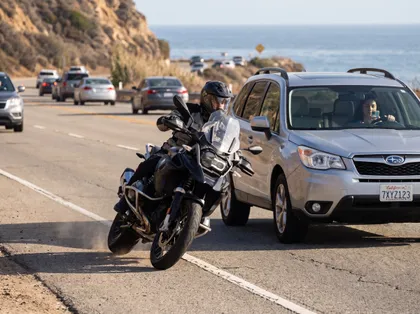
Left-turn conflicts are a common pattern in fatal two-vehicle motorcycle crashes. According to NHTSA, 46% of fatal two-vehicle crashes involving a motorcycle and another type of vehicle in 2023 occurred when the other vehicle was turning left while the motorcycle was going straight, passing, or overtaking. Several factors can make left-turn crashes especially dangerous for motorcyclists, including difficulty seeing a motorcycle and judging its distance or speed.
Some left-turn motorcycle crashes may involve failures to detect the motorcycle or accurately judge its distance or speed, although the cause of any individual crash depends on the evidence.
- Inattentional Blindness: Drivers may look toward an approaching motorcycle without fully registering it. Research on “looked-but-failed-to-see” crashes suggests motorcycles can receive less attentional priority than larger vehicles.
- Smaller Visual Presence: Because motorcycles occupy less visual space than passenger vehicles, they may be harder for motorists to distinguish from surrounding traffic, signs, and other background features.
- Difficulty Judging Approach: Drivers may have difficulty estimating the distance and closing speed of an approaching motorcycle, which can affect their judgment of whether there is enough time to turn safely.
- Path Conflict: A vehicle making a left turn may enter the motorcycle’s line of travel, leaving the rider limited time or space to brake or take evasive action.
Several perception problems may occur at once. A driver who overlooks the motorcycle may also underestimate its approach speed or mistakenly believe the available turning gap is sufficient.
What Factors Lead to Motorcycle Accidents?
Motorcycle accidents can result from another driver’s actions, the rider’s conduct, roadway conditions, or mechanical problems. The most common factors often vary depending on whether the crash involves another vehicle or only the motorcycle.
Two-Vehicle and Multi-Vehicle Crashes
Crashes involving other vehicles often result from conflicts over right-of-way, lane position, or visibility.
Factors that may contribute include:
- Left-Turn Conflicts: A driver may turn across the path of an approaching motorcycle.
- Unsafe Lane Changes: A driver may move into a rider’s path without adequately checking mirrors or blind spots.
- Failure to Yield: A vehicle may enter an intersection, driveway, or roadway without yielding to the motorcycle.
- Distracted Driving: Texting, navigation systems, eating, or other distractions may prevent a driver from noticing or reacting to a rider.
- Speeding: Excessive or unsafe speed by either road user can reduce reaction time and make a collision harder to avoid.
- Impairment: Alcohol or drugs can affect judgment, perception, coordination, and reaction time.
- Sudden Traffic Conflicts: Rear-end crashes, chain-reaction collisions, and vehicles entering from side streets can also lead to motorcycle crashes.
Single-Vehicle Crashes
Single-vehicle crashes often involve rider behavior, loss of control, roadway conditions, or mechanical failure. Common factors may include:
- Unsafe Speed: Speed that is too high for a curve, traffic, weather, visibility, or road conditions can contribute to loss of control.
- Impaired Riding: Alcohol or drugs can interfere with balance, judgment, and reaction time. The NHTSA reported that 41% of motorcycle riders killed in single-vehicle crashes in 2023 were alcohol-impaired, with a blood alcohol concentration of .08 g/dL or higher.
- Loss of Control: A rider may lose control while cornering, braking, accelerating, or reacting to a sudden hazard.
- Roadway Hazards: Potholes, loose gravel, uneven pavement, debris, slick surfaces, and construction conditions can destabilize a motorcycle.
- Mechanical Problems: Tire failures, brake defects, steering or suspension issues, and faulty repairs can contribute to a crash.
The NHTSA reported that 36% of motorcycle riders involved in fatal crashes in 2023 were speeding, and alcohol impairment was also common among riders killed in single-vehicle crashes.
Roadway, Construction, and Mechanical Causes
Not every motorcycle crash is primarily caused by the actions of a driver or rider. Roadway defects, poorly maintained pavement, defective traffic controls, unsafe construction zones, and debris may contribute to a crash. Mechanical or product defects may also be involved, including defective tires, brakes, wheels, steering components, or improperly performed repairs.
Depending on the evidence, these crashes may involve liability by a public entity, construction contractor, motorcycle or parts manufacturer, distributor, dealership, or repair facility.
The cause of a motorcycle crash must be determined from the specific facts and evidence. A common crash pattern does not automatically establish who was legally at fault.
What Are the California Laws That Apply to Motorcycles?
California motorcycle accident claims often turn on whether the rider or another driver violated a traffic law, and whether that violation contributed to the crash. The most relevant laws include:
- Lane Splitting (CVC § 21658.1): California law expressly defines lane splitting as riding a two-wheeled motorcycle between rows of stopped or moving vehicles in the same lane. Lane splitting is not unlawful by itself, but a rider may still be found partially or fully at fault if the manner of lane splitting was negligent under the circumstances.
- Unsafe Lane Changes (CVC § 22107): Drivers may not move right or left until the movement can be made with reasonable safety and must signal when another vehicle may be affected. This can support liability when a driver changes lanes into a motorcycle, including a motorcycle traveling between lanes.
- Left Turns (CVC § 21801): A driver turning left or making a U-turn must yield to approaching traffic that is close enough to constitute a hazard. This law is particularly important in motorcycle crashes where a vehicle turns across the rider’s path.
- Helmet Requirement (CVC § 27803): Motorcycle operators and passengers generally must wear a qualifying safety helmet. Riding without one does not automatically eliminate an injury claim. However, if there is sufficient evidence that the lack of a helmet contributed to the injuries or their severity, the defense may argue for a reduction in damages.
- Speeding (CVC § 22350): California’s basic speed law prohibits driving faster than is reasonable or prudent for traffic, visibility, weather, and roadway conditions. Evidence that either the motorcyclist or another driver was speeding can affect comparative fault.
- DUI (CVC § 23152): It is unlawful to drive while under the influence of alcohol or drugs. Evidence that an impaired driver caused the collision can strongly support negligence and causation, although the injured rider must still establish the elements of the civil claim.
- General Negligence (Civil Code § 1714): California imposes a general duty to exercise reasonable care. That principle can apply when a driver fails to keep a proper lookout, follows too closely, opens a door into a rider’s path, or otherwise operates a vehicle unsafely, even when no motorcycle-specific statute directly addresses the conduct.
- Traffic-Law Violations and Negligence Per Se (Evidence Code § 669): A violation of a statute or regulation can create a rebuttable presumption of negligence when the statutory requirements are met. For example, violating the left-turn or unsafe-lane-change laws may strengthen a motorcycle rider’s liability argument.
Traffic violations can help establish fault, but a citation or statutory violation does not by itself resolve every issue in a personal injury case. Causation, damages, and comparative fault may still be disputed.
Proving Driver Fault Under California Law
When a driver turns left across the path of an approaching motorcycle, Vehicle Code § 21801 generally requires the turning driver to yield if the motorcycle is close enough to constitute a hazard. Whether the turning driver is ultimately liable depends on the facts and any comparative fault.
If the requirements of Evidence Code § 669 are satisfied, a violation of Vehicle Code § 21801 can create a rebuttable presumption that the driver failed to exercise due care. The driver may attempt to rebut that presumption, but the rider must still prove causation and damages.
CVC § 22107 requires a driver to turn or move right or left from a direct course only when the movement can be made with reasonable safety and, when another vehicle may be affected, after giving an appropriate signal. If the requirements of Evidence Code § 669 are satisfied, a violation of § 22107 can also create a rebuttable presumption that the driver failed to exercise due care.
A driver may be at fault for conduct such as:
- Turning across a motorcycle’s path without yielding when required.
- Making an unsafe lane change into the rider’s path.
- Failing to keep a proper lookout for motorcycles and other road users.
- Speeding or driving too fast for traffic or road conditions.
- Driving while distracted or impaired.
A motorcycle rider may also share fault if their own negligent conduct contributed to the crash, such as:
- Unsafe speeding.
- Making an unsafe maneuver.
- Riding while impaired.
- Engaging in other conduct that contributed to the collision.
California follows pure comparative negligence. A rider’s share of fault generally reduces the damages recoverable rather than automatically barring the claim.
How Is the Cause of a Motorcycle Accident Proven?
The cause of a crash is established through evidence, not merely through the type of collision or an initial allegation of fault.
The following evidence may help motorcycle accident lawyers determine how a crash occurred:
- Crash-scene photographs and video. These may show vehicle positions, impact points, skid or tire marks, debris, sight obstructions, traffic controls, and road conditions.
- Surveillance, dashcam, or traffic-camera footage. Video may establish the movement and timing of vehicles before impact.
- Vehicle damage. The location and direction of damage may help establish impact geometry and vehicle movement.
- Witness statements. Independent witnesses may describe speed, traffic-signal phases, lane position, turns, or other conduct.
- Phone and electronic records. When legally obtainable, these may help evaluate allegations of distracted driving.
- Toxicology and law-enforcement evidence. These records can be important when alcohol or drug impairment is alleged.
- Vehicle and event data. Available electronic data may assist in evaluating speed, braking, acceleration, or other vehicle activity, depending on the vehicle and system involved.
- Accident reconstruction. Experts may analyze physical evidence, vehicle dynamics, sight lines, speed, and timing in serious or disputed crashes.
- Roadway maintenance and construction records. Inspection, repair, complaint, work-zone, and maintenance records may help determine whether a dangerous roadway condition contributed to the crash.
- Motorcycle inspection and component evidence. When mechanical failure is suspected, the motorcycle and the failed component may need to be preserved for inspection before they are repaired or destroyed.
Surveillance footage and other evidence can disappear over time, so knowing what to do after a motorcycle accident and taking prompt steps to preserve evidence may be important.
Injured in a motorcycle crash? Call Arash Law at (888) 488-1391 for a free case evaluation with our motorcycle accident lawyers. Arash Law has recovered over $1 billion for clients across California.
Will Shared Fault or Uninsured Drivers End Your Claim?
No. California follows a pure comparative negligence rule established by the California Supreme Court in Li v. Yellow Cab Co., 13 Cal. 3d 804 (1975). Under this rule, a rider’s own negligence does not automatically bar recovery. Instead, the rider’s damages are generally reduced in proportion to their share of fault.
For example, if a rider is found 30% responsible for a crash, the damages awarded would generally be reduced by 30%. Allegations that a rider was speeding, lane splitting unsafely, or otherwise negligent may therefore reduce recovery without necessarily eliminating the claim.
If the driver who caused the crash has no insurance, the rider’s own uninsured motorist (UM) coverage may apply under California Insurance Code § 11580.2. Underinsured motorist (UIM) coverage may apply when the at-fault driver’s bodily injury liability limits are lower than the insured’s applicable UIM limits, and the statutory requirements are met.
California’s minimum auto liability limits increased effective January 1, 2025. The minimum limits are:
- $30,000 for injury or death to one person.
- $60,000 for injury or death to more than one person.
- $15,000 for property damage.
These limits apply under California’s updated financial responsibility requirements.
California Filing Deadlines for Motorcycle Crash Claims
Motorcycle crash claims in California are subject to strict filing deadlines, and the applicable time limit depends on who may be responsible for the crash. Missing a deadline can bar recovery, so the timing should be evaluated early.
- Standard Two-Year Deadline: Under CCP § 335.1, an injured person generally has two years from the date of the crash to file a personal injury lawsuit against a private driver or business.
-
Shorter Public-Entity Deadline: A personal injury claim against a public entity generally must be presented within six months after the cause of action accrues under Government Code § 911.2. This rule may apply when a road defect, failed signage, government vehicle, or other public property contributed to the crash.
A public entity generally has 45 days to act on a claim, subject to statutory extensions; if it does not act within that period, the claim is generally deemed rejected. The deadline to file suit afterward depends on whether the entity gives a compliant written rejection notice under Government Code § 913. Under Government Code § 945.6, a suit generally must be filed within six months after a compliant rejection notice is personally delivered or mailed. If no compliant notice is given, a different deadline generally applies.
The six-month claim-presentation rule can apply when a public entity may be legally responsible, including some claims involving government-owned or controlled roadways, traffic signals, guardrails, or public vehicles. A claim alleging that a pothole on a state highway, a missing guardrail on a Caltrans-maintained road, or a defective traffic signal on city-owned infrastructure caused the crash may therefore be subject to the government-claim presentation requirements.
For many private personal injury claims, the filing deadline may be tolled while the injured person is a minor. Government-entity claims and other specialized claims can have different timing rules, so the applicable deadline should be reviewed with an attorney.
What Arash Law Has Recovered in Motorcycle Accident Cases
Arash Law has recovered over $1 billion for clients across California. The following case results show what our attorneys have recovered for motorcycle accident victims:
$1,450,000 — (Road Defect): A motorcycle rider suffered fractured ribs and head trauma after encountering uneven pavement in a construction zone. The contractors and the city disputed liability, but the case settled after the first day of trial.
$1,550,000 — (Rideshare Accident): Arash Law secured a settlement in July 2021 for a motorcycle rider who suffered spinal and wrist injuries in a collision involving a rideshare vehicle. The result was reported as the largest motorcycle settlement in Tulare County that year.
Past results do not guarantee future outcomes. Every case is different, and results depend on the specific facts and evidence involved.
Frequently Asked Questions About Motorcycle Accident Causes in California

Should I Give a Recorded Statement to the Insurance Adjuster?
A third-party claimant generally does not have to provide the other driver’s insurer with a recorded interview. The insurer may consider any statements provided when evaluating the claim. If you are unsure about your rights or obligations, you may want to speak with an attorney before giving a recorded statement.
Does California Law Require Motorcyclists to Wear a Helmet?
Yes. CVC § 27803 requires all California motorcycle riders and passengers to wear a DOT-compliant helmet. Not wearing a helmet does not automatically bar a rider’s injury claim. Still, the defense may use it to argue that the rider’s injuries were more severe than they would have been, potentially reducing the damages recoverable under California’s comparative fault framework.
What Damages Can I Recover After a Motorcycle Accident?
You may seek compensation for medical expenses, lost income, reduced earning capacity, and other financial losses caused by the crash. You may also recover non-economic damages for pain, suffering, and emotional distress. The amount depends on your injuries, supporting evidence, available insurance, and any share of fault assigned to you.
Can a Motorcycle Passenger File an Injury Claim?
Yes. An injured passenger may pursue a claim against the motorcycle operator, another driver, or another party whose negligence contributed to the crash. The passenger must show that the defendant’s negligence caused the injuries and resulting losses.
Talk to Arash Law About Your California Motorcycle Crash
If you were injured in a California motorcycle crash, consider speaking with an attorney promptly, particularly when a public entity may be involved. Deadlines can be short, especially if a public entity is responsible. Evidence such as surveillance footage, skid marks, and witness recollections can become unavailable over time.
Whether your crash involved a left-turning driver, an uninsured motorist, or a road defect on a government-maintained highway, Arash Law can evaluate your case and explain your options. Call us today at (888) 488-1391. No attorney’s fees unless we win your case.
Sources
- National Highway Traffic Safety Administration (NHTSA). 2023 Motorcycles Traffic Safety Facts, DOT HS 813 732.
https://crashstats.nhtsa.dot.gov/Api/Public/ViewPublication/813732- National Highway Traffic Safety Administration (NHTSA). Motorcycle Safety.
https://www.nhtsa.gov/road-safety/motorcycles- UC Berkeley Safe Transportation Research and Education Center (SafeTREC). 2025 Traffic Safety Facts: Motorcycle Safety (provisional 2023 SWITRS data).
https://safetrec.berkeley.edu/2025-safetrec-traffic-safety-facts-motorcycle-safety- California Vehicle Code § 21658.1, lane splitting.
https://leginfo.legislature.ca.gov/faces/codes_displaySection.xhtml?lawCode=VEH§ionNum=21658.1- California Vehicle Code § 21801, left-turn and U-turn yield duty.
https://leginfo.legislature.ca.gov/faces/codes_displaySection.xhtml?lawCode=VEH§ionNum=21801- California Vehicle Code § 22107, turning and lane-movement safety.
https://leginfo.legislature.ca.gov/faces/codes_displaySection.xhtml?lawCode=VEH§ionNum=22107- California Vehicle Code §§ 27802–27803, motorcycle helmet requirements.
https://leginfo.legislature.ca.gov/faces/codes_displaySection.xhtml?lawCode=VEH§ionNum=27803- California Vehicle Code § 22350, Basic Speed Law.
https://leginfo.legislature.ca.gov/faces/codes_displaySection.xhtml?lawCode=VEH§ionNum=22350- California Vehicle Code § 23152, driving under the influence.
https://leginfo.legislature.ca.gov/faces/codes_displaySection.xhtml?lawCode=VEH§ionNum=23152- California Civil Code § 1714, general duty of ordinary care.
https://leginfo.legislature.ca.gov/faces/codes_displaySection.xhtml?lawCode=CIV§ionNum=1714- California Evidence Code § 669, rebuttable presumption based on statutory violations.
https://leginfo.legislature.ca.gov/faces/codes_displaySection.xhtml?lawCode=EVID§ionNum=669- Li v. Yellow Cab Co., 13 Cal. 3d 804 (1975), California pure comparative negligence.
- California Civil Code § 3333.4, limitations on non-economic damages in certain motor-vehicle cases.
https://leginfo.legislature.ca.gov/faces/codes_displaySection.xhtml?lawCode=CIV§ionNum=3333.4- California Code of Civil Procedure § 335.1, two-year personal injury statute of limitations.
https://leginfo.legislature.ca.gov/faces/codes_displaySection.xhtml?lawCode=CCP§ionNum=335.1- California Government Code § 911.2, claim-presentation deadline.
https://leginfo.legislature.ca.gov/faces/codes_displaySection.xhtml?lawCode=GOV§ionNum=911.2- California Government Code § 912.4, time for a public entity to act on a claim.
https://leginfo.legislature.ca.gov/faces/codes_displaySection.xhtml?lawCode=GOV§ionNum=912.4- California Government Code § 913, written rejection notice.
https://leginfo.legislature.ca.gov/faces/codes_displaySection.xhtml?lawCode=GOV§ionNum=913- California Government Code § 945.6, the deadline to file suit after the claims process.
https://leginfo.legislature.ca.gov/faces/codes_displaySection.xhtml?lawCode=GOV§ionNum=945.6- California Insurance Code § 11580.2, uninsured and underinsured motorist coverage.
https://leginfo.legislature.ca.gov/faces/codes_displaySection.xhtml?lawCode=INS§ionNum=11580.2- SB 1107 (2021–2022 Reg. Sess.), Stats. 2022, ch. 717, California minimum auto liability limits effective January 1, 2025.
https://leginfo.legislature.ca.gov/faces/billNavClient.xhtml?bill_id=202120220SB1107- Pammer et al. The inattentional blindness effect on motorcycle detection.
https://pubmed.ncbi.nlm.nih.gov/28982011/Disclaimer
The information on this page is for general educational purposes and does not constitute legal advice. No attorney-client relationship is formed by reading or relying on this content. If you were injured, consult a licensed California personal injury attorney about your specific situation.