TL;DR: After a motorcycle accident in Orange County, call 911 and document the scene before evidence disappears. Don’t forget to report the accident to your insurer and the authorities. You usually have 2 years from the date of the accident to file a personal injury lawsuit. Missing this deadline may compromise your right to recover medical bills, lost wages, and pain and suffering.
Key Facts
- An SR-1 Report of Traffic Accident is required with the California DMV within 10 days if the crash caused any bodily injury or property damage over $1,000.
- An administrative claim must be filed within 6 months if a public entity is involved.
- Orange County motorcycle injury lawsuits are typically filed in the Orange County Superior Court, Central Justice Center, in Santa Ana.
- 902 victims were killed or injured in motorcycle accidents in Orange County in 2023, according to OTS.
- The victim may recover both economic and non-economic damages.
- California Insurance Code § 11580.2 generally requires motor-vehicle bodily-injury liability policies to include UM/UIM coverage unless the named insured rejects or modifies that coverage in writing as permitted by law.
Table of Contents

After a motorcycle crash in Orange County, the decisions you make in the first hours are among the most consequential for your claim. To protect yourself, get to safety, seek medical care right away, and take steps to preserve your legal claim. Acting quickly is important. Evidence from the crash scene fades fast. Other parties start building their defense immediately.
In Orange County, collisions can happen on Pacific Coast Highway (PCH) in Huntington Beach, SR-55 in Costa Mesa, or at the busy I-405/SR-22 interchange. These areas combine coastal roads, freeway interchanges, and crowded commercial zones. This mix leads to conditions quite different from those in a typical car accident. Motorcycle riders face a far greater risk of injury and far less physical protection.
What To Know First About An Orange County Motorcycle Crash
Motorcycle accident claims can present issues that do not arise in the same way in standard passenger-vehicle crashes. Motorcycle visibility, lane positioning, lane splitting, protective gear, road defects, and the severity of a rider’s injuries may all become important.
- Where Your Case May Be Filed: Civil personal injury claims arising from Orange County crashes are generally heard at the Orange County Superior Court, Central Justice Center, 700 Civic Center Drive West, Santa Ana, CA 92701. Court assignments and filing locations may change, so confirm before filing.
- Common Crash Scenarios on Orange County Roads: Common dispute patterns alleged in Orange County motorcycle claims include left-turn conflicts and blind-spot freeway merges on corridors such as SR-55, Pacific Coast Highway, and the I-405/SR-22 interchange, where the road geometry and traffic volumes create frequent lane-change and speed-differential hazards.
- What Kind of Firm Your Case Requires: Orange County motorcycle claimants could face a built-in bias, as adjusters and sometimes jurors assume the rider was reckless. Your attorney needs specific experience in motorcycle litigation, not just general personal-injury experience.
- The Deadlines That Govern Your Claim: Deadlines differ for private and public-entity defendants. They could be months or years, depending on your case. Both run from the date of injury.
Orange County reported 902 people killed or injured in motorcycle accidents in 2023, according to the California Office of Traffic Safety (OTS). Motorcyclists are one of the most vulnerable groups on the road. They lack protection and face a much higher risk of serious injury or death in crashes compared to people in passenger vehicles.
Critical Steps To Take After An Orange County Motorcycle Crash
The actions below do not always happen in a fixed order. What you should do first depends on your injuries, immediate safety, the condition of the crash scene, and whether emergency responders are already present. Focus on the steps that are safe and practical in your circumstances. Each one can help protect your health, preserve evidence, and safeguard your legal rights.
Step 1: Call 911, Stay At The Scene, And Get Out Of Immediate Danger
Call 911 from anywhere on Orange County roads. The California Highway Patrol (CHP) serves freeway corridors and unincorporated areas of Orange County. At the same time, local police departments, such as the Costa Mesa PD, Huntington Beach PD, and Santa Ana PD, may respond to crashes within their jurisdictions.
If you are in an active traffic lane, focus first on immediate safety:
- Move out of the path of approaching vehicles if you can do so without worsening an injury.
- Avoid unnecessary movement if you may have suffered a serious head, neck, back, or spinal injury, unless remaining where you are presents an immediate danger.
- Do not unnecessarily remove an injured rider’s helmet if a neck or spinal injury may be present. Unless removal is necessary to address an immediate airway or breathing emergency, allow trained emergency personnel to handle it.
California Vehicle Code (CVC) §§ 20001 and 20003 require drivers involved in an injury accident to remain at the scene and render reasonable assistance. If the other driver leaves, do not chase them. Instead:
- Write down or photograph the vehicle description.
- Record the license plate number.
- Note the direction of travel.
- Give that information to the responding officer.
Before leaving, note the responding agency and obtain the incident or report number. You or your attorney can later request the collision report from the agency that investigated the crash.
Step 2: Get Emergency Medical Care
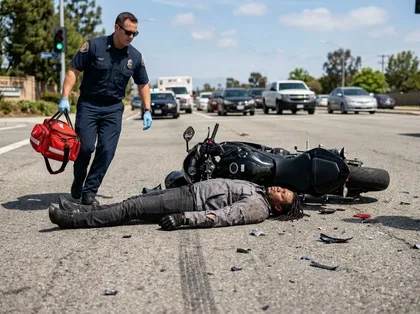
Seek prompt medical attention after a motorcycle crash, even if you do not immediately feel significant pain. If you have serious or concerning symptoms, seek emergency medical care. UCI Health’s Trauma and Critical Care Surgery program is Orange County’s specialized resource for serious crash injuries, including traumatic brain injury, spinal trauma, and internal hemorrhage. Imaging in the emergency department, such as CT scans and X-rays, can detect internal injuries that a physical exam might miss.
Follow the treatment plan recommended by your healthcare providers. If your symptoms worsen after your first check-up, seek further medical help. Be sure to tell them when the crash happened and when the symptoms started.
Step 3: Exchange Information At The Scene
If another driver causes your motorcycle accident, get their driver’s license and insurance info. Stay calm and polite. Stay calm and polite, and avoid making statements about who caused the crash. California law generally protects expressions of sympathy from being used as admissions of liability, but an accompanying statement admitting fault may still be admissible.
Collect the following:
- Full name and contact details.
- Driver’s license number.
- License plate number.
- Vehicle make, model, and color.
- Insurance company name and policy number.
- Name and contact information for the vehicle owner, if different from the driver.
Step 4: Document The Crash Scene
If the crash happened on SR-55, I-405, SR-22, PCH, or another major Orange County corridor, photograph the exact roadway location, lane markings, nearby exits or intersections, construction areas, and traffic-control devices. These details can help identify the roadway owner and preserve the appearance of the scene at the time of the crash. Capture everything that tells the story of what happened:
- Your motorcycle and all other vehicles involved.
- Damage to each vehicle from multiple angles.
- Skid marks, debris fields, and fluid spills.
- Traffic signals, road signs, and lane markings.
- Potholes, loose gravel, pavement defects, or road construction hazards.
- Weather conditions, lighting, and traffic patterns.
- Your helmet, riding gear, and any visible injuries.
Write down your account of the crash while your memory is sharpest. Include the direction each vehicle was traveling, estimated speeds, and what happened in the moments just before impact.
Do not repair, sell, or dispose of your motorcycle, helmet, or riding gear until they have been photographed and your attorney or insurer has had a chance to inspect them. Physical evidence from the bike itself, including impact angles, gouge marks, and handlebar position, can help a reconstruction expert establish how the crash occurred.
Also, act quickly to identify any Orange County Transportation Authority (OCTA) bus cameras or intersection cameras that may have captured the crash on OC roads. Video from these sources may be overwritten quickly, so your attorney should send a preservation demand as soon as possible.
Step 5: Get Witness Contact Information
Ask every witness for a name, phone number, and email address before they leave. Do not assume the responding officer gathered everyone’s information. An independent witness who saw the other driver speed through a light, change lanes without signaling, or run a stop sign can provide objective evidence that is difficult for an insurer to dispute.
In busy Orange County commercial areas, such as parts of Santa Ana, Anaheim, Huntington Beach, and Costa Mesa, nearby storefronts or parking facilities may have surveillance cameras even when no eyewitnesses were present at the scene.
Step 6: Report The Crash To Your Insurer
Notify your own insurance company within the time period your policy requires. Most policies demand prompt reporting, sometimes within 24 to 48 hours. Give accurate information about what happened.
The other driver’s insurer may contact you to request a recorded statement or ask you to sign a medical authorization. You are generally not required to give the other insurer a recorded statement. Before you speak with any adjuster about fault or injuries, consider consulting an Orange County motorcycle accident lawyer. Recorded statements are a common tool insurers use to lock in early versions of events before the full picture is clear.
Step 7: File The California DMV SR-1 Report
If the crash caused any bodily injury or more than $1,000 in property damage, you must file an SR-1 Report of Traffic Accident with the California Department of Motor Vehicles (DMV) within 10 days. This filing is separate from the police report and your insurance claim. You can submit it online through the DMV’s Traffic Accident Report portal or mail your completed form to the address listed on the SR-1 instructions page.
Failing to submit a required SR-1 may result in suspension of your driving privilege. The SR-1 is an administrative filing for financial-responsibility purposes. The DMV does not determine fault or civil liability through this process.
What To Do In The Days And Weeks After The Crash
The work of protecting your health and documenting a potential personal injury claim does not end when you leave the accident scene. In Orange County, your next steps may also depend on which law enforcement agency investigated the crash and whether a local or state public entity was involved.
Continue to:
- Follow your medical treatment plan. Attend recommended appointments and report new or worsening symptoms to your healthcare providers. Keep records from any Orange County hospitals, specialists, rehabilitation providers, or other medical professionals involved in your care.
- Obtain the collision report. If CHP investigated the crash, an eligible party can request the report through CHP’s online crash-report system or a CHP office. If an Orange County city police department investigated the collision, request the report through that department’s current records-request process.
- Document financial losses. Save medical bills, prescription receipts, towing and storage invoices, motorcycle repair estimates, transportation expenses, pay stubs, employer correspondence, time-off records, disability paperwork, and other documents showing crash-related expenses or lost income.
- Track your recovery. Keep a simple record of significant symptoms, physical limitations, medical appointments, sleep disruption, missed activities, and changes in your ability to perform ordinary daily tasks.
- Preserve physical and digital evidence. Keep the motorcycle, helmet, damaged riding gear, photographs, videos, camera files, and other evidence in substantially the same condition whenever possible. If an OCTA vehicle, an intersection camera, or a nearby business or residence may have recorded the crash, promptly identify the source, as footage may not be retained indefinitely.
- Consider legal advice when the stakes are significant. Speaking with a personal injury attorney may be particularly useful when:
- Injuries are serious.
- The fault is disputed.
- Multiple parties may be responsible.
- A commercial vehicle or public agency is involved.
- The other driver lacks sufficient insurance.
- An insurer is requesting a recorded statement, broad medical authorization, or release.
Proving Fault After A Motorcycle Crash In Orange County
To recover compensation after a motorcycle crash, an injured rider generally must show that another party acted negligently. Evidence may include police reports, traffic-camera footage, witness statements, vehicle damage, medical records, phone records, and accident reconstruction findings.
In Orange County, useful evidence may include CHP or local police reports, Caltrans or municipal roadway records, OCTA-related footage, surveillance footage from nearby businesses, and photographs showing the exact lane or road conditions where the crash occurred.
Under California law, a negligence claim usually requires proof of four elements:
- Duty of Care: The other party had a legal duty to exercise reasonable care, including obeying traffic laws and watching for motorcycles.
- Breach of Duty: The party violated that duty by speeding, driving while distracted, making an unsafe turn, or engaging in other careless conduct.
- Causation: The careless conduct was a substantial factor in causing the motorcycle crash and the rider’s injuries.
- Damages: The rider suffered measurable losses.
Depending on the facts, liable parties may include:
- A negligent car, truck, or rideshare driver.
- A driver’s employer or commercial vehicle company.
- A motorcycle, vehicle, or defective-parts manufacturer.
- A road construction company or property owner.
- A city, county, or state agency responsible for a dangerous road condition.
Drivers may be at fault in motorcycle accidents, but fault depends on how the crash occurred. Still, more than one party may share fault for the same crash, including the motorcyclist. Road ownership can matter in Orange County. A crash involving a Caltrans-controlled highway, an OCTA vehicle, a city street, or an unincorporated county road may involve different procedures and shorter notice requirements if a claim is being pursued against the responsible public entity.
How Pure Comparative Negligence Works
California courts follow a pure comparative negligence standard. This fault system reduces your compensation by the percentage of responsibility you bear. If a jury finds you 20% at fault and the other driver 80% at fault for a crash on Pacific Coast Highway, your $500,000 award is reduced by 20% to $400,000.
Motorcycle riders may face assumptions about lane position, speed, or riding style when fault is disputed. Objective evidence, such as physical crash data, independent witness accounts, and available traffic-camera footage, can help establish how the crash occurred.
When Multiple Parties Share Fault
If the other driver and a road-maintenance agency both contributed to the crash, you may pursue claims against both parties. For example, a distracted driver, combined with a pothole on an OCTA bus route, could create liability for multiple parties. When multiple parties may be responsible, identifying and preserving evidence concerning each potential cause is important because different defendants may be subject to different liability rules, insurance coverage, and filing deadlines.
Compensation Orange County Motorcycle Riders Can Pursue
A serious crash on Orange County roads can generate substantial medical bills: UCI Health trauma care, emergency surgery, neurological follow-up, and long-term rehabilitation all carry high costs. California law lets you pursue two categories of damages to address the full financial and personal impact.
Economic damages cover your concrete, documentable financial losses:
- Medical Expenses: Emergency care, trauma surgery, hospital stays, specialist follow-up, physical therapy, chiropractic care, and projected future treatment costs.
- Lost Wages: Income lost during recovery, plus lost earning capacity if your injuries affect your ability to work going forward.
- Property Damage: The cost to repair or replace your motorcycle, helmet, protective gear, and any other personal property damaged in the crash.
- Other Out-of-Pocket Costs: Certain transportation, medical equipment, and other expenses incurred as a result of the accident.
Non-economic damages cover the personal harm that does not appear on a bill:
- Pain and Suffering: Compensation for the physical pain and emotional distress your injuries have caused and will continue to cause.
- Loss of Enjoyment of Life: Damages for activities, hobbies, and routines you can no longer participate in because of your injuries.
- Loss of Consortium: A claim your spouse or registered domestic partner may bring separately for the loss of your companionship, support, and partnership.
Keeping bills, receipts, wage documentation, medical records, and a contemporaneous record of significant limitations can help document these losses.
What To Expect From The Claim Process
The claims process often begins with filing an insurance claim and sending a demand letter that describes the accident, injuries, expenses, lost income, and requested compensation. The insurance company investigates the claim and may accept it, deny it, or negotiate a settlement.
If the parties cannot reach a fair agreement, your lawyer may file a lawsuit in Orange County Superior Court. The case may then involve discovery, depositions, settlement discussions, and possibly a trial. Most cases settle before trial, but every claim is different, and strict filing deadlines apply.
How Orange County Courts And Deadlines Shape Your Claim
Deadline rules apply to all motorcycle injury claims in Orange County. The standard two-year lawsuit deadline applies in most cases; a shorter government-claim deadline applies only if a public entity is a potential defendant. Missing an applicable deadline can permanently bar you from recovering.
- Personal Injury Lawsuit Deadline: Under California Code of Civil Procedure § 335.1, you generally have two years from the crash date to file a personal injury lawsuit. Missing the deadline may prevent you from recovering compensation. Narrow exceptions may apply, such as:
- Claims Involving Minors: If the injured person is under 18, the two-year deadline is tolled until they turn 18, usually giving them until age 20 to sue. This rule generally does not extend government claim deadlines.
- Delayed Discovery: In limited cases, the deadline may start when you discovered, or reasonably should have discovered, both the injury and that someone’s wrongful conduct may have caused it.
- Government Claim Deadline: If you are pursuing a personal injury claim against OCTA, Caltrans, a city or county agency, or another public entity, you generally must present an administrative claim within six months under Government Code § 911.2. If the agency properly rejects the claim in writing, you generally have six months from the mailing or delivery date to sue. If no compliant notice is provided, you generally have two years from the claim’s accrual date, subject to exceptions.
- California Wrongful Death Deadline: If a person dies in a motorcycle crash, a wrongful death lawsuit generally must be filed within two years of the person’s death under CCP § 335.1. If a government agency or public employee may be responsible, the six-month government claim deadline may also apply.
How To Choose A Motorcycle Attorney In Orange County
Not every motorcycle accident requires an attorney. However, legal advice may be particularly useful when the rider suffered significant injuries, liability is disputed, the insurer is blaming the rider, multiple defendants may be involved, a roadway defect contributed to the crash, or an insurer is requesting a recorded statement, medical authorization, or settlement release.
Evaluate any attorney you are considering on these specific criteria:
- Motorcycle Litigation Track Record: Ask specifically about motorcycle cases, not only vehicle crash cases, and ask for examples of how anti-rider bias was challenged.
- Litigation Capability: Ask about the attorney’s experience handling cases through litigation, including discovery, depositions, motions, settlement negotiations, and trial when necessary. A lawyer who is prepared to take a case to court may be better positioned to handle disputes that cannot be resolved through settlement.
- Experience With Serious Injuries: Motorcycle claims may involve significant medical treatment, future-care issues, lost earning capacity, and medical liens.
- Local Court Familiarity: Local knowledge of the Central Justice Center in Santa Ana, including its filing procedures, judges, and local discovery rules, affects case management at every stage.
You can verify any California attorney’s license and current standing through the State Bar of California’s online attorney search at calbar.ca.gov. For court experience, Orange County Superior Court maintains searchable case records on its public access portal at occourts.org. Ask the attorney directly which Orange County judges they have tried cases before and how recently. A specific, confident answer is a positive sign.
What Arash Law Has Recovered For Injured Clients
Our personal injury attorneys at Arash Law have over $1 billion for injury clients. The cases below are representative results. They illustrate the scope of recovery Arash Law has achieved in serious California motorcycle crash cases.
Motorcycle vs. Construction Contractor — $1,450,000: A motorcyclist struck uneven pavement in a construction zone, suffering fractured ribs and head trauma. Although the contractors and city denied responsibility, the case settled on the first day of trial.
Motorcycle vs. Truck — $1,000,000: A police report initially identified our client as responsible for a motorcycle-truck collision. Through a detailed investigation, our team presented evidence showing that the truck driver caused the crash and recovered the available policy limit for the victim.
Note: Case results displayed depend on the unique facts of each case; different facts will yield different results. No guarantee of outcome is implied or expressed. Past results do not guarantee future outcomes.
Frequently Asked Questions About Orange County Motorcycle Accidents
Motorcycle crash cases raise questions that standard auto-accident guidance often doesn’t answer: helmet laws, lane-splitting rights, uninsured drivers, and what happens when evidence is limited. These answers reflect California law as it applies to Orange County riders, and where local conditions shape the facts of each claim.
Can I Recover Compensation If I Wasn’t Wearing A Motorcycle Helmet?
Yes. California law requires motorcycle operators and passengers to wear a safety helmet. If you were not wearing one, the defense may argue comparative fault, particularly in cases involving head injuries. Your damages may be reduced only to the extent the failure to wear a helmet is shown to have contributed to the harm for which you seek compensation.
Is Lane Splitting Legal For Motorcycles In Orange County?
Yes. California law permits motorcycle lane splitting. State law, including CVC §21658.1, defines lane splitting and authorizes the CHP to develop lane-splitting safety guidelines.
Following the CHP’s lane-splitting safety guidelines, such as limiting your speed differential relative to surrounding traffic and avoiding high speeds while splitting, may support a finding that lane splitting did not contribute to the crash. Riding at unsafe speeds while splitting, however, could be used to argue partial fault under California’s comparative negligence standard.
What If The Driver Who Hit My Motorcycle Was Uninsured?
You can seek compensation through your own uninsured/underinsured motorist coverage (UM/UIM). California Insurance Code §11580.2 generally requires motor-vehicle bodily-injury liability policies to include UM/UIM coverage unless the named insured rejects or modifies that coverage in writing as permitted by law.
What If There Were No Witnesses To My Motorcycle Accident?
The absence of witnesses does not mean your case cannot be built. An attorney can use physical crash evidence (skid marks, vehicle damage patterns, road geometry, and gouge marks), along with any available footage from nearby business security cameras or other video sources, to reconstruct what happened. In complex crashes, an accident reconstruction expert can establish speed, angle of impact, and fault from physical evidence alone. A witness is helpful; it is not required.
What If My Injuries Appeared Days After The Accident?
Seek medical care as soon as any symptoms appear, and tell your doctor exactly when the crash occurred so the record connects the injury to the incident. The two-year filing deadline typically runs from the crash date, not the date symptoms appeared.
Delayed symptoms can complicate the causation argument if you waited to seek care, because the defense will argue the gap in treatment suggests the crash did not cause the injury. Our attorneys at Arash Law can preserve the medical and physical evidence that supports the causal connection between the crash and your injuries.
Talk To Arash Law About Your Orange County Motorcycle Accident
Your rights as an injured Orange County rider are real, and they are time-limited. The decisions you make in the days after a crash, including what you document, what you say to insurers, and when you seek medical care, directly shape what you can recover under California law.
Arash Law represents injured riders across Orange County and throughout California, with over $1 billion recovered for clients. Our team works on a contingency fee basis. If there is no recovery, there are no attorney’s fees.
If you choose to hire Arash Law, our Orange County motorcycle accident lawyers can handle communications with insurance adjusters, help preserve critical crash evidence, and work to negotiate the medical liens that may otherwise reduce your net recovery. Call Arash Law today at (888) 488-1391 for a free consultation. Make ’em pay; call AK.
About This Guide
This guide was researched and written using verified primary sources specific to Orange County and California motorcycle law.
Court venue information was confirmed on the Orange County Superior Court’s official location page for the Central Justice Center, 700 Civic Center Drive West, Santa Ana.
The OCTA claims procedure was verified on OCTA’s official claims form page (Risk Management: P.O. Box 14184, Orange, CA 92863-9831; phone: 833-711-7475).
UCI Health’s Trauma and Critical Care Surgery program was confirmed through the UCI Health website as Orange County’s specialized trauma resource for serious crash injuries.
Corridor information for SR-55, Pacific Coast Highway, and the I-405/SR-22 interchange reflects verified Orange County road network geography. The Transportation Injury Mapping System (TIMS), maintained by UC Berkeley SafeTREC, provides public access to geocoded California SWITRS crash data and tools for mapping and analyzing motorcycle crashes. No specific intersection-level crash counts are stated here.
California statutes cited throughout are established California law verified through official legislative sources. Statutes cited include CCP §335.1, Government Code §911.2, Civil Code §§1714 and 1431.2, Insurance Code §11580.2, and relevant Vehicle Code provisions.
Arash Law’s case results are drawn from the firm’s case results page. All results are labeled representative where no Orange County motorcycle-specific match exists; past results do not guarantee future outcomes.
Sources
- Orange County Superior Court — Central Justice Center location and civil case filing. https://www.occourts.org/location/central-justice-center
- UCI Health — Trauma and Critical Care Surgery program. https://www.ucihealth.org/medical-services/programs/trauma-critical-care-surgery
- OCTA — Claim for Damages form and Risk Management contact information. https://www.octa.net/contact/contact-us/claim-form/
- UC Berkeley SafeTREC / TIMS — Transportation Injury Mapping System (authoritative California SWITRS crash data repository). https://tims.berkeley.edu/
- California Highway Patrol — California Motorcyclist Safety program; lane-splitting legal status and CHP guidelines. https://www.chp.ca.gov/programs-services/programs/california-motorcyclist-safety/
- California Code of Civil Procedure §335.1 — Personal injury statute of limitations (2 years). https://leginfo.legislature.ca.gov/faces/codes_displaySection.xhtml?sectionNum=335.1&lawCode=CCP
- California Vehicle Code §16000 — SR-1 DMV accident report requirement (10-day deadline). https://leginfo.legislature.ca.gov/faces/codes_displaySection.xhtml?sectionNum=16000&lawCode=VEH
- California Government Code §911.2 — Government claim filing deadline (6 months). https://leginfo.legislature.ca.gov/faces/codes_displaySection.xhtml?sectionNum=911.2&lawCode=GOV
- California Civil Code §1714 — General duty of reasonable care. https://law.justia.com/codes/california/code-civ/division-3/part-3/section-1714/
- California Insurance Code §11580.2 — UM/UIM coverage requirements. https://leginfo.legislature.ca.gov/faces/codes_displaySection.xhtml?sectionNum=11580.2&lawCode=INS
- California Vehicle Code §20001 — Duty to remain at scene of injury accident. https://leginfo.legislature.ca.gov/faces/codes_displaySection.xhtml?sectionNum=20001&lawCode=VEH
- California Vehicle Code §20003 — Duty to provide identifying information and render reasonable assistance after an injury collision. https://leginfo.legislature.ca.gov/faces/codes_displaySection.xhtml?sectionNum=20003.&lawCode=VEH
- Arash Law — Case results. https://arashlaw.com/case-results/
This page is for informational purposes only and does not constitute legal advice. Reading this page does not create an attorney-client relationship between you and Arash Law. Every case depends on its own facts. Consult a licensed California attorney for advice specific to your situation.