TL;DR: Amusement park liability in California applies when negligence injures guests, like operator error, broken restraints, or slippery walkways. Waivers do not cover safety violations. Missing the filing deadline can prevent you from seeking payment for medical care, surgery, and lost income.
Key Facts
- Rowland v. Christian (1968) holds that California property owners, including amusement parks, must use reasonable care to keep their premises safe for visitors.
- Gomez v. Superior Court (2005) 35 Cal. 4th 1125 states that common carrier rules can apply to roller coasters and similar amusement rides, and California Civil Code section 2100 requires “utmost care and diligence” for passenger safety.
- California’s Permanent Amusement Ride Safety Program, through the California Division of Occupational Safety and Health, regulates permanent amusement ride inspections, maintenance, operation, employee training, safety systems, and accident reporting.
- Evidence Code section 669 provides that, when its requirements are met, violation of an applicable statute or regulation may support a presumption of negligence.
- California Code of Civil Procedure § 335.1 generally gives an injured person 2 years from the date of injury to file a personal injury lawsuit.
- Under the California Government Claims Act, a claim involving a government-owned park generally must be presented within 6 months of the injury, and if a proper written rejection notice is mailed or personally delivered, a lawsuit generally must be filed within six months after that notice.
Table of Contents
An amusement park may be liable when the park, its workers, or another responsible party fails to exercise the care required by California law, and that failure causes injury. Liability may arise from unsafe ride operation, poor maintenance, broken restraints, dangerous walkways, inadequate warnings, or other preventable hazards.
A park is not automatically liable every time someone gets hurt. The main question is whether a person or company had a legal duty to act safely, failed to meet that duty, and caused the injury. California law generally requires reasonable care in the management of property and conduct.
When Can An Amusement Park Be Held Liable In California?
Under Rowland v. Christian (1968), California property owners, including amusement parks, must use reasonable care to keep their premises safe for visitors. Parks take on this duty the moment they open their gates.
In Gomez v. Superior Court (2005) 35 Cal. 4th 1125, the California Supreme Court held that the common carrier rules can apply to roller coasters and similar amusement rides. California Civil Code section 2100 requires a carrier of persons for reward to use the “utmost care and diligence” for passenger safety.
When they fall short and someone gets hurt, the park may be found legally responsible. Liability often comes down to whether the park’s own actions or oversights created the danger.
To pursue a negligence claim, an injured guest usually must prove four things.
1. Duty Of Care
You must establish that the park or another party has a duty to use reasonable care to keep the areas used by customers reasonably safe.
California has specific safety rules for permanent amusement rides. The state regulates inspections, maintenance, operation, employee training, safety systems, and accident reporting through its Permanent Amusement Ride Safety Program and related regulations.
Important requirements include:
- Inspections: Permanent amusement rides are subject to annual qualified safety inspections. A ride found unsafe during an inspection must remain closed until required repairs or modifications are completed.
- Maintenance: Owners and operators must follow the required maintenance and inspection procedures, and only authorized personnel may perform the work.
- Worker Training: Operators and attendants must be trained and must follow the ride’s operating procedures.
- Safety Instructions: Operators must provide needed instructions, limits, restrictions, and warnings for rider safety.
- Restraints: California rules address passenger restraints and other systems designed to keep riders safely contained.
- Accident Reporting: Certain serious ride accidents must be reported to California’s Division of Occupational Safety and Health. Equipment or conditions involved in certain serious accidents may also have to be preserved for investigation.
A violation of the safety rules does not automatically prove a personal injury claim. However, violating an applicable statute or regulation may be important evidence and, when the requirements of Evidence Code section 669 are met, may support a presumption of negligence.
2. Breach Of Duty
In a negligence claim, you must also show that the at-fault party failed to act with the care the law required.
For example, a park may be liable if a worker fails to check a restraint and that failure causes a rider to be hurt. A claim may also exist when a park knows or should know about a dangerous walkway, railing, or other condition but fails to fix it or provide a reasonable warning.
To effectively prove a breach of duty, gathering and preserving relevant evidence is crucial, as it can substantiate the claim and demonstrate the park’s failure to uphold safety standards.
Amusement park operators may have records concerning training, inspections, maintenance, repairs, accidents, and ride incidents. California regulations require permanent ride operators to keep several types of these records for at least five years.
Other useful evidence may include:
- Photos or videos of the ride, restraint, walkway, or hazard.
- Tickets, receipts, wristbands, and reservation records.
- Witness names and contact information.
- A park incident report.
- Medical records that are tied to the injury.
- Emails, messages, or app notices.
- Surveillance video or ride-camera footage.
After an injury, appropriate medical care comes first. Reporting the event and preserving available records can also help document what happened.
3. Causation
Another thing you need to prove is that the unsafe act or condition was a substantial factor in causing the injury.
Common causes of amusement park injury claims include:
Ride Operator Error
A park may be responsible when an employee operates a ride unsafely. California requires permanent ride operators and attendants to follow operating procedures and receive required training.
Examples may include:
- Failing to confirm that a restraint is locked.
- Allowing a rider who does not meet a required safety restriction to board.
- Starting a ride before guests are properly seated.
- Ignoring a warning light or known malfunction.
- Failing to follow shutdown or emergency procedures.
The unsafe act must be connected to the injury. A mistake that did not contribute to the harm is not enough by itself.
Poor Inspection Or Maintenance
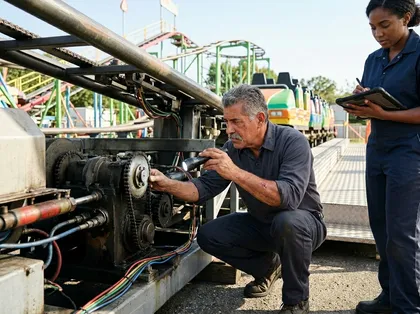
A park may face liability if it fails to inspect, repair, or remove from service a ride that it knew or should have known was unsafe. California regulations require maintenance, inspection, training, and recordkeeping for permanent rides.
Maintenance records, inspection reports, earlier malfunctions, repair logs, and complaints may help show what the park knew and when.
Unsafe Property Conditions
Not every amusement park injury happens on a ride. Premises liability may apply to hazards such as:
- Wet or slippery walkways.
- Broken stairs or handrails.
- Unsafe queue areas.
- Falling objects.
- Dangerous parking areas.
- Unsafe crowd-control barriers.
A property owner is not automatically responsible simply because an accident happened. When a claim involves a dangerous condition created by someone else, actual or constructive notice is often important. California courts have held that reasonable inspection practices can affect whether an owner should have discovered a hazard.
Defective Rides Or Parts
A ride, restraint, seat, control system, or other component may itself be defective. California product liability law recognizes claims involving manufacturing defects, design defects, and inadequate warnings. Manufacturers, distributors, and retailers may face strict product liability when a defect in their product causes an injury.
Depending on the facts, both the park and a product manufacturer could be involved in the same injury claim.
Inadequate Warnings
Some attractions have risks that guests need to understand before riding. California regulations require permanent ride operators to provide safety instructions, restrictions, limitations, and warnings deemed necessary for patron safety.
A warning does not excuse unsafe operation or maintenance. Telling riders that an attraction is intense does not remove other safety duties imposed by law.
4. Damages
Finally, you must prove that you suffered legal harm, such as medical bills, lost wages, emotional distress, and pain and suffering.
If you get hurt at a theme park, California allows you to seek financial compensation.
Depending on the facts, compensation may include the following:
Economic Damages
- Medical Bills: Coverage for emergency room visits, hospital stays, surgeries, physical therapy, and future medical care.
- Lost Income: Payment for wages missed while recovering from your injuries.
- Loss of Earning Capacity: Compensation if your injury prevents you from returning to your previous career.
- Out-of-Pocket Expenses: Travel costs for medical appointments, medical devices, and home care.
Non-Economic Damages
- Pain and Suffering: Compensation for physical discomfort and chronic pain.
- Emotional Distress: Recovery for trauma, anxiety, depression, or PTSD caused by the accident.
- Loss of Enjoyment of Life: Compensation if your injuries stop you from enjoying daily hobbies and family activities.
Punitive Damages
In rare cases involving extreme misconduct, such as a park knowingly running a ride with broken safety brakes, a court may award punitive damages to punish the park and prevent similar reckless behavior in the future.
When Is The Amusement Park Not Liable?
While amusement parks prioritize guest safety and provide a range of thrill-seeking experiences, they are not liable for every incident that occurs on their property. The park may defend itself or avoid liability under these circumstances:
- Rider Misconduct: If a guest intentionally ignores posted rules, unbuckles their safety belt, stands up on a moving coaster, or jumps into restricted areas, the park is usually not at fault.
- Failure to Follow Physical Guidelines: Parks post height restrictions, weight limits, and health warnings (e.g., heart condition alerts). If a guest ignores these warnings and suffers an injury, the park may not be liable.
- Inherent Risks: Certain activities carry minor, natural risks. For example, getting slightly jostled on a bumper car is an expected part of the ride.
Can I Still File A Claim If I Was Partly At Fault?
Breaking a park rule does not automatically end your claim. California gives visitors the right to seek compensation even when they share some blame. What changes is the amount of compensation you may be able to recover, not whether you can pursue a claim.
California follows a pure comparative negligence system. The California Supreme Court confirmed this rule in Li v. Yellow Cab Co. (1975). Under it, your compensation is reduced by your percentage of fault. A court assigns your share of fault and adjusts your award.
If a jury finds you 20% at fault, your award is reduced by 20%. The park may still be held legally responsible for its share of the harm.
Comparative negligence is one of several defenses parks may raise, arguing that the injured party shares some responsibility for the incident. It’s crucial to work with experienced premises liability lawyers who can counter such claims and advocate for fair compensation on your behalf.
Does Assumption Of Risk Protect Amusement Parks From Liability?
Not always. Assumption of risk is a legal doctrine that shields a park from liability for the risks inherent in a ride. Courts treat sudden drops, sharp turns, and bumps as expected parts of certain rides, not as something a park has to prevent. However, the operator still has a limited duty not to unreasonably increase the risks beyond those inherent in the activity.
The California Supreme Court applied this doctrine to amusement parks in Nalwa v. Cedar Fair, L.P. (2012). A woman broke her wrist when her bumper car was struck by another rider’s car. The court found that being bumped is an inherent part of that ride, so the park wasn’t liable.
The court also drew a key distinction. A bumper car rider controls their own car, while a roller coaster rider gives up control entirely. This difference can affect whether a court treats an injury as an assumed risk or a common carrier failure.
In short, a park usually isn’t liable for the ordinary thrills built into a ride. It may be liable when an injury goes beyond those risks, such as a mechanical failure, a design flaw, or an operator’s mistake.
Does A Ticket Waiver Prevent You From Suing The Park?
When you buy a ticket, you often sign a waiver, a statement giving up certain rights to sue. A waiver may bar some ordinary negligence claims if its language clearly covers the injury and the waiver is otherwise enforceable under California law. Its effect is generally limited to the inherent speed, drops, or turns of a ride, so equipment, inspection, or maintenance claims are not automatically excluded.
However, California generally does not enforce releases of future gross negligence, and statutory violations may be subject to additional restrictions.
Under California law, a waiver may not protect a park that violates state safety statutes. A note on a ticket may not excuse a park from skipping required safety checks or from letting known hazards go unfixed.
If something went wrong that the park should have caught, the waiver likely does not end your case. Proving that the park failed its safety obligations, which is what defeats a waiver, depends on what you document now. Act quickly. The steps you take in the hours and days after the incident determine what evidence survives.
What Actions Should You Take After A Theme Park Injury?
Theme parks often have staff on hand to manage incident scenes quickly, which means evidence can disappear before you have a chance to document it. If you wait to take action, the evidence you need to support your claim may be gone. Here is what you can do right after an injury.
- Report the injury to park staff and demand a written incident report before you leave. Ask for the incident number and the names of any employees who responded. Keep your copy.
- Document the scene with your phone. Take photos of the hazard, the ride or attraction, any warning signs nearby, and your visible injuries. Time-stamped photos carry real weight.
- Preserve your admission ticket, wristbands, and any food or merchandise receipts. Purchase receipts help show where you were and when, which supports your timeline.
- See a doctor as soon as possible. Some injuries, like soft tissue damage or concussions, may not feel serious right away but need medical documentation to support your claim.
- Before speaking to the park’s insurance company, consider reaching out to amusement park accident attorneys at Arash Law to discuss your options. Insurers often reach out within days to request recorded statements. A recorded statement made without legal guidance can hurt your case.
California Statute Of Limitations
Under California Code of Civil Procedure § 335.1, you generally have 2 years from the date of injury to file a personal injury lawsuit.
If a government agency owns the park, the California Government Claims Act requires you to file an administrative claim with the government entity within 6 months of the injury. A separate deadline applies to the subsequent lawsuit. Missing an applicable deadline can bar you from seeking compensation, though certain exceptions, such as tolling rules for minors, may apply depending on the facts of your case.
Submitting the government claim does not preserve the case indefinitely. If the public entity provides proper written notice rejecting the claim, a lawsuit generally must be filed within six months after that notice is personally delivered or mailed. If the required written notice is not provided, a different deadline applies.
An attorney can help determine the applicable deadline and act before it closes.
Frequently Asked Questions About Theme Park Injuries
Amusement park injury claims raise many specific questions about rides, a child’s rights, and the cost of hiring a lawyer. These answers address common concerns from injured visitors and their families in California.
Can I Sue If A Defective Ride Caused My Injury?
California law may impose strict product liability on manufacturers and other entities in the distribution chain when a defective ride or component causes injury. Strict liability generally does not require proof that the defendant was negligent. However, the injured person must still prove the elements applicable to the claimed manufacturing defect, design defect, or inadequate warning.
What If My Child Was Injured On A Ride?
Minors have special legal protections in California, including more time to file a lawsuit. A personal injury attorney can explain how those protections apply to your child’s case.
If the injury involves a government-owned or government-operated park, different rules apply. The ordinary statute-of-limitations tolling available to minors does not generally extend the Government Claims Act deadlines. A claim involving a California public entity generally must be presented within six months of the date the claim arose. However, California law provides procedures for seeking relief from a late claim in some circumstances involving minors.
Are Amusement Parks Responsible For The Actions Of Other Guests?
Parks may be responsible if they failed to provide adequate security or crowd control, and that failure contributed to your injury. In these cases, liability depends on the circumstances.
Do Lawyers Only Get Paid If They Win?
Many personal injury attorneys work on a contingency fee basis, meaning the attorney’s fee is typically a percentage of the recovery if the case succeeds. The written fee agreement should also explain whether the client may be responsible for case costs or expenses.
Can I Still File A Claim If I Didn’t Report The Injury Immediately?
Yes, but act quickly. Surveillance footage and incident records can disappear fast, so your attorney needs time to gather what remains.
Who Is Liable If I Slip And Fall In A Park Restroom?
The park may be liable under premises liability, the legal rule that holds property owners responsible for hazards they knew or should have known about. If the floor was wet and no warning sign was posted, the park may have failed its duty to guests.
Who Can Be Held Responsible For An Amusement Park Injury?
More than one party can share responsibility for an amusement park injury. California law can allocate fault among multiple parties when their conduct contributed to an injury.
- The park’s owner or operator can be held responsible if the premises’ conditions, staffing decisions, and overall supervision of the property resulted in an accident.
- The ride’s manufacturer, if a design or manufacturing defect made the ride unreasonably dangerous, potentially under a product liability theory that does not always require proof of negligence.
- A maintenance or inspection contractor, if faulty repairs, a missed inspection, or a botched certification played a role in the failure.
- An individual employee, such as a ride operator or attendant, whose careless conduct on the job may be imputed to the employer under the doctrine of respondeat superior.
- A food or beverage vendor, in cases involving foodborne illness, particularly where the vendor operates independently from the park under a lease or licensing agreement.
- A third-party security company, where the park has contracted out security functions, and inadequate staffing or training contributed to a negligent security claim.
- A government entity, where a city, county, or state agency owns or operates the fairground, pier, or park involved in the injury.
Identifying every potentially responsible party can be important because insurance coverage, contractual indemnity agreements, and the applicable legal standard may differ significantly among a park operator, a manufacturer, and a contractor.
Speak With Arash Law About Amusement Park Injury Claims In California
An amusement park is liable for injuries when it fails to maintain safe rides, neglects property upkeep, provides poor staff training, or fails to deliver adequate security. While parks try to use ticket waivers to limit claims, California law holds them liable for negligence, failure to comply with state safety standards, and breach of common-carrier duties.
If you or a family member suffered a serious injury at a California theme park, getting free advice from an amusement park accident attorney can clarify your next steps if you are weighing your legal options.
Our lawyers at Arash Law have years of experience handling various types of personal injury cases, including premises liability cases.
- $18,700,000: Our eighteen-year-old client was seriously injured while operating machinery on the defendant’s farm. Following arbitration, we secured an $18.7 million award after the defendant denied responsibility.
- $14,000,000: A factory worker sustained a head injury from an industrial machine, and the case faced numerous defenses from the opposition. Ultimately, we achieved the maximum recovery available under the policy limits, securing $14 million for our client.
- $2,200,000: Our client, an air compressor repairman, suffered serious leg and knee injuries when the compressor he was servicing exploded. He required multiple surgeries. Because his employer had no workers’ compensation insurance, we pursued the business’s general liability policy and recovered the full policy limits for his medical care.
Disclaimer: Case results vary based on individual circumstances and do not guarantee similar outcomes.
Our lawyers can explain what your claim may be worth under California law. Arash Law can review your case and determine how the firm can help you pursue fair compensation.
Call us at (888) 488-1391 to schedule your free consultation.