TL;DR: The driver who hits a commercial truck may be liable, but responsibility can extend to another racer who helped cause the crash. California law also allows fault to be divided among other responsible parties. An on-duty truck driver may have workers’ compensation benefits and a separate claim against third parties.
Potential liability can extend beyond the vehicle that physically struck the commercial truck. Another racer may share responsibility if that driver’s conduct contributed to the sequence of events that led to the collision.
The analysis turns on causation: what each driver did before impact, whether the drivers appeared to be racing or acting together, and whether those actions contributed to the crash. Even when the evidence does not establish a formal street race, reckless or negligent driving can still support liability.
If the commercial driver was working at the time, the same crash may also involve workers’ compensation and a separate third-party claim against the responsible parties.
Table of Contents

I was Driving a Commercial Truck for Work When a Vehicle that Appeared to be Racing Another Car Hit My Truck. Who May Be Liable for My Injuries?
The driver who struck your truck may be liable if that driver’s conduct caused the collision. Another suspected racer may also share responsibility if their racing or coordinated driving helped create the danger that led to the crash.
Other parties may be liable depending on the facts, including a vehicle owner, an employer, another negligent motorist, or, in limited cases, a public entity. Because you were driving for work, you may also have a workers’ compensation claim in addition to a third-party claim against those responsible for the crash.
Key Facts About Street Racing Truck Crash Liability in California
- A non-contact racer may share liability. California courts have recognized liability when that driver’s participation helped create the hazard that caused the collision (Tischoff v. Wolfchief).
- California prohibits motor vehicle speed contests. Vehicle Code § 23109 prohibits racing and aiding or abetting a speed contest.
- Reckless driving can create separate liability. Vehicle Code § 23103 prohibits driving with willful or wanton disregard for people or property.
- An on-duty driver may pursue a third-party claim. Labor Code § 3852 preserves claims against non-employer parties.
- Fault can be divided among several parties. California comparative fault rules allow responsibility to be assigned among defendants, other responsible parties, and the injured person.
Who May Be Liable if Street Racing Causes a Commercial Truck Crash?
If a trucker gets into an accident due to street racing, the driver who hit the truck may be liable if that driver’s conduct caused the collision. Another suspected racer may also share responsibility if the evidence connects that person’s conduct to the crash.
That often raises the question, “Can both racing drivers be liable if only one hit my truck?” In some cases, yes. A driver does not always need to make physical contact with the truck to share liability. If the second driver was racing, pacing, competing for position, repeatedly accelerating, or making coordinated maneuvers that helped create the dangerous situation, that conduct may support a finding that both drivers contributed to the crash.
The key issue is causation. Evidence must connect the non-contact driver’s conduct to the collision, rather than merely showing that both vehicles were speeding in the same area. Video footage, witness statements, vehicle data, and police observations may help show whether the drivers were acting together or independently. Two unrelated drivers who happen to be speeding are not automatically responsible for each other’s actions.
California addressed liability for non-contact racing in Tischoff v. Wolfchief. Two vehicles were traveling beside each other at dangerous speeds, but only one struck the plaintiff. The court explained that physical contact was not required when the non-contact driver’s conduct helped create the hazard.
Beyond the two suspected racers, other parties may share responsibility depending on how the crash occurred:
- A person who aided the race. Someone who knowingly assisted or encouraged the speed contest may face liability when that conduct contributed to the collision.
- A vehicle owner. Vehicle Code § 17150 may impose liability when a permissive driver negligently operates the owner’s vehicle, subject to applicable statutory rules and limits.
- A motor carrier or other employer. An employer may be responsible for an employee’s negligence when the employee was acting within the scope of employment.
- Another negligent motorist. A separate driver may share fault if their unsafe conduct also contributed to the collision.
- A public entity. Government Code § 835 may apply in limited circumstances when a dangerous condition of public property contributed to the crash.
If the injured commercial driver also shares responsibility, their recovery may be reduced by their percentage of fault. Civil Code § 1431.2 generally limits each defendant’s responsibility for non-economic damages to that defendant’s share of fault.
Liability Involving Racing or Reckless Drivers
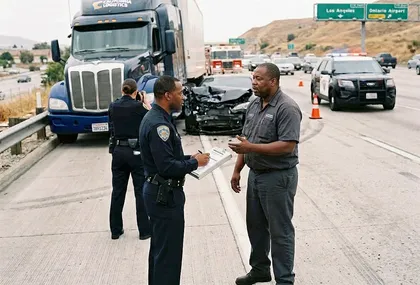
A driver may be civilly liable when street racing, reckless driving, or another unsafe maneuver causes a commercial truck crash. Neither a criminal charge nor a conviction is required for an injured truck driver to pursue a civil claim. The central issue is whether the driver’s conduct contributed to the collision and resulting injuries.
Speed is a major concern in crashes in California. During federal fiscal year 2022–2023, the California Highway Patrol (CHP) reported:
- 28,781 speed-related crashes
- More than 390 deaths
- 28,383 injuries
- About 39% of all fatal and injury crashes involved speed
California law addresses several types of dangerous driving that may be relevant after a suspected street racing crash:
- Street Racing: Vehicle Code § 23109 prohibits motor vehicle speed contests and aiding or abetting a race.
- Reckless Driving: Vehicle Code § 23103 prohibits driving with willful or wanton disregard for the safety of people or property.
- Other Unsafe Driving: Speeding, weaving through traffic, unsafe passing, and sudden lane changes may support a negligence claim even when the evidence does not prove a formal race.
A violation of a traffic safety law may also support a presumption of negligence under Evidence Code § 669 when the legal requirements are met.
However, dangerous driving does not automatically make someone liable for every crash that happens nearby. The injured driver must still show that the racing, reckless driving, or other unsafe conduct helped cause the commercial truck collision and the resulting injuries.
Does a Work-Related Truck Crash Caused by Street Racing Support a Third-Party Injury Claim?
Yes. An employee injured while driving a commercial truck for work may have a workers’ compensation claim and a separate injury claim against street racers or other responsible third parties.
Under Labor Code § 3602, workers’ compensation is generally the employee’s exclusive remedy against the employer, subject to limited exceptions. Labor Code § 3852 preserves the employee’s right to pursue responsible third parties.
A third-party claim may seek damages that workers’ compensation does not provide, including pain and suffering. The employer or workers’ compensation insurer may also have reimbursement or lien rights against a third-party recovery under Labor Code § 3856.
A big rig truck accident attorney can review the third-party case alongside the workers’ compensation claim.
If you were injured while driving a commercial truck for work, call Arash Law at (888) 488-1391 for a free case evaluation.
What Evidence Matters When Racing or Reckless Drivers Cause a Commercial Truck Crash?
Street racing claims often depend on evidence showing what the drivers were doing before the impact. That evidence may establish speed, vehicle movements, coordination between drivers, and the commercial driver’s response.
Important evidence may include:
- Police or CHP reports. Officers may record statements, witnesses, citations, road evidence, and observations from the scene.
- Truck dashcam footage. Video may show the suspected racers approaching, passing, weaving, or changing lanes before impact.
- Traffic or business cameras. Nearby footage may capture events outside the truck camera’s view.
- Witness statements. Other motorists may have seen the racing behavior before the truck driver did.
- Vehicle data. Available EDR or telematics records may show speed, braking, throttle use, or other vehicle activity.
- Commercial truck records. GPS, dispatch, and fleet information can help establish the truck’s movements.
- Electronic communications. Messages or social posts may help establish coordination when lawfully obtained.
A police report can be useful evidence, but it does not determine civil liability on its own. Video and electronic records should be preserved promptly because systems may overwrite data, and vehicles may be repaired, moved, or sold.
The agency that investigates the crash may also hold important records. For example, in San Francisco, the CHP’s San Francisco Area patrols I-80, US-101, I-280, SR-1, and I-380, so CHP reports and collision-investigation materials may be relevant after a freeway crash involving suspected racing. For selected major collisions, CHP may also use its Multidisciplinary Accident Investigation Team for detailed reconstruction.
What Insurance Coverage Issues May Arise After a Commercial Truck Crash Caused by Street Racing?
When more than one person may be responsible for a street racing crash, more than one insurance policy may also be involved. Identifying the liable parties can therefore affect which sources of coverage are available.
Common issues include:
- Multiple liability policies. Each responsible racer may have separate coverage, and additional insurance may be available through a vehicle owner or employer.
- Coverage disputes. An insurer may argue that an exclusion applies because of the driver’s conduct. A coverage dispute does not by itself eliminate the driver’s potential civil liability.
- Insufficient limits. One driver’s policy may not be enough to cover serious injuries and financial losses.
- Uninsured or underinsured drivers. Uninsured/underinsured motorist (UM/UIM) coverage may apply when a responsible driver has no insurance or inadequate coverage, depending on the applicable policy and California law.
- Unidentified drivers. Claims involving an unknown hit-and-run driver can involve additional requirements under Insurance Code § 11580.2.
When the injured truck driver was working, workers’ compensation benefits and reimbursement or lien issues may also affect the overall recovery.
What Injuries and Damages May Result?
High-speed collisions involving commercial trucks can cause serious injuries that affect medical needs, the ability to work, and the damages available in a third-party claim.
Serious injuries may include:
- Traumatic brain injuries, including concussions and more severe head trauma.
- Spinal cord injuries, which may cause weakness, loss of sensation, or paralysis.
- Neck and back injuries, including disc and spinal injuries.
- Broken bones and crush injuries, including injuries to the arms, legs, ribs, or pelvis.
- Internal organ injuries or internal bleeding.
- Severe burns, lacerations, or disfigurement.
- Amputations or other catastrophic limb injuries.
- Post-traumatic stress disorder and other psychological injuries.
An on-duty commercial driver may have two potential sources of recovery: workers’ compensation benefits and damages from responsible third parties.
Workers’ Compensation Benefits
Depending on the circumstances, workers’ compensation may provide medical care, temporary or permanent disability benefits, supplemental job displacement benefits, and death benefits for qualifying dependents. California workers’ compensation does not provide damages for pain and suffering or punitive damages.
Third-Party Injury Compensation
A claim against the racers or other responsible parties may seek compensation for:
- Past and future medical expenses.
- Past and future lost income.
- Reduced earning capacity.
- Pain and suffering.
- Physical impairment or disability.
- Loss of enjoyment of life.
- Property damage and other supported financial losses.
Punitive damages may be available in qualifying cases. Civil Code § 3294 generally requires clear and convincing evidence of oppression, fraud, or malice.
If the commercial driver dies from crash-related injuries, certain family members and dependents authorized by California law may bring a wrongful death claim under Code of Civil Procedure § 377.60. Depending on the family circumstances, this can include a surviving spouse or domestic partner, children, and certain other heirs or dependents.
Workers’ compensation and third-party claims can arise from the same crash, but they provide different forms of recovery. Workers’ compensation lien or reimbursement rights may also affect a third-party recovery.
Practical Next Steps for an Injured Commercial Driver to Take After the Crash?
After a suspected street racing crash, early action can help preserve evidence and protect both a third-party claim and a workers’ compensation claim.
- Get medical care. Describe your symptoms accurately and keep records of treatment, work restrictions, and related expenses.
- Report the suspected racing. Tell law enforcement what you personally observed, including any racing, pacing, weaving, or sudden lane changes.
- Notify your employer. Promptly reporting a work-related injury can help protect the workers’ compensation claim.
- Preserve video and vehicle data. Save dashcam footage and identify other cameras or electronic records before they are overwritten or lost.
- Collect witness information. Other motorists may have seen the suspected racers before the collision.
- Keep work and crash records. Preserve dispatch information, wage records, photographs, insurance correspondence, and other documents connected to the incident.
Legal deadlines also matter. California generally allows two years to file a personal injury lawsuit against a private party under Code of Civil Procedure § 335.1, and three years to file a property damage lawsuit under Code of Civil Procedure § 338. If a public entity may be responsible, Government Code § 911.2 generally requires a claim involving personal injury or property damage to be presented within six months. Workers’ compensation and UM/UIM claims have separate notice and timing requirements.
These deadlines should not be confused with evidence preservation. Dashcam footage, traffic video, vehicle data, and other records may disappear long before a legal filing deadline expires.
Frequently Asked Questions About Street Racing Accidents Involving Commercial Trucks in California
Can a Criminal Street Racing Case Affect My Civil Injury Claim?
Yes, but the criminal and civil cases are separate. A criminal prosecution does not determine whether you can bring a personal injury claim.
Evidence gathered during the criminal investigation may also become relevant to the civil case. However, you should not wait for the criminal case to end before protecting your own filing deadlines.
What Happens if One Racer Settles but Another Racer Does Not?
A claim may continue against other responsible parties even if one defendant settles. California law has specific rules for settlements involving multiple defendants. The effect on the remaining claims can depend on the settlement terms, fault allocation, and the types of damages involved.
Can a Vehicle Owner Be Liable if Someone Else Was Street Racing in Their Car?
Potentially. California Vehicle Code § 17150 may impose liability on a vehicle owner when another person negligently operates the vehicle with the owner’s permission. The owner’s liability depends on the facts and applicable statutory rules and limits.
Can an Employer Be Liable if One of the Racing Drivers Was Working?
An employer may be liable for an employee’s negligent driving when the employee was acting within the scope of employment. Whether the employer shares responsibility depends on what the employee was doing at the time of the crash and how that activity related to the job.
Talk to Arash Law About a Commercial Truck Crash Caused by Street Racing
A street racing truck crash may involve more than the driver who made physical contact. Another racer, a vehicle owner, an employer, or other responsible party may also affect the claim, available insurance, and potential recovery.
Arash Law handles commercial truck accident claims involving multiple drivers and overlapping work-related injury issues. Call (888) 488-1391 for a free case evaluation.
Sources
- California Highway Patrol. Speed-related crash data.
https://www.chp.ca.gov/news-alerts/news-list/chp-secures-%242.6-million-federal-grant-to-address-speeding-and–aggressive-driving-on-california-roads- California Vehicle Code § 23109. Motor vehicle speed contests.
https://leginfo.legislature.ca.gov/faces/codes_displaySection.xhtml?lawCode=VEH§ionNum=23109.- California Vehicle Code § 23103. Reckless driving.
https://leginfo.legislature.ca.gov/faces/codes_displaySection.xhtml?lawCode=VEH§ionNum=23103.- California Evidence Code § 669. Presumption of failure to exercise due care.
https://leginfo.legislature.ca.gov/faces/codes_displaySection.xhtml?lawCode=EVID§ionNum=669.- California Labor Code § 3852. Third-party claims after work injuries.
https://leginfo.legislature.ca.gov/faces/codes_displaySection.xhtml?lawCode=LAB§ionNum=3852.- California Labor Code § 3856. Third-party judgments and employer liens.
https://leginfo.legislature.ca.gov/faces/codes_displaySection.xhtml?lawCode=LAB§ionNum=3856.- California Vehicle Code § 17150. Vehicle owner liability.
https://leginfo.legislature.ca.gov/faces/codes_displaySection.xhtml?lawCode=VEH§ionNum=17150.- California Labor Code § 5400. Notice of work injury.
https://leginfo.legislature.ca.gov/faces/codes_displaySection.xhtml?lawCode=LAB§ionNum=5400- California Labor Code § 5405. Time limits for workers’ compensation proceedings.
https://leginfo.legislature.ca.gov/faces/codes_displaySection.xhtml?lawCode=LAB§ionNum=5405- California Insurance Code § 11580.2. Uninsured and underinsured motorist coverage.
https://leginfo.legislature.ca.gov/faces/codes_displaySection.xhtml?lawCode=INS§ionNum=11580.2.- California Civil Code § 1431.2. Non-economic damages and comparative fault.
https://www.leginfo.legislature.ca.gov/faces/codes_displayText.xhtml?article=&chapter=2.&division=3.&lawCode=CIV&part=1.&title=2.- California Code of Civil Procedure § 335.1. Personal injury filing deadline.
https://leginfo.legislature.ca.gov/faces/codes_displaySection.xhtml?lawCode=CCP§ionNum=335.1.- California Government Code § 911.2. Government claim deadline.
https://leginfo.legislature.ca.gov/faces/codes_displaySection.xhtml?lawCode=GOV§ionNum=911.2.- California Department of Motor Vehicles. SR-1 accident reporting.
https://www.dmv.ca.gov/portal/dmv-virtual-office/accident-reporting/- California Highway Patrol. San Francisco Area.
https://www.chp.ca.gov/find-an-office/golden-gate-division/335-san-francisco/- California Highway Patrol. Multidisciplinary Accident Investigation Teams.
https://www.chp.ca.gov/find-an-office/headquarters/assistant-commissioner-staff/collision-investigation-unit/multidisciplinary-accident-investigation-teams- Tischoff v. Wolfchief (1971) 16 Cal.App.3d 703.
https://www.courtlistener.com/opinion/2120354/tischoff-v-wolfchief/Disclaimer
This page is for general informational purposes only and does not constitute legal advice. Reading this page does not create an attorney-client relationship. If you have been injured in a truck accident or street racing incident, contact a qualified California personal injury attorney to discuss the specific facts of your case.
Arash Law, (888) 488-1391.