TL;DR: Cyclists can be partly to blame for road accidents if they break traffic laws or ride negligently. In California, pure comparative negligence reduces an injured rider’s compensation by percentage of fault, which can limit recovery when both driver and cyclist share responsibility.
Highlights:
- Document the scene, vehicles, road hazards, and any dooring position immediately.
- Get driver and witness names, contact details, and quick factual statements.
- Request the police report and note any DUI or distraction indicators.
- Track your lane position, signals used, and traffic-light or right-of-way sequence.
- Follow bike-lane and side-of-road rules unless safety requires taking the lane.
- Stay sober while riding – impairment can reduce your recovery.
- Review your uninsured/underinsured motorist coverage for hit-and-run protection.
Tip: Save your helmet, bike, lights, and damaged clothing as evidence, and stick to facts when describing what happened.
Table of Contents
In a bicycle-involved motor vehicle accident, several factors must be considered to determine who is at fault and to what extent. One of the important factors is whether either party acted negligently by breaching their duty of care under California law, which means they were responsible for preventing harm but failed to do so properly or in a timely manner. As a result of this negligence, an injury occurred in an otherwise avoidable accident.
 Are Cyclists Partly To Blame For Road Accidents?
 Are Cyclists Partly To Blame For Road Accidents?
Just because the injuries sustained by the bicyclist are usually more serious does not mean they may not be at fault. With many factors involved, an experienced bicycle accident attorney can help you determine the potential liability of each party in traffic accidents.
Determining fault after an accident is different from establishing liability. Under California law, strict liability means a party can be held responsible regardless of excuses or justifications. In contrast, fault liability is the principle that victims are generally liable for their losses unless the adverse party is at fault.
These are distinct legal standards for determining responsibility in an accident.
Determining Who Is At Fault
Legal concepts such as negligence, fault liability, and strict liability can be complicated, which is why many find it beneficial to seek assistance from experienced California car accident lawyers who handle bike crash cases. An attorney can examine the events of the accident and help determine which party can be held liable and to what degree.
If only one person is found at fault for an accident, that individual is typically liable for the resulting losses. For example, if a drunk driver hits a bicyclist who is lawfully riding in a bike lane, the driver would generally be responsible for compensating the bicyclist’s losses and may also face criminal charges for DUI.
Unfortunately, not all cases are this simple, and, in many accidents, both parties may have contributed to the accident to some degree. Under California’s comparative negligence laws, even if you were partially responsible for the accident, you may still be eligible to seek compensation for your injuries and losses.
California Is A Pure Comparative Negligence State
When determining liability in an accident, two legal theories are applied, namely contributory negligence and comparative negligence.
Under contributory negligence, if a cyclist is found responsible for causing an accident in any way, they may not be able to seek any damages for their injuries in a personal injury lawsuit. This means that a cyclist who is only 1% at fault for causing an accident cannot sue the driver, even if the driver was 99% at fault. This rule of law is only in place in the following areas:
- Alabama
- Maryland
- North Carolina
- Virginia
- District of Columbia (except for certain motor vehicle accidents)
Except for the ones listed above, all other states use a comparative negligence fault system; however, it’s applied differently from state to state.
Under pure comparative negligence, people involved in the accident may be able to pursue damages reduced by their percentage of fault. Under modified comparative negligence, an individual may not be able to seek damages sustained in an accident if their share of fault is 50% or more; however, that percentage varies from state to state.
California is a pure comparative negligence state. For example, if a cyclist is involved in an accident with a car and is found to be 25% at fault for causing the accident, then a California jury would award the cyclist 75% of the claimed damages. So, if the cyclist’s damages amounted to $300,000, they may be able to recover $225,000, which is 75% of their total damages.
Duty Of Care For California Drivers
Drivers in California have a legal responsibility to operate their vehicles safely to avoid collisions and prevent injuries to others on the road, including bicyclists and pedestrians. Drivers must stay coherent, be aware of their surroundings at all times, and follow all traffic laws.
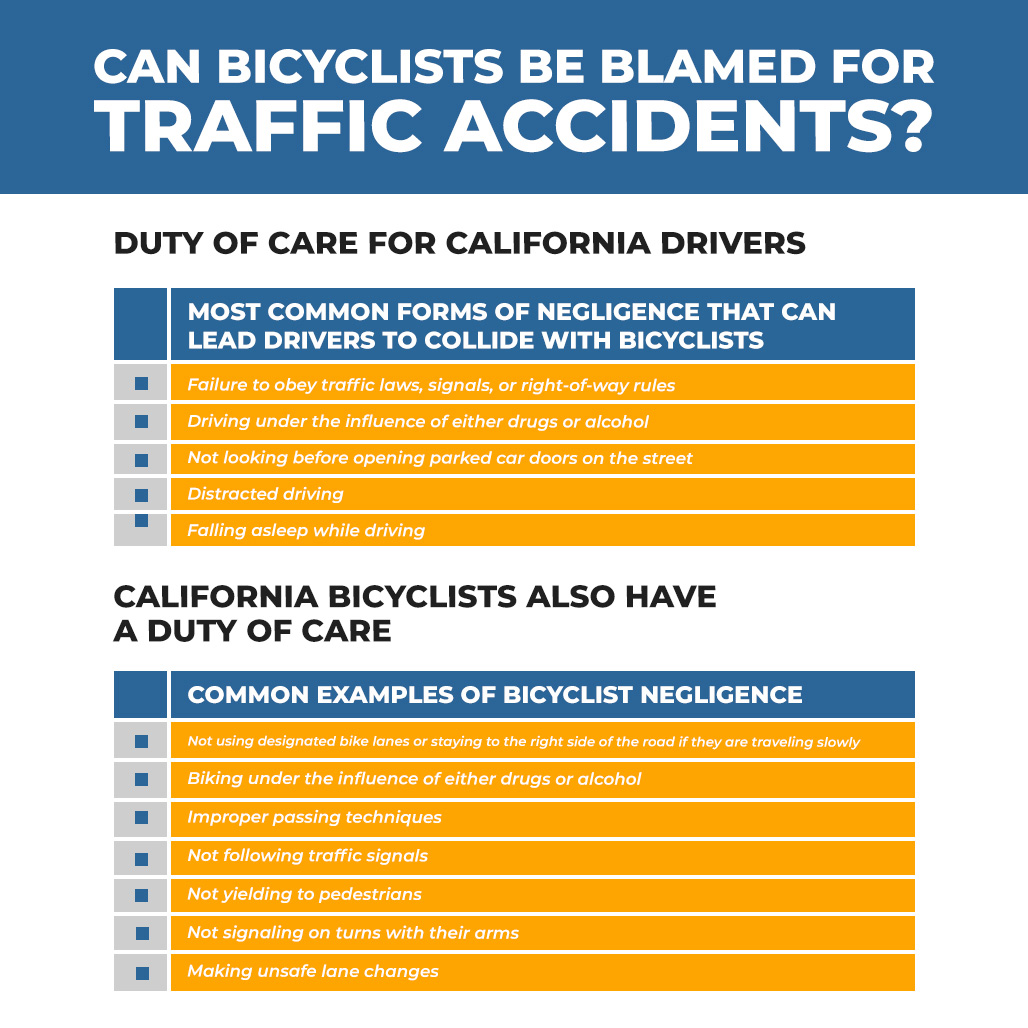
When a driver does not behave responsibly and causes property damage or injury to others, that driver can be held liable for such negligence. Some of the common forms of negligence that can lead drivers to collide with bicyclists include:
- Failure to obey traffic laws, signals, or right-of-way rules.
- Driving under the influence of either drugs or alcohol.
- Not looking before opening parked car doors on the street.
- Distracted driving.
- Falling asleep while driving.
California Bicyclists Also Have A Duty Of Care
Bicyclists in California share the same duty of care as drivers. While traveling on roads with motor vehicles, they must obey traffic signals, follow all traffic laws, and be aware of their surroundings. If bicyclists fail to follow these road rules and are involved in an accident, they can be held liable for the collision. Some common examples of bicyclist negligence include:
- Not using designated bike lanes or staying to the right side of the road if they are traveling slowly.
- Biking under the influence of either drugs or alcohol.
- Improper passing techniques.
- Not following traffic signals.
- Failing to yield to pedestrians.
- Not signaling on turns with their arms.
- Making unsafe lane changes.
Many states have “side of the road” rules, which require bicyclists to ride on the far right side of the road or in a designated bike lane when they are not moving as fast as motor vehicle traffic. Non-compliance with “side-of-the-road” rules often accounts for three common types of traffic accidents involving bicyclists, which are:
- Being hit by a passing vehicle.
- Hitting the open door of a parked vehicle.
- Being struck by a motor vehicle while making a right turn.
‘Side-of-Road’ And Bike Lane Laws
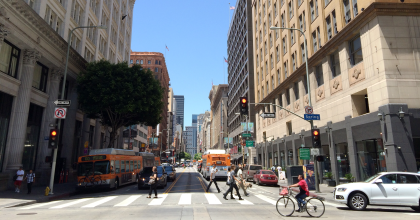 Generally speaking, a bicycle has as much right to use public roads as motor vehicles. Unless a specific law says otherwise, a bicyclist can legally ride in the center of a traffic lane when it’s unsafe to ride on the right and must be given the same right-of-way afforded to other motor vehicles.
These “side-of-the-road” rules, combined with other laws, provide additional protection for riders when they share the streets with motor vehicles.
If a cyclist is riding slower than the current flow of motor vehicle traffic, they are generally required to ride as far off to the right-hand side of the road as safely as possible. This rule differs on one-way streets, where some states may allow the cyclist to ride to the far left instead. If a designated bike lane is provided, cyclists are required to use it.
In some instances, bicyclists are allowed to break the “side-of-the-road” rules, for example:
- If the lane is too narrow to share safely with passing cars.
- If the rider keeps pace with moving traffic.
- To make a left turn.
- To avoid hazardous conditions.
In many circumstances, cyclists are required by law to ride near areas where vehicles are often parked, placing them at risk of “dooring” accidents. Principles of negligence state that a person shouldn’t open a car door unless it is safe to do so. As a result, accidents caused by opening a parked car door are typically considered the fault of the person who opened the door, not the cyclist.
An exception might exist if, for example, there was no motor vehicle traffic at all, which eliminates the requirement for the cyclist to stay to the far right side of the road (or left if it’s a one-way street). In such cases, the motorist who opened the car door might argue that the cyclist had ample opportunity to avoid the door and therefore was at least partly responsible for causing the accident.
Who Is At Risk Of Becoming A Bicycle Accident Victim?
To better understand some of the common causes of bicycle accidents in California, you first need to understand who is commonly at risk of becoming a victim. A recent study by the NHTSA offers a detailed breakdown of bicycle accident victims and the circumstances that led to their injuries.
- The average age of victims in deadly bicycle accidents rose from 24 in 1988 to 32 in 1998 to 44 in 2013.
- Of those bicyclists killed, 83% were male.
- The majority of bicycle deaths, which account for 68%, occur in urban areas.
- A notable portion of deadly crashes, accounting for 22%, occurred within the three hours between 6 p.m. and 9 p.m.
- In nearly 1/3 of all bicycle crashes, either the driver or the cyclist had a BAC (Blood Alcohol Concentration) of 0.08% g/dL or higher.
How Are Bicyclists Injured In Accidents?
According to the NHTSA National Survey on Bicyclist and Pedestrian Attitudes and Behaviors, the six common causes of injury to cyclists were:
- Directly being hit by a car (30%).
- Falling off their bike (17%).
- The roadway was in disrepair (13%).
- Rider error (13%).
- Crashed into a fixed object (7%).
- A dog (or another animal) ran out in front of them (4%).
When Is The Bicyclist At Fault For An Accident?
In many bike-versus-car collisions, liability is often attributed to the motor vehicle driver, particularly if they failed to yield or did not see the cyclist. However, liability is determined by the specific circumstances and the actions of each party. The common instances in which a bicyclist can be at fault for a traffic accident are usually because:
- They were ignoring traffic signals.
- Failed to ride in the designated bike lane.
- They were riding on the wrong side of the street or against the direction of vehicle traffic.
- Engaging in other forms of negligent behavior, like riding while under the influence of drugs or alcohol.
In cases like these, a cyclist’s ability to pursue damages may be reduced or, in some states, barred entirely, depending on the jurisdiction’s negligence rules. While all road users must exercise reasonable care, drivers are expected to be especially cautious around cyclists due to the greater risk of serious injury or death.
In California, when a cyclist is found to have acted negligently and contributed to an accident, they can be assigned comparative negligence. This means that a cyclist’s negligent actions partly contributed to the injuries they suffered. The fault is allocated between both parties to the degree they contributed to the accident. Compensation depends on each party’s share of fault and may be less than the total damages claimed.
The age of the cyclist is also an important factor in determining liability. Under the “tender years” doctrine, children are incapable of contributory or comparative negligence. As a result, responsibility for accidents involving young cyclists is often attributed to the motor vehicle driver. In the eyes of the law, young children cannot be expected to exercise the normal duty of care on the road that is expected of a mature adult.
A well-versed bicycle accident lawyer can assess whether your actions involved any negligence or contributed, even minimally, to the accident. If you or a loved one is involved in any bicycle accident in California, speak to our California accident lawyers to help you determine if you are eligible for compensation. Call us at (888) 488-1391 or fill out our “Do I Have A Case?” form here.
 Preventing A Bicycle Accident
 Preventing A Bicycle Accident
Even in states where the road laws are favorable to bicyclists, they should not forget that the laws of physics are indifferent and will apply to anyone, anywhere, and anytime. Cars and trucks, being much larger and heavier than bicycles, offer significant physical protection to their occupants in the event of a collision, unlike bicycles.
Simply put, cyclists need to take preventive measures to avoid accidents more than their motor vehicle driving counterparts. One important preventative measure is not to take alcohol before riding a bike. According to the NHTSA, 20% of cyclists who were killed in accidents in 2013 had a BAC (blood alcohol concentration) of 0.08% or higher.
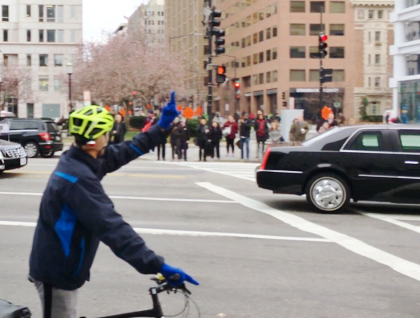
Another way for cyclists to avoid accidents is to be visible to motorists, especially at night, by wearing garments with reflectors, installing blinking lights on their tires, and using proper lighting attachments to see the road and be seen by motorists.
Lastly, a bicyclist should wear protective gear, such as a helmet, which may also be compulsory depending on their location. Any cyclist involved in an accident in a state that mandates helmets for cyclists may face challenges in pursuing compensation from the at-fault driver if they weren’t wearing one.
Other ways to help prevent accidents include:
- Following all traffic laws.
- Remaining sober, alert, and vigilant.
- Wearing protective gear, especially a helmet.
Carrying sufficient uninsured and underinsured motorist coverage is also recommended. It’s especially helpful in the event of a hit-and-run accident.
Talk To Our Bicycle Accident Attorneys In California
Existing and emerging bicycle and traffic laws can determine whether you are eligible to seek damages through a personal injury claim. However, these laws can be overwhelming to understand. Seeking help from a skilled bicycle accident attorney can be an advantage.
If you or a loved one has been injured in a bicycle accident, carefully review settlement offers and confirm if they reflect the full value of your claim. You can also work with our California lawyers at Arash Law, who will handle the legal aspects of your case. Explore your possible options by calling (888) 488-1391.