TL;DR: You can hire an injury lawyer while you are still in the hospital, by phone, video call, or bedside visit. Hiring an attorney early may help you manage insurance communications, identify time-sensitive evidence, and understand legal deadlines while you focus on medical care.
Yes, you can hire a personal injury lawyer while you are still in the hospital after an accident. You do not need to wait until you are discharged or able to visit a law office. You can request a phone consultation, a video call, or a hospital visit, depending on hospital policies and your condition.
Table of Contents

I Am Still Hospitalized After an Accident. Can I Start Talking to an Injury Lawyer Now, and What Can My Family Help Organize?
Yes, you can start talking to an injury lawyer while you are still hospitalized. With your permission, your family can help arrange the consultation and organize available information. You do not need to visit a law office or gather every accident record before making the first call.
You may be able to speak with an attorney by phone or video call. An in-person meeting may also be possible, depending on the law firm’s availability, hospital rules, and your circumstances.
Your consultation should fit around your medical care. Tell the law firm when you feel able to talk, how you prefer to communicate, and whether you want a family member involved. If medication or your injuries affect your ability to understand the discussion or documents, let the attorney know before signing anything.
With your permission, a trusted family member can:
- Contact the injury law firm. Explain that you are hospitalized and ask about available consultation options.
- Arrange a suitable time. Help identify when you feel able to talk and when you are less likely to need treatment.
- Gather accident information. Collect available photos, witness contact details, incident report numbers, and insurance information.
- Organize documents. Keep available medical bills, accident-related records, and insurance letters together.
- Prepare questions. Write down what you want to know about attorney fees, signing documents, and next steps.
- Coordinate follow-up. Help track future calls and requests for information.
A family member can help with these tasks without making legal decisions for you. Being your relative does not automatically authorize someone to hire a lawyer or sign documents on your behalf. The attorney should confirm any representative’s authority and clarify whom the firm would represent.
Key Facts About Hiring an Injury Lawyer From the Hospital
- You do not need an office visit to make initial contact. An attorney’s office may discuss details by phone, video, or another method of consultation, depending on availability.
- A first call does not automatically create legal representation. You can ask questions and discuss your situation before deciding whether to hire the attorney.
- Family members can help with permission. They may gather records, schedule calls, and help manage communication, but they cannot automatically sign an agreement on your behalf.
- You should understand an agreement before signing. You must have the legal capacity to understand and agree to its terms. Physical limitations alone do not prevent you from hiring a lawyer (California Probate Code §§ 810–812).
- Many personal injury attorneys use contingency fees. The written agreement should explain attorney fees and responsibility for case costs (California Business and Professions Code § 6147).
How to Prepare for an Injury Lawyer Consultation From the Hospital
You can prepare by choosing how and when to meet, deciding who can speak for you, and gathering any incident records you have. You don’t need to gather everything before contacting an injury lawyer. This checklist can help you and your family get ready for the first conversation:
- Preferred Contact: Decide whether you prefer a phone call, video call, or an in-person meeting, if available.
- Availability: Identify suitable times that will not interfere with your medical care.
- Permission to Share Information: Decide who may contact the law firm and what information they may share with your consent.
- Available Incident Records: Gather photos, witness information, police or property incident report numbers, and insurance documents you already have.
- Questions About Signing: Ask about the attorney’s fees, case costs, the representation agreement, and whether you can review the documents before signing.
- Follow-Up Contact: Choose a trusted person to help coordinate future communication if you want that assistance.
Missing records should not prevent you from requesting a consultation. You can explain what information you have and ask which documents may be helpful later.
What Happens When You Contact an Injury Lawyer From the Hospital?
Contacting an injury lawyer does not automatically mean you have hired one. The process generally involves three stages:
- Introductory Call: You or a family member contacts the law firm and explains what happened. The firm may ask about the accident, your current situation, and how to reach you.
- Consultation: If you arrange a consultation, an attorney can discuss your accident, review available information, and answer questions about your legal options.
- Representation Agreement: If you decide to hire the attorney and the firm agrees to represent you, review the written agreement. You must be able to understand and freely agree to its terms, or a legally authorized representative must have the necessary authority to act.
You can ask questions before deciding whether to hire a lawyer. If you are tired, receiving treatment, or unable to concentrate, you can request another time to discuss the agreement.
Can I Sign a Lawyer’s Agreement Without Leaving the Hospital?
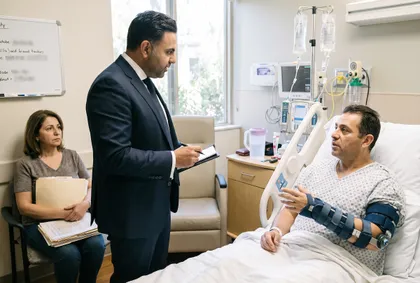
You may be able to review and sign a representation agreement while hospitalized without visiting the attorney’s office. Depending on the law firm’s procedures and applicable legal requirements, the agreement may be provided electronically, by mail, or during an arranged in-person visit.
You can ask the attorney how the agreement will be delivered, how to return the signed document, and whether you will receive a copy. You should have an opportunity to review the terms and ask questions before signing. California requires written contingency fee agreements and signed copies to be provided as specified by law (Cal. Bus. & Prof. Code § 6147).
Can You Review Documents and Discuss Next Steps While Receiving Medical Care?
You can discuss available documents and possible legal steps while hospitalized without interrupting your treatment. An attorney can explain what information may help evaluate your claim and whether additional records will be needed.
Some documents, including certain medical records, may require your authorization or another lawful basis before they can be obtained or shared.
You can also ask the law firm to arrange follow-up calls at suitable times. If you are not ready to review or sign an agreement, you can explain your concerns and ask about the options available. Your medical care remains the priority while you explore your legal options.
Can I Have a Private Consultation With a Lawyer While Hospitalized?
Yes. You can ask to arrange a private conversation with an injury attorney while hospitalized. If you share a room or have visitors, you may request a suitable time or place to discuss sensitive information, subject to your medical needs and hospital rules.
You can also decide whether a family member should participate in the consultation. A lawyer generally must protect confidential information received from a prospective client, even if the prospective client does not ultimately hire the lawyer (California Rules of Professional Conduct, Rules 1.6 and 1.18).
Why Does Timing Matter for a California Injury Claim?
Contacting an attorney early may help you understand which steps need attention while you are still hospitalized. You can ask about protecting your potential claim without rushing into a representation agreement. Some matters may need prompt attention, while others can be handled when you are ready.
The following considerations explain why timing matters after an accident.
Accident Evidence May Become Harder to Obtain
Security cameras may automatically overwrite older recordings, someone may repair a hazardous condition or remove physical evidence, and witnesses may become harder to contact. The length of time footage remains available depends on the recording system, storage settings, and operator.
Depending on the accident, useful evidence may include:
- Surveillance footage from nearby businesses.
- Photos of the accident scene and any hazards.
- Witness names and contact information.
- Property inspection, maintenance, and repair records.
- Equipment inspection records and damaged items.
- Police reports or workplace or property incident reports.
- Vehicle recordings and damage records, when relevant.
A California injury attorney may help identify relevant evidence and contact the person or organization holding it. For an injury involving an unsafe property condition, a premises liability attorney may help identify who owned, maintained, or controlled the area.
A written preservation request may ask the holder to retain specific records related to the accident. However, whether the holder has a legal duty to preserve those records depends on the circumstances. The request also does not guarantee that the evidence will be available or provided.
You do not need to leave the hospital or gather every record before contacting an injury lawyer. A family member can help organize available photos, report numbers, and witness details with your permission.
Medical Records May Help Explain Your Injuries
Medical records can help show when your symptoms began, what treatment you received, and how your injuries affect your daily activities and ability to work. Some concussion symptoms may not appear until hours or days after an injury. Tell your medical team about new or worsening symptoms so they can assess and document them.
While you are hospitalized, an attorney can explain which medical records may be relevant to your injury claim and review them with appropriate authorization. Your healthcare providers remain responsible for your diagnosis and treatment.
California Has Different Deadlines for Personal Injury Lawsuits and Government Claims
The deadline depends on who may be legally responsible for your injury and whether you need to file a lawsuit or first present a government claim.
Here’s what you need to know:
- Personal Injury Lawsuits — Two Years: You generally have two years from the injury date to file a lawsuit in court. Hospitalization does not automatically pause this deadline, although exceptions may apply (California Code of Civil Procedure § 335.1).
- Government Administrative Claims — Six Months: If a public entity may be responsible for your injury, you generally must first present a written claim to the appropriate public entity within six months of the injury (California Government Code §§ 911.2, 945.4).
- Lawsuits Against Public Entities — Separate Filing Deadlines: If the public entity sends a legally sufficient written rejection notice, you generally have six months from the date the notice is personally delivered or mailed to file a lawsuit. Different deadlines may apply if the required notice is not provided (California Government Code § 945.6).
An attorney can help determine the correct filing procedure and applicable deadlines. Different rules may apply to cases involving minors or other circumstances.
How Can an Injury Lawyer Help After Being Hired?
Once a personal injury attorney agrees to represent you, they can begin handling legal matters covered by your representation agreement. This may reduce the work you need to manage while hospitalized and allow you to focus on your medical care.
Depending on your situation, an injury lawyer may provide the following assistance:
Reviewing the Accident and Available Evidence
An injury lawyer can review incident reports, photos, witness statements, and other records to determine how the accident happened and who may be legally responsible. They can also identify additional sources of evidence and request preservation of relevant materials when appropriate. However, these requests do not guarantee that the evidence is still available or can be obtained.
Communicating With Insurance Companies
An attorney can handle all communications with insurers about matters covered by your representation agreement after notifying the relevant parties. This may reduce the number of insurance-related calls and requests you need to manage while recovering.
However, hiring a lawyer does not automatically end all contact with all insurers. You may still need to meet certain obligations under your own insurance policy.
Reviewing Potential Damages
An attorney may evaluate the financial and personal losses caused by your injuries. Depending on the circumstances, recoverable damages may include:
- Medical expenses.
- Lost income.
- Reduced future earning capacity.
- Future medical expenses.
- Physical pain and emotional suffering.
- Other legally recoverable losses.
The amount you can pursue depends on the available evidence, applicable law, responsibility for the accident, and other factors, including insurance coverage where relevant.
Explaining Your Legal Options
An attorney can explain the available legal options and recommend appropriate next steps. Depending on your case, these may include negotiating a settlement or filing a lawsuit.
Your lawyer should keep you informed about significant developments and explain matters that affect your decisions. You retain the authority to decide whether to accept a settlement (Cal. Rules of Prof. Conduct, rules 1.2 & 1.4).
IMPORTANT NOTE: Hiring an attorney does not guarantee a settlement or court award.
You can contact Arash Law to learn how an attorney may assist with your specific injury claim.
Our team can explain the available consultation options and help arrange a suitable time to discuss your situation without interfering with your medical care.
Call us at (888) 488-1391 for a free case evaluation.
What Should You Look Out For When Hiring a Lawyer While in the Hospital?
You can hire a lawyer from the hospital, but you may be more vulnerable to rushed decisions and unwanted solicitation. You can take your time, ask questions, and choose your own attorney.
Watch for these warning signs before you agree to anything:
- Unexpected Contact: Be cautious if someone approaches you without an invitation. California Rule of Professional Conduct 7.3 restricts direct attorney solicitations for financial gain, including those involving pressure or harassment. Ask who they represent, decline further contact, and consider reporting the approach to the State Bar of California.
- Pressure to Sign: Be wary of anyone who pushes you to sign immediately or discourages you from comparing lawyers. Ask whether an actual legal deadline requires quick action and request a clear explanation.
- Unclear Fees: Ask what percentage the lawyer charges, how case expenses affect your recovery, and whether you could owe costs without receiving compensation. Make sure the written agreement clearly explains these terms before signing.
- Confusing Agreements: Request a copy of the agreement and time to read it. Ask someone you trust to help review it. Tell the lawyer if pain or medication makes it difficult to understand the terms.
- Guaranteed Results: Be cautious if someone promises a settlement amount or guarantees a win. Ask how they assess your case and what uncertainties remain. A lawyer cannot guarantee how your claim will turn out.
- Broad Records Requests: Before signing a medical release, ask which records it covers, who will receive them, and why they matter. Request an explanation if it includes medical information that seems unrelated to your injury.
- Pressure From an Insurance Adjuster: While you compare lawyers, an adjuster may request a recorded statement or offer a settlement. Ask which insurer they represent. Discuss any cooperation requirements under your own policy with a lawyer.
An attorney can explain insurance requests, review settlement terms, and discuss your options before you make decisions that could affect your claim.
Frequently Asked Questions About Hiring an Injury Lawyer While Hospitalized in California
Can I Hire a Lawyer for a Family Member Who Is Unconscious or Unable to Communicate?
You can contact an injury law firm to discuss the situation if your family member is unconscious or unable to communicate. However, being a spouse, parent, or other relative does not automatically give you authority to sign a legal representation agreement for them.
The attorney may need to determine whether you have valid authority under a power of attorney, conservatorship, or another applicable legal arrangement. A healthcare decision-making document does not necessarily authorize you to handle a personal injury claim. The available options depend on the circumstances and the scope of your legal authority.
Do I Need a Lawyer if My Injuries Seem Minor or I Want to Handle the Claim Myself?
You are not required to hire a lawyer for every personal injury claim in California. However, speaking with an attorney may help if you are hospitalized, if fault is disputed, or if your losses are uncertain. An injury lawyer can review your circumstances and explain whether legal representation may be beneficial.
Do Lawyers Only Get Paid if They Recover Compensation for Me?
Many personal injury lawyers work on a contingency fee basis, meaning their attorney’s fees generally depend on recovering compensation for you. Arash Law offers free case evaluations and no upfront attorney’s fees for qualifying personal injury cases. The written agreement should explain how fees and case expenses are handled, including if there is no recovery (California Business and Professions Code § 6147).
Can I Talk to a Lawyer While Taking Pain Medication?
Yes, you can speak with an injury lawyer while taking pain medication if you can participate in the conversation. However, signing a representation agreement requires sufficient ability to understand and consent to its terms. If medication or your condition affects your judgment, the attorney can discuss arranging another time to review the agreement.
When Is the Right Time to Call an Injury Lawyer After an Accident?
You can contact an injury lawyer as soon as you are able, even while hospitalized. Early consultation may help identify evidence, insurance requirements, and legal deadlines that need attention. If you cannot call yourself, a trusted family member can contact an injury law firm to ask about suitable consultation arrangements.
Talk to Arash Law About an Injury Consultation While Hospitalized
A free case review with Arash Law comes with no obligation to hire our firm. You can ask questions, learn about your options, and decide whether you want to move forward.
You do not need every record ready before contacting us. Our team can discuss consultation arrangements around your medical care. With your permission, a trusted family member can help schedule the conversation and organize available information.
Call Arash Law at (888) 488-1391 for a free case review. We can explain our services, attorney’s fees, and case expenses so you understand the terms before deciding whether to hire us.
Sources
- California Code of Civil Procedure § 335.1. Two-year statute of limitations for personal injury lawsuits. https://leginfo.legislature.ca.gov/faces/codes_displaySection.xhtml?sectionNum=335.1.&lawCode=CCP
- California Government Code § 911.2. Deadline for presenting government claims. https://leginfo.legislature.ca.gov/faces/codes_displaySection.xhtml?sectionNum=911.2.&lawCode=GOV
- California Government Code § 945.4. Requirement to present a government claim before filing a lawsuit. https://leginfo.legislature.ca.gov/faces/codes_displaySection.xhtml?sectionNum=945.4.&lawCode=GOV
- California Government Code § 945.6. Deadlines for filing lawsuits against public entities after the government claim process. https://leginfo.legislature.ca.gov/faces/codes_displaySection.xhtml?sectionNum=945.6.&lawCode=GOV
- California Business and Professions Code § 6147. Requirements for contingency fee agreements. https://leginfo.legislature.ca.gov/faces/codes_displaySection.xhtml?sectionNum=6147.&lawCode=BPC
- California Rules of Professional Conduct, Rule 1.2, 1.4, 1.6, 1.18. https://www.calbar.ca.gov/legal-professionals/rules/rules-professional-conduct/current-rules-professional-conduct/chapter-1-lawyer-client-relationship
- California Rules of Professional Conduct, Rule 7.3. Solicitation of clients. https://www.calbar.ca.gov/legal-professionals/rules/rules-professional-conduct/current-rules-professional-conduct/chapter-7-information-about-legal-services
- California Probate Code § 810. Presumption of capacity. https://leginfo.legislature.ca.gov/faces/codes_displaySection.xhtml?sectionNum=810.&lawCode=PROB
- California Probate Code § 811. Evidence of deficits in mental functions when determining capacity. https://leginfo.legislature.ca.gov/faces/codes_displaySection.xhtml?sectionNum=811.&lawCode=PROB
- California Probate Code § 812. Capacity to make decisions and enter into contracts. https://leginfo.legislature.ca.gov/faces/codes_displaySection.xhtml?sectionNum=812.&lawCode=PROB
Disclaimer
Past results do not guarantee future outcomes. Every case is different. This article is for general educational purposes only and does not constitute legal advice. Reading this content or contacting our firm does not automatically establish an attorney-client relationship. Consult a licensed California attorney about your specific situation. Arash Law: (888) 488-1391.