TL;DR: If you got hurt during a break at work in California, a workers’ compensation lawyer should review your claim. They can assess how the injury relates to your job and which benefits may apply. If a contractor, property owner, driver, or another party may have contributed to your injury, a personal injury lawyer can review whether you can pursue a separate injury claim.
If your employer says you weren’t working when an injury happened, a California workers’ compensation lawyer should still review your claim. Being on a break, even an unpaid one, doesn’t automatically rule out benefits. You may also need a personal injury lawyer to review your case if another person or business contributed to the harm.
Your employer’s position alone does not decide whether the injury qualifies for workers’ compensation benefits. The workers’ compensation lawyer will review how the break fit into your shift and what led to the injury. Your break schedule, location, and work instructions can help establish whether the injury was work-related.
For a possible personal injury claim, the lawyer examines who may be responsible and what losses followed. For example, if you slipped after a cleaning contractor mopped the break room, the lawyer can review who created the hazard.
Key Facts About California Work Break Injuries
- California workers’ compensation can cover injuries during required work breaks. Labor Code § 3600 still requires the injury to arise out of and occur in the course of employment.
- Covered employees generally receive paid rest breaks. California’s wage orders count these breaks as work time for pay purposes, but workers’ compensation coverage requires a separate review.
- Workers generally have 30 days to report an injury. Labor Code §§ 5400 and 5402 address notice requirements and when an employer’s knowledge can satisfy them.
- Claims administrators must review reported injuries. Under Labor Code § 5402, an injury generally becomes presumed compensable if the administrator does not reject liability within 90 days after the worker files the DWC 1.
- Outside parties may have separate legal responsibility. Labor Code § 3852 preserves an injured worker’s right to seek damages from a legally responsible party other than the employer.
Table of Contents

What a Workers’ Compensation Lawyer Reviews About Your Break
A workers’ compensation lawyer reviews what caused your injury, where you were, and what you were doing when it happened. The lawyer also checks whether your activity was reasonably connected to your job.
California recognizes the personal comfort doctrine, which allows certain everyday activities to remain part of employment. For example, getting water, eating, or using the restroom during work may fall within this rule. Being on a break does not automatically disqualify you from benefits.
The lawyer will also review your treatment records, work restrictions, and missed shifts. These records help establish the injury’s effect on your health and ability to work.
Paid, Unpaid, and Off-Site Breaks Raise Different Questions
Your lawyer will consider whether the break was paid, where you took it, and what you were doing when you got hurt. Each situation raises different questions:
- Paid Rest Breaks: California generally requires employers to pay covered employees for rest periods. However, getting hurt during a paid break does not automatically qualify you for workers’ compensation.
- Unpaid On-Site Meal Breaks: Clocking out for lunch does not automatically prevent a claim. If you slipped in the employee break room, your lawyer may review what you were doing and what caused the fall.
- Off-Site Breaks: Leaving work for a personal errand may raise different coverage questions than doing so to follow a supervisor’s instructions. Your lawyer may check whether your activity was connected to your job.
No matter what kind of break you were on, the details of your injury matter more than the label your employer puts on it. A denial isn’t always the final word, and the right path forward depends on where you were, what you were doing, and who was responsible. Talking with a workers’ compensation attorney early can help you understand your options, protect your deadlines, and make sure you don’t give up a claim you’re entitled to pursue.
When a Personal Injury Lawyer Should Review Your Break Injury
A personal injury lawyer should review the incident if a contractor, property owner, driver, or another party may have contributed to the injury. The lawyer can assess whether the circumstances support a third-party personal injury claim separate from workers’ compensation.
If you fell on a wet floor or unsafe walkway during your break, workplace slip-and-fall lawyers can investigate the hazard. They can review whether a property owner, cleaning contractor, or another party may be legally responsible.
Workers’ compensation generally does not require you to prove that your employer was negligent. A third-party personal injury claim has different requirements. The lawyer must identify a legal basis for holding the outside party responsible.
California generally limits personal injury lawsuits against employers for covered workplace injuries. However, Labor Code § 3852 allows injured workers to pursue certain claims against other legally responsible parties.
Workers’ Compensation and Personal Injury Claims Provide Different Benefits

Workers’ compensation provides several types of benefits for employees with qualifying work-related injuries. Depending on the injury and the worker’s eligibility, benefits may include:
- Medical Care: Treatment reasonably required for the work-related injury.
- Temporary Disability: Partial wage replacement when qualifying work restrictions cause lost earnings during recovery.
- Permanent Disability: Payments for lasting impairment.
- Supplemental Job Displacement Benefits: A voucher for retraining or skill development if your injury causes permanent partial disability and your employer does not make a timely offer of qualifying work.
- Death Benefits: Payments to eligible dependents after a fatal work-related injury.
A separate third-party personal injury claim may cover medical expenses, lost income, reduced earning capacity, and pain and suffering. Severe injuries may also involve future treatment and long-term care costs.
Workers’ compensation generally does not provide damages for pain and suffering. California workers’ compensation lawyers can review which medical, disability, and other benefits may apply to your injury.
If your workers’ compensation payments are delayed or denied, you may qualify for State Disability Insurance (SDI) benefits while your claim is under review. SDI may provide partial wage replacement if you cannot work and meet the eligibility requirements. You must apply separately through the Employment Development Department (EDD). If your workers’ compensation payments are lower than your SDI benefits, you may qualify for the difference.
Do You Need One Lawyer or Two?
A firm that handles both workers’ compensation and third-party personal injury claims may be able to review both. Ask a California work injury lawyer whether they can represent you on each claim and who would manage the deadlines and insurance communications.
If separate lawyers handle your claims, ask them to share records and coordinate any settlement. A workers’ compensation insurer may seek repayment or a credit from your third-party recovery.
What To Do If Your Employer Disputes Your Break Injury
If your employer says you were off duty when you got hurt, take these steps to document the injury and protect your claim:
- Get medical care. Seek prompt treatment and tell your doctor how the injury happened. Keep your medical records and any work restrictions.
- Report the injury in writing. Notify your employer and ask for a workers’ compensation claim form, called a DWC 1. Your employer generally must provide the form within one working day after learning of an injury that requires more than first aid. The same rule applies if the injury causes lost work time beyond your shift.
- Submit the claim form. Download the DWC 1 workers’ compensation claim form from the California Division of Workers’ Compensation if your employer has not provided it. Complete the employee section, return the form to your employer, and keep a copy and proof of delivery.
- Preserve evidence of your break. Save your break schedule, time records, supervisor messages, and witness information. If cameras may have recorded the incident, promptly ask your employer or the business controlling them to preserve the footage. These records can help show what you were doing when you got hurt.
- Keep any denial letter. If the claims administrator denies your claim, save the written decision. A workers’ compensation lawyer can review the reason for the denial and explain your options.
If you need help with claim forms, benefit disputes, or hearing procedures, contact the California Division of Workers’ Compensation’s Information and Assistance Unit. It provides free guidance to injured workers.
Get legal help after a work-related injury. If your employer disputes your work injury, bring your work records, treatment information, and claim letters to a free initial consultation. Call Arash Law at (888) 488-1391 to discuss which lawyer should review your claims and whether both legal paths may apply.
Each Claim Has Its Own Filing Deadline
Track when you got hurt, when you notified your employer, and when you returned the DWC 1. A workers’ compensation claim and a separate personal injury claim have different deadlines.
- Reporting the Injury: You generally have 30 days to notify your employer about a work-related injury. If you reported it late, tell your lawyer who at work already knew about the injury and when (Labor Code §§ 5400 and 5402).
- Starting Workers’ Compensation Proceedings: You generally have one year from an applicable starting date to begin proceedings for certain benefits. The deadline can depend on the injury date, disability payments, or qualifying medical benefits (Labor Code § 5405).
- Effect of Filing the DWC 1: Filing the claim form pauses the applicable deadline until the employer denies the claim or the injury becomes presumed compensable (Labor Code § 5401(d)). A disputed case may still require a separate filing with the Workers’ Compensation Appeals Board (WCAB).
- Filing a Third-Party Lawsuit: You generally have two years from the injury date to file a personal injury lawsuit against a private party (Code of Civil Procedure § 335.1). Filing a workers’ compensation claim does not automatically extend this deadline.
- Claims Involving Public Agencies: If a public agency may be responsible for your injury, you generally have six months to submit an injury claim to the appropriate agency. The agency generally has 45 days to respond. A qualifying written rejection usually gives you six months to file a lawsuit. If the agency does not send the required written rejection notice, you generally have two years from the injury date to sue (Government Code §§ 911.2, 912.4, and 945.6).
If the claims administrator denies your claim, you can file an Application for Adjudication of Claim with the WCAB to start a formal case. A denial does not necessarily prevent you from obtaining workers’ compensation.
Injuries involving minors and fatal workplace accidents may follow different filing rules. A lawyer can review which deadlines apply to the injured worker or surviving family members.
Work Break Injury and Claim Timeline
Use this timeline to track what happened before, during, and after your break injury. Add dates and times when possible. If you cannot remember an exact time, mark it as an estimate.
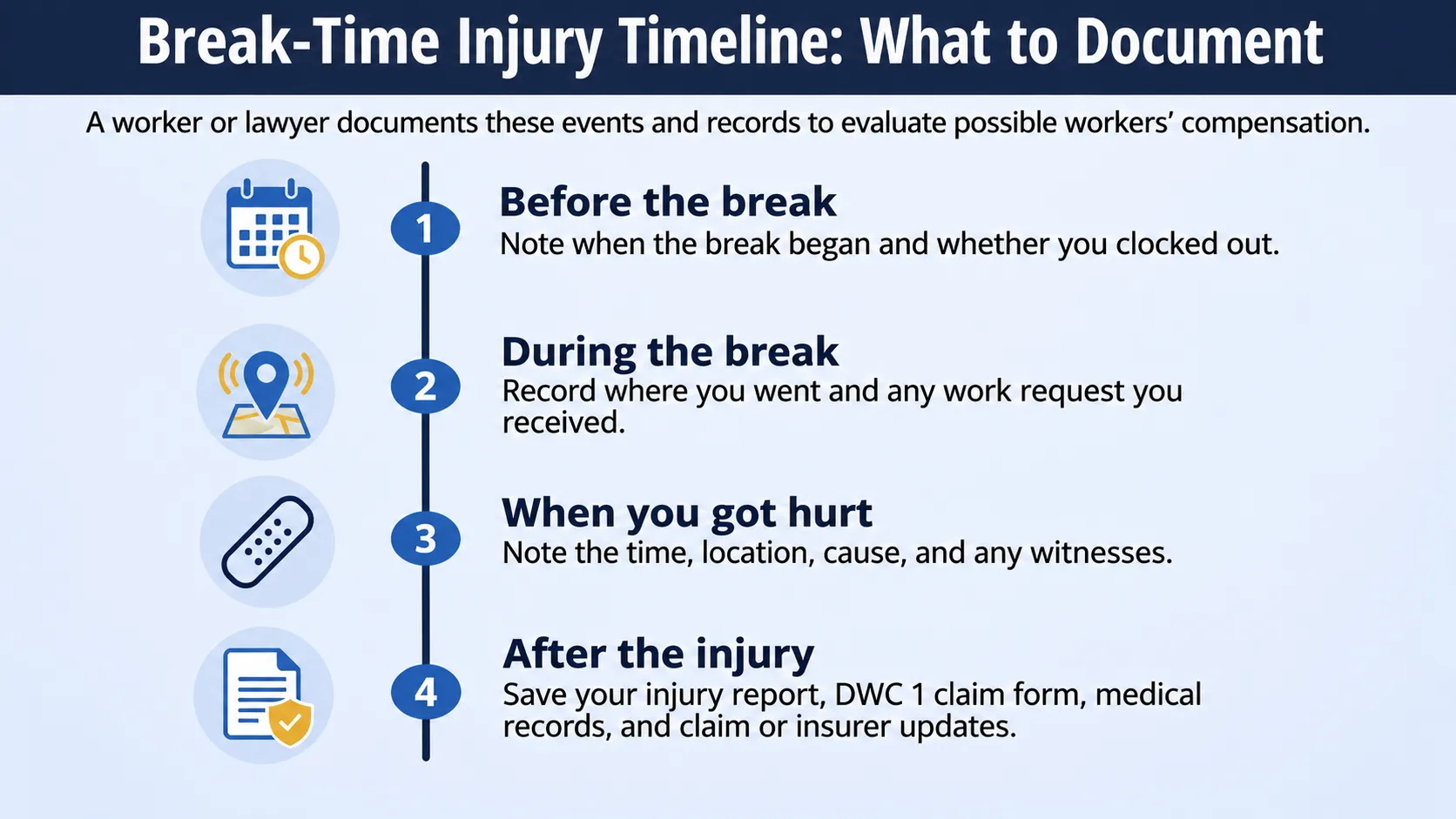
| Event | What to Record | Documents to Gather | Who Reviews It and Why |
|---|---|---|---|
| Before the break | Your last work task, when the break started, whether you clocked out, and whether you had to stay available. | Shift schedule, timecard, break policy, and supervisor messages. | Workers’ compensation lawyer: Checks how the break fit into your shift. |
| During the break | Where you went, why you went there, what you were doing, and whether anyone asked you to handle a work task. | Work messages, call logs, or written instructions. | Workers’ compensation lawyer: Reviews whether your activity was connected to your job. |
| When you got hurt | Date, time, exact location, what caused the injury, who saw it, and who controlled or maintained the area. | Photos, video, witness contact details, and any incident report. | Workers’ compensation lawyer: Reviews the injury’s connection to your job.
Personal injury lawyer: Reviews a separate claim if an outside party may have contributed. |
| When you reported the injury | When you reported it, who you told, what you said, and how your employer responded. | Emails, texts, and any written injury report. | Workers’ compensation lawyer: Checks when your employer learned about the injury and how it responded. |
| When you got medical care or missed work | Your first treatment date, work restrictions, and dates you missed work. | Medical records, bills, work status notes, and pay stubs. | Both lawyers: Review your injuries, treatment, and lost income. |
| When you submitted the DWC 1 claim form | When and how you returned the form to your employer. | A copy of the completed form and proof of delivery. | Workers’ compensation lawyer: Checks when you started the claim. |
| When you received a workers’ compensation claim update | When you received the notice, what it said, and any reason the claims administrator gave. | Notices accepting, delaying, or denying the claim. | Workers’ compensation lawyer: Reviews the decision and applicable deadlines. |
| When you identified a possible outside party | When you learned of the person or company, their role, and what they did or controlled. Note any contact from them or their insurer. | Messages, insurer letters, settlement offers, and any documents you were asked to sign. | Personal injury lawyer: Reviews possible legal responsibility and settlement issues. |
Frequently Asked Questions About Work Break Injuries in California
Can I Get Medical Treatment While the Claims Administrator Investigates?
Yes. After you file the DWC 1, your employer generally must authorize appropriate treatment within one working day. Labor Code § 5402 limits the employer’s liability for treatment during this review period to $10,000.
This interim limit is not the maximum medical benefit for an accepted claim. If treatment authorization is delayed or refused, contact the claims administrator or a DWC Information and Assistance officer. You can also ask about treatment options through your health insurance.
What If I Haven’t Received an Update About My Claim?
Contact the claims administrator to check your claim’s status. If the administrator needs more time to decide, it generally must send you a delay notice within 14 days after your employer learns of the injury. The notice must explain the delay and say when a decision is likely.
Keep records of your calls and messages. If you cannot get an update, ask a DWC Information and Assistance officer for help.
Can I Choose My Own Doctor After a Work Break Injury?
It depends on your employer’s medical provider network and whether you selected a personal physician before the injury. If your employer uses a Medical Provider Network (MPN), you generally must receive treatment within that network unless an exception applies.
Ask the claims administrator which doctors you can see and how to request a different treating physician.
What If My Employer Does Not Have Workers’ Compensation Insurance?
You may still have legal options if your employer is illegally uninsured. The Uninsured Employers Benefits Trust Fund may provide benefits to eligible workers under certain conditions.
Labor Code § 3706 may also allow a civil injury claim against an illegally uninsured employer. A lawyer can review your employment status, insurance information, and available remedies.
Can My Employer Fire Me for Filing a Workers’ Compensation Claim?
California law generally prohibits employers from discriminating against employees for filing or intending to file a workers’ compensation claim. If your employer fires you or takes other prohibited action, you may have a separate claim.
A discrimination petition under Labor Code § 132a generally has a one-year filing deadline. To pursue this petition, you generally need an existing case before the Workers’ Compensation Appeals Board. Keep messages, termination notices, or other records showing what happened.
Talk to Arash Law About an Injury During a Work Break
If your employer says you weren’t working when you got hurt, we can review where you were and what you were doing during your break. We can also explain your next steps if you haven’t filed a workers’ compensation claim or have received a written denial.
If someone outside your employer’s company may have contributed to your injury, we can also review whether you may have a separate personal injury claim.
Call (888) 488-1391 to learn what options may be available and which steps could help protect your right to seek compensation.
Sources
- California Labor Code § 3600. Requirements for a compensable work-related injury. https://leginfo.legislature.ca.gov/faces/codes_displaySection.xhtml?lawCode=LAB§ionNum=3600
- California Supreme Court, Price v. Workers’ Compensation Appeals Board (1984). Personal comfort doctrine and employment connection. https://scocal.stanford.edu/opinion/price-v-workers-comp-appeals-bd-28452/
- California Labor Commissioner. Paid rest periods and requirements for covered employees. https://www.dir.ca.gov/dlse/FAQ_RestPeriods.htm
- California Labor Code § 3852. Third-party personal injury claims involving workers. https://leginfo.legislature.ca.gov/faces/codes_displaySection.xhtml?lawCode=LAB§ionNum=3852
- California Labor Code § 3860. Settlements and reimbursement issues involving third-party claims. https://leginfo.legislature.ca.gov/faces/codes_displaySection.xhtml?lawCode=LAB§ionNum=3860
- California Labor Code § 5400. Requirements for reporting a workplace injury to an employer.
https://leginfo.legislature.ca.gov/faces/codes_displaySection.xhtml?lawCode=LAB§ionNum=5400- California Labor Code § 5401. Employer’s duty to provide a workers’ compensation claim form and the effect of filing it on deadlines. https://leginfo.legislature.ca.gov/faces/codes_displaySection.xhtml?lawCode=LAB§ionNum=5401
- California Labor Code § 5402. Employer knowledge, claim decisions, and medical treatment during review. https://leginfo.legislature.ca.gov/faces/codes_displaySection.xhtml?lawCode=LAB§ionNum=5402
- California Labor Code § 5405. Filing periods for certain workers’ compensation proceedings. https://leginfo.legislature.ca.gov/faces/codes_displaySection.xhtml?lawCode=LAB§ionNum=5405
- California Division of Workers’ Compensation. Filing a workers’ compensation claim and submitting the DWC 1. https://www.dir.ca.gov/dwc/fileaclaim.htm
- California Division of Workers’ Compensation. Medical treatment and Medical Provider Network rules. https://www.dir.ca.gov/dwc/medicalcare.htm
- California Division of Workers’ Compensation. Workers’ compensation benefits for accepted claims. https://www.dir.ca.gov/dwc/MyClaimWasAccepted.htm
- California Division of Workers’ Compensation. Challenging a denied workers’ compensation claim. https://www.dir.ca.gov/DWC/MyClaimWasDenied.htm
- California Courts. Personal injury lawsuits and general filing deadlines. https://selfhelp.courts.ca.gov/civil-lawsuit/personal-injury
- California Courts. Government claims and deadlines for suing public agencies. https://selfhelp.courts.ca.gov/civil-lawsuit/government-claim
- California Division of Workers’ Compensation. Uninsured Employers Benefits Trust Fund and available benefits for qualifying workers whose employers lack required insurance. https://www.dir.ca.gov/dwc/claims.html
- California Division of Workers’ Compensation. Instructions for filing a discrimination petition under Labor Code § 132a, including the filing deadline. https://www.dir.ca.gov/dwc/iwguides/IWGuide07.pdf
- California Employment Development Department. State Disability Insurance eligibility when workers’ compensation benefits are delayed, denied, or lower than disability benefits. https://edd.ca.gov/en/disability/faq_di_workers_compensation/
Disclaimer
This article provides general information for educational purposes. Reading it does not create an attorney-client relationship. Consult a licensed California attorney about your circumstances. Past results do not guarantee future outcomes. Arash Law — (888) 488-1391.