TL;DR: After a bike accident in San Diego, get medical care immediately, even if you feel fine. Then call 911, document the scene, and preserve your bicycle and any video. You face strict filing deadlines: if the City of San Diego or another public entity may be responsible, you must file a government claim within six months.
Key Facts
- Cyclists riding on public roads generally have the same rights and duties applicable to motor vehicle drivers (California Vehicle Code § 21200).
- Injured cyclists generally have two years from the date of injury to file a personal injury lawsuit against a private party (California Code of Civil Procedure § 335.1).
- The San Diego Superior Court, Central Division (Hall of Justice), which handles civil matters, is located at 330 W. Broadway, San Diego, CA 92101.
- If a motor vehicle was involved in an accident with a bike, the driver must file an SR-1 with the DMV within 10 days if someone was injured or killed, or if property damage exceeded $1,000.
- City of San Diego Smart Streetlight footage is generally purged no later than 13 days after collection unless retained as evidence.
Table of Contents

The steps you take in the hours and days after a bike accident in San Diego, including what you photograph, what you say to insurance adjusters, and what deadlines you track, can shape what compensation you can pursue. Important actions include seeking medical attention, documenting the scene, and reporting the crash.
In addition to that, a bicycle crash claim handled in San Diego can involve multiple layers of complexity, including:
- California’s pure comparative negligence rules.
- Potential claims against the City of San Diego, if a road defect played a role.
- Evidence held by the San Diego Police Department (SDPD), including collision records and, in some cases, Smart Streetlight video.
- Cases that may ultimately be filed at the San Diego Superior Court in the Central Division at 330 W. Broadway.
Understanding the local landscape before you take action can make a meaningful difference in your outcome.
Five Things That Matter Most After A San Diego Bike Accident
San Diego bike accident claims turn on local details that a general guide will not capture. Here are the five points every injured cyclist in this city needs to know before making any decisions.
- Your case may be filed at the San Diego Superior Court, Central Division. Civil cases arising in the City of San Diego may be filed in the Central Division, subject to applicable venue and court filing rules. The Central Division’s Hall of Justice, which handles civil matters, is at 330 W. Broadway, San Diego, CA 92101. The court, the local procedural rules, and the local jury pool all affect how a case is built and valued.
- San Diego recorded 1,693 bicyclist crashes over five years. City of San Diego and Statewide Integrated Traffic Records System (SWITRS) data show 1,693 bicyclist-involved collisions from 2019 through 2023. That works out to nearly one fatal bicyclist-involved collision every three months over five years, a pace that underscores how serious the risk is for San Diego cyclists.
- Critical evidence can disappear quickly. Traffic-camera footage and private security footage may be overwritten or deleted in accordance with applicable retention practices. Sending a written preservation demand on the same day, or as soon as possible, may help preserve footage before it is reviewed. Contact an attorney promptly so appropriate preservation efforts can begin.
- Choose a firm with experience at the San Diego Superior Court and against local insurers. A bicycle accident claim in San Diego may involve SDPD collision reports, available City of San Diego camera footage, and negotiations with insurance carriers. Experience in this specific market matters when fault is disputed.
- Different deadlines may apply. A government claim generally must be presented within six months if the City of San Diego or another public entity may be responsible. A two-year statute of limitations generally applies to personal injury lawsuits against private parties. Confirm which deadlines apply before assuming you have two full years.
What To Do After A Bike Accident In San Diego: 10 Steps
The steps you take after a San Diego bike accident can affect your health and your ability to pursue compensation. Focus first on your safety and medical needs. Then, preserve evidence, document your losses, and keep track of important deadlines.
The following ten steps can help protect your interests after a crash:
Step 1: Get To Safety, Call 911, And Seek Medical Care
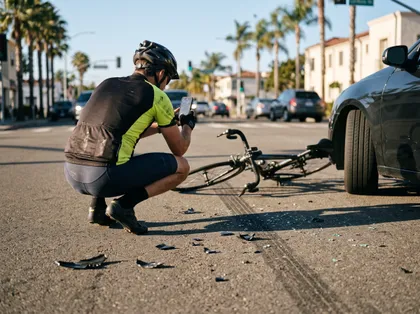
Your health is the priority after a bicycle accident in San Diego. If you can move without worsening an injury, get out of traffic and reach a sidewalk or safe shoulder. If you have severe neck, back, or spinal pain, avoid unnecessary movement and wait for emergency responders.
Call 911 if anyone is hurt, if the collision is serious, or if the driver flees. Call 911 if anyone is hurt, if the collision is serious, or if the driver flees. Depending on the circumstances, San Diego Police Department (SDPD) or California Highway Patrol (CHP) officers may respond and prepare a traffic collision report documenting the crash. When officers arrive:
- Explain what happened using simple facts.
- Do not guess about details you do not remember.
- Do not admit fault.
- Ask for the officer’s name, badge number, and report number.
If the collision caused injury or death and involved a motor vehicle, the motor vehicle driver generally must make, or ensure that someone makes, a written report to the SDPD or the CHP within 24 hours. This statutory duty does not generally apply to someone solely because they were riding a human-powered bicycle. If officers do not respond or prepare a report, contact the appropriate law enforcement agency promptly to determine how to submit one.
Seek medical evaluation as soon as possible, even if you initially feel fine. Some injuries may not produce obvious symptoms immediately after a crash. For example, concussion symptoms can emerge hours or even days later. Follow your doctor’s treatment plan and keep all follow-up appointments. Insurers or defendants may question treatment gaps when evaluating your injuries and claim.
Step 2: Exchange Information And Document The Crash Scene
Collecting accurate information at the scene is one of the most valuable things you can do for your claim. Start with the people and vehicles involved in the crash.
If a motor vehicle was involved, get the driver’s:
- Full name.
- Phone number.
- Address.
- Driver’s license information.
- Insurance company and policy information.
- License plate number.
- Vehicle make and model.
Also, collect the names and contact information of every witness. Their accounts may help explain what happened, especially when the parties disagree about the crash.
After collecting this information, document the physical scene if possible. Photograph and video:
- Your bicycle and the vehicle.
- Damage to both.
- Your visible injuries, helmet, and clothing.
- Vehicle and bicycle positions.
- Bike lane markings, traffic lights, and signs.
- Skid marks, debris, potholes, or damaged pavement.
- Construction areas and barriers.
- Lighting and visibility conditions.
Take close-up and wide-angle photos. Bicyclist crash conditions in San Diego vary significantly by location. The physical scene details you capture may be the only record of exactly how the crash happened.
Step 3: Preserve Physical And Digital Evidence
Do not repair or discard your bicycle, helmet, or gear before a lawyer or investigator has had a chance to document them. Keep all of the following in a secure location.
- Bicycle
- Helmet
- Clothing and shoes
- Lights and cycling computer
- Any other damaged equipment
Physical evidence can help document the condition of your bicycle and gear after the crash. Digital evidence can provide additional details about how and where the collision occurred. Save the following:
- Helmet-camera or bicycle-camera footage.
- Dashcam footage from your vehicle or nearby vehicles.
Other cameras near the crash site may also have captured the collision. These may include private security cameras, parking garage cameras, business doorbell cameras, or other recording systems. Identifying and preserving that evidence early can help support your claim.
| Evidence Type | Why It Matters | Retention or Action | Who Controls It |
|---|---|---|---|
| SDPD traffic collision report | An official record of the crash may document officer observations, statements, and initial findings about how the collision occurred. | Request through SDPD’s applicable traffic collision report request process after the report becomes available. | San Diego Police Department |
| City of San Diego or other government camera footage | Available footage may show the collision, vehicle behavior, traffic conditions, or surrounding road conditions. | Retention varies by system. San Diego Smart Streetlight footage is generally purged no later than 13 days after collection unless retained as evidence; prompt preservation efforts are important. | City of San Diego, Caltrans, or another agency, depending on the camera system |
| Private security, doorbell, and parking garage video | Private video may capture the collision from angles or locations that public cameras do not cover. | Retention varies by system and property owner. Footage may be overwritten or deleted quickly, so note camera locations and contact the property owner promptly. | Private property owners or system operators |
| Driver cell phone and telematics data | These records may provide evidence of phone use, vehicle speed, braking, or other activity around the time of the crash. | Retention varies by carrier, manufacturer, service, and record type. Prompt preservation efforts may help prevent the loss of relevant data. | Wireless carriers, vehicle manufacturers, service providers, or other data custodians |
| Ride-tracking data, including Strava, Garmin, Apple Watch, or GPS records | Ride data may help establish the cyclist’s route, location, timing, and speed before or around the time of the crash. | Export and save relevant files promptly because platform and device retention practices vary. | Cyclist’s device, app account, or service provider |
Legal Basis: California Vehicle Code § 20012; California Public Records Act (Gov. Code § 7920.000 et seq.); and applicable California discovery and evidence-preservation rules.
Your attorney can send preservation demands to businesses, property owners, government agencies, or other parties that may control relevant footage. Acting quickly can improve the chances that available recordings are preserved before they are overwritten. However, retention policies vary, and footage may still be unavailable.
Step 4: Keep Records Of Your Injuries And Financial Losses
Medical records and receipts for your expenses can help establish the causation of your injury, the treatment provided, its severity, and the extent of accident-related damages. Start a dedicated file for every document connected to your accident.
Keep copies of:
- Medical records and emergency treatment documentation.
- Medical bills and prescription receipts.
- Imaging and test results.
- Physical therapy records.
- Ambulance bills.
- Bicycle repair or replacement estimates.
- Receipts for damaged gear.
- Transportation expenses related to treatment.
- Records showing missed work and lost wages.
In addition to keeping these records, consider maintaining a pain journal. Note your daily symptoms, physical limitations, and how the injuries affect your ability to work, exercise, or perform ordinary activities. These observations can help document the effects of the crash that billing records alone may not show.
Step 5: Handle Insurance Companies And Social Media With Care
The driver’s insurance carrier may contact you after the crash. What you say or sign during these early conversations may affect how the insurer evaluates your claim. Avoid guessing about the crash or signing documents you do not fully understand. Consider speaking with a lawyer before providing information that could affect your rights.
Avoid the following:
- Admitting any degree of fault.
- Giving a recorded statement to the at-fault driver’s insurer.
- Signing broad medical authorizations.
- Signing any release without fully understanding what rights you are giving up.
- Accepting a quick settlement offer before you understand the extent of your injuries and treatment needs.
Your obligations may be different when dealing with your own insurer. Your policy may require you to cooperate with its investigation. Their insurer may also request a written or recorded statement. Consider speaking with a lawyer before responding if you are unsure about your obligations.
Use similar care with social media. Avoid posting:
- Details about how the crash happened.
- Your opinion about who caused it.
- Descriptions of your injuries or treatment.
- Photos showing your physical activities.
- Anything related to your insurance claim.
Publicly available social media posts may become relevant evidence in a personal injury claim. A post may be used to question the severity of your injuries or your account of the crash.
Step 6: Understand California Bicycle Laws And How Fault Is Decided
Under California Vehicle Code § 21200, cyclists riding on public roads generally have the same rights and duties applicable to motor vehicle drivers. If a driver violates a traffic law and causes a collision, that violation may support a negligence per se theory.
Furthermore, more than one person can share responsibility for a crash. California follows pure comparative negligence, established in Li v. Yellow Cab Co., 13 Cal. 3d 804 (1975). If you contributed to your accident, you are not barred from recovering compensation; instead, your percentage of fault reduces your recovery. For example, if your total damages are $100,000 and a San Diego Superior Court jury assigns you 20% of the fault, your recovery would be $80,000.
Insurance adjusters handling bicycle accident claims may dispute fault or argue that the cyclist shares responsibility. That is why preserving evidence at the scene and avoiding unnecessary statements about responsibility can be important: fault is a legal determination made after the evidence is reviewed, not a judgment to make in the moments after a crash.
Step 7: Identify Every Party That May Be Responsible
The driver who hit you may not be the only party with legal responsibility for your injuries. The circumstances of the crash may point to other people, companies, or public entities.
Responsible parties in a San Diego bicycle accident may include one or more of the following:
- The negligent driver.
- The driver’s employer, if the driver was acting within the scope of employment.
- A rideshare or delivery company, depending on the driver’s status at the time of the crash.
- The vehicle owner, if different from the driver, and the applicable law provide a basis for liability.
- A bicycle or bicycle-component manufacturer, if a defective product played a role.
- A public entity, if a dangerous condition of public property contributed to the crash.
If a public entity may be responsible, a different legal process applies. Examples may include a pothole on a city-maintained street, a malfunctioning traffic signal, or another dangerous road condition, subject to California’s statutory requirements and public-entity immunities.
Potential public entity defendants in a San Diego bicycle crash include the following:
- City of San Diego: A dangerous condition on a city-owned or controlled street may create a basis for liability. Claims against the city are presented to the City of San Diego Risk Management Department before a lawsuit may be filed. The City’s Transportation Department may be involved in the underlying facts if it maintains the street. However, the City of San Diego would generally be the defendant in a lawsuit.
- Caltrans (State of California): A crash involving a dangerous condition on a state highway or other Caltrans-controlled property may involve Caltrans. These claims follow California’s applicable government claim procedures. The proper submission process can depend on the type and amount of the claim.
If you were riding your bike when the crash occurred, or if the collision also involved a pedestrian, different traffic laws may apply. The pedestrian accident attorneys at Arash Law also handle claims involving government and private-party liability in San Diego.
Step 8: Track Your Reporting And Filing Deadlines
San Diego bicycle accident cases can involve multiple deadlines. The applicable deadline depends on who may be responsible and what action you need to take. Tracking each deadline separately can help protect your right to pursue a claim or lawsuit.
| Type of Case or Report | General Deadline | What You Need to Do | Legal Citation |
|---|---|---|---|
| Personal injury lawsuit against a private party. | Two years from the date of injury. | File the personal injury lawsuit before the applicable statute of limitations expires. This deadline generally applies to lawsuits against private parties. | California Code of Civil Procedure § 335.1. |
| Personal injury claim against a public entity. | Six months after the claim accrues. | Present a government claim to the responsible public entity. For a claim against the City of San Diego, present it to the City’s Risk Management Department.
|
California Government Code § 911.2. |
| DMV SR-1 report for a motor vehicle driver. | Within 10 days of a reportable collision. | The driver of a motor vehicle must report the collision to DMV if someone was injured or killed, or property damage exceeded $1,000. | California Vehicle Code § 16000. |
Certain circumstances can affect filing deadlines.
- When the victim is a minor, the two-year deadline tolls until they turn 18. However, the minority does not automatically suspend the claim deadline. A government claim for personal injury generally must still be submitted within six months.
- If the injury or its cause was not reasonably discoverable right away, the filing deadline may begin when the injury was discovered or should have been discovered.
For the SR-1 requirement, a bicyclist does not automatically have a statutory duty to file the report merely because a motor vehicle was involved. The reporting requirement applies to the driver of a motor vehicle involved in a reportable collision.
Step 9: Consider All Available Insurance Coverage
There are several insurance sources that may apply to a San Diego bike accident claim. The applicable one depends on who caused your injuries and how they happened.
Some insurance sources include:
- The driver’s liability insurance.
- Your uninsured motorist coverage.
- Your underinsured motorist coverage.
- MedPay (medical payments coverage under your own policy).
- Commercial vehicle insurance, if the driver was operating a work vehicle.
- Rideshare or delivery company insurance, depending on the driver’s status.
- Employer insurance, if the driver was acting in the course of employment.
Your own auto insurance may include uninsured motorist (UM) or underinsured motorist (UIM) coverage that applies when you are injured by a vehicle while riding a bicycle, not only when you are driving. Coverage depends on the specific terms of your policy.
If the driver fled the scene, the claim is treated as a hit-and-run. For a UM claim involving an unidentified hit-and-run driver, California law generally requires physical contact between the vehicle and the insured or the bicycle the insured occupied. The accident must also be reported to the appropriate law enforcement agency within 24 hours. The insured must submit a sworn statement supporting the claim to the insurer within 30 days after the accident. Additional policy requirements may apply.
Your policy and California law may impose additional notice and reporting requirements for hit-and-run UM claims; contact an attorney promptly to understand your obligations.
Step 10: Talk To A San Diego Bicycle Accident Lawyer
Bike accident cases could involve disputed fault, fast-disappearing evidence, and multiple potential defendants, including public entities, all while you are trying to recover from serious injuries. A San Diego personal injury attorney can help you navigate these layers while you focus on healing.
At Arash Law, our legal team can:
- Investigate the crash and interview witnesses.
- Send preservation demands to agencies and private property owners who may possess relevant video footage.
- Obtain SDPD collision reports through the applicable traffic collision report request process.
- Identify all potentially responsible parties.
- Handle all insurance communications on your behalf.
- Calculate the full value of your economic and non-economic losses.
- Track every applicable deadline, including the six-month government claim window.
- Prepare the case for settlement or trial at the San Diego Superior Court.
What Compensation May Be Available After A San Diego Bike Accident
If someone else caused your San Diego bicycle accident, you may be able to seek compensation for the financial and personal effects of your injuries. Depending on the circumstances, available compensation may include:
- Economic Damages: Medical expenses, future care, lost income, reduced earning capacity, bicycle and equipment damage, and other accident-related costs.
- Non-economic Damages: Pain and suffering, emotional distress, loss of enjoyment of life, physical limitations, scarring, and disfigurement.
- Wrongful Death Damages: In case of a fatal accident, eligible family members may seek compensation for funeral expenses, lost financial support, household services, and loss of care, companionship, and guidance.
- Punitive Damages: In limited cases involving oppression, fraud, or malice, punitive damages may be available to punish and deter particularly wrongful conduct.
- Workers’ Compensation Benefits: Cyclists injured while performing job duties may qualify for medical treatment, disability benefits, and other compensation. A separate claim against a negligent third party may also be possible.
The compensation available depends on factors such as the severity of the injuries, available insurance, employment status, and each party’s share of responsibility.
Arash Law Results In Cases Involving Road Users
Arash Law has recovered over $1 billion for injured clients across California. Our results include cases involving bicyclists who suffered serious injuries after being struck by vehicles.
- Our lawyers recovered $3,500,000 for a six-year-old boy who suffered a traumatic brain injury after a pickup truck struck him while he crossed a street on his bicycle. The defense tried to place fault on the child for riding across the middle of the street. Our team focused instead on the driver’s conduct. Through discovery and deposition testimony, we obtained an admission that the driver was distracted.
The San Diego bicycle accident lawyers at Arash Law can help with San Diego Superior Court filings, SDPD collision report requests, the City of San Diego’s government claim process, and negotiations with insurers on bicycle accident claims. We have also represented other vulnerable road users, including pedestrians and motorcyclists, after serious vehicle collisions.
- We recovered $10,000,000 for a pedestrian who suffered serious injuries after a speeding vehicle ran him over. In addition to pursuing compensation, our firm helped the client secure medical care and treatment for his injuries.
- Our team recovered $5,000,000 for a severely injured motorcyclist despite significant issues with the initial evidence. The police report placed fault on the rider, who was also accused of speeding and riding under the influence. Our lawyers investigated the truck driver’s actions. We showed that the driver violated his training and company procedures when making a dangerous turn that contributed to the collision.
These results are representative examples and do not guarantee a similar outcome. Every bicycle accident claim depends on its own facts, injuries, available evidence, insurance coverage, and applicable law.
How To Submit A Government Claim To The City Of San Diego
If a dangerous condition of City property contributed to your San Diego bicycle accident, you generally must present a government claim before filing a lawsuit against the City.
Examples may include a qualifying road defect, malfunctioning traffic signal, or another dangerous condition of City property, subject to applicable statutory requirements and public-entity immunities. Below is what to expect:
- Where To Submit Your Claim: The City of San Diego accepts liability claims through its Risk Management Department. You can submit a claim through the City’s online Public Liability Claims Portal. You may also mail or deliver a completed RM-9 claim form to:
City of San Diego
Risk Management Department
1200 Third Ave., Suite 1000
San Diego, CA 92101The City provides current submission methods, forms, and instructions on its Liability Claims page.
- What Happens After Submission: The City reviews the claim and may accept or reject it. How and when the City responds can affect the next deadline for filing a lawsuit. Keep copies of your claim, supporting documents, and proof of submission.
- Claims Involving Caltrans: A bicycle crash involving a dangerous condition on a state highway or other Caltrans-controlled property follows the applicable state claim process rather than the City’s process. Identifying which public entity owned or controlled the property can help determine where to present the claim.
Frequently Asked Questions About San Diego Bike Accidents
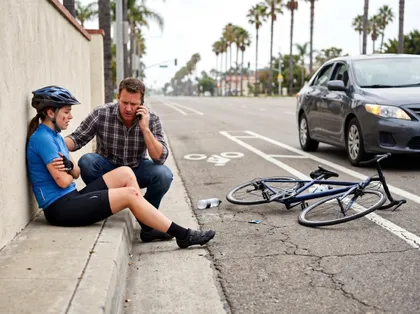
If you were hit while riding a bicycle in San Diego, you probably have questions that go beyond the immediate steps: questions about fault, deadlines, insurance, and what your claim might actually be worth. The answers below address what our bicycle accident lawyers hear most often from San Diego cyclists after a crash.
Who Is At Fault If A Car Hits A Bicycle In San Diego?
The liable party in a San Diego bicycle accident depends on which traffic laws were violated and by whom. Under California Vehicle Code § 21200, cyclists generally have the same rights and are subject to the same provisions as vehicle drivers. Exceptions apply to rules that, by their nature, cannot apply to bicycles.
A driver may be at fault for speeding, failing to yield at an intersection, or making an unsafe left turn across a bike lane. Other examples include distracted driving, violating California’s bicycle-passing requirements, or opening a car door into a cyclist’s path, sometimes called a “dooring crash”. A cyclist may also share some responsibility if their conduct contributed to the crash.
Can I Recover Compensation If I Was Partly At Fault?
Yes. California law allows you to recover compensation even if you were partly at fault for the crash. Under California’s pure comparative negligence rule, your recovery is reduced by your percentage of fault.
For example, suppose a San Diego Superior Court jury finds you 25% at fault and awards $200,000 in damages. Your recovery would generally be reduced by 25%, resulting in $150,000. Insurers may dispute how much fault each party bears, so preserving evidence from the crash can be important.
Should I See A Doctor If I Feel Fine After The Crash?
Yes. A medical evaluation after a significant bicycle collision may be advisable even if you have no obvious injuries. Some injuries may not cause obvious symptoms immediately after a crash. For example, concussion symptoms can appear hours or even days later, so medical evaluation may be advisable after a significant collision, even if you initially feel fine.
Prompt medical evaluation can help identify injuries and document your condition after the crash. A delay in seeking care may also become an issue in your claim. An insurer or defendant may argue that the delay raises questions about whether the collision caused your injuries.
Should I Repair My Bicycle Right Away?
Avoid repairing or discarding your bicycle until its condition has been properly documented and any necessary inspection has taken place. Damage to the bicycle, including scrapes, bends, and impact points on the frame, may help show how the crash occurred.
Repairs can alter or destroy physical evidence that may be relevant to your San Diego bike accident claim. Preserve the bicycle in its post-crash condition until your attorney or another qualified professional advises that it can be repaired.
Can My Own Car Insurance Cover Me As A Cyclist?
Possibly, yes. Uninsured motorist (UM) and underinsured motorist (UIM) coverage under your own auto policy may apply when a vehicle injures you while you are riding a bicycle. The coverage is not necessarily limited to injuries suffered while driving your car.
Coverage depends on your policy terms and the circumstances of the crash. MedPay may also cover certain medical expenses regardless of fault, subject to the terms of your policy. Review your policy or ask your attorney to review it with you.
Talk To Arash Law About Your San Diego Bike Accident Claim
A bicycle accident in San Diego can leave you managing injuries, medical bills, lost wages, a damaged bicycle, and insurance disputes. Depending on the crash, you may also need to obtain SDPD records or navigate the City of San Diego’s government claim process. Different claim and lawsuit deadlines may also apply.
Arash Law has recovered over $1 billion for injured Californians and handles bicycle accident claims throughout San Diego. Call Arash Law at (619) 431-4840 or reach our 24-hour line at (888) 488-1391 for a free consultation.
Legal fees are contingent on recovery and governed by a written fee agreement as required by California Business and Professions Code § 6147. There is no attorney’s fee unless we recover on your behalf.
Arash Law — Make ‘Em Pay, Call AK.
About This Guide
This guide was prepared by Arash Law using official and publicly available sources. Bicycle collision data comes from the City of San Diego Bicycle Master Plan Update. The report identifies 1,693 bicyclist-involved collisions from 2019 through 2023, including 18 fatal collisions. The report cites City of San Diego and SWITRS data for these figures.
Procedural information about the San Diego Superior Court was drawn from the court’s official website. Information about the City of San Diego government claim process was verified through the City’s Risk Management Department. Legal authorities cited throughout this guide include applicable provisions of the California Code of Civil Procedure, Government Code, Vehicle Code, and Insurance Code.
The geographic information and collision data discussed in this guide focus on the City of San Diego. They should not be treated as data for all of San Diego County. A cyclist injured in Chula Vista, El Cajon, or another municipality may need to follow different local procedures. The responsible public entity may also differ based on who owns or controls the property involved.
Sources
- City of San Diego — Bicycle Master Plan Update, State of the Network (2019–2023): https://www.sandiego.gov/sites/default/files/2025-04/01-sd_bmpu_stateofthenetwork_clean_rev_2025_03-28_0.pdf
- San Diego Superior Court — Civil Division, Where to File: https://sdcourt.ca.gov/sdcourt/civil2/civilwheretofile
- City of San Diego Risk Management — Liability Claims: https://sandiego.gov/riskmanagement/services/liability
- California Government Code § 911.2 (six-month government claim deadline): https://leginfo.legislature.ca.gov/faces/codes_displaySection.xhtml?sectionNum=911.2.&lawCode=GOV
- California Code of Civil Procedure § 335.1 (two-year personal injury statute of limitations): https://leginfo.legislature.ca.gov/faces/codes_displaySection.xhtml?sectionNum=335.1.&lawCode=CCP
- California Vehicle Code § 21200 (cyclists’ rights and duties): https://leginfo.legislature.ca.gov/faces/codes_displaySection.xhtml?sectionNum=21200.&lawCode=VEH
- California DMV — Traffic Accident: Must I Report It? (SR-1 Fast Facts): https://www.dmv.ca.gov/portal/driver-education-and-safety/educational-materials/fast-facts/traffic-accident-must-i-report-it-ffdl-28/
- Arash Law Case Results: https://arashlaw.com/case-results/
This page is for general informational purposes only and does not constitute legal advice. Reading this page does not create an attorney-client relationship between you and Arash Law. The law changes frequently, and the information here may not reflect the most current legal developments. Every case depends on its unique facts. Please consult a licensed California attorney for advice specific to your situation.