TL;DR: After a motorcycle accident in Los Angeles, move to safety, call 911, get medical care, then photograph vehicles, road hazards, and injuries. Photos, witness names, plus the LAPD or CHP report help prove fault, and a road-defect case can fail if you miss the 6-month government deadline.
Key Facts
- California Vehicle Code § 20008 requires a driver in a crash causing injury or death to make or cause to be made a written report within 24 hours to the CHP or, when the crash occurs within a city, to either the CHP or the local police department.
- California Vehicle Code § 16000 generally requires a driver to report a crash to the California Department of Motor Vehicles (DMV) within 10 days if it involves more than $1,000 in property damage, any injury, or a death.
- Government Code § 911.2 generally requires that a claim for personal injury against a public entity, such as a City of Los Angeles road defect, be presented within six months of the incident.
- Government Code § 911.4 states a late-claim application generally must be presented within one year of the incident, and Government Code § 945.6 provides that a written rejection generally triggers a six-month deadline to file a lawsuit.
- California Office of Traffic Safety (OTS) reports 553 people were killed or injured in motorcycle accidents in the City of Los Angeles in 2023, and it ranked the city out of 15 in its population group.
- California Vehicle Code § 21658.1 makes lane splitting legal in California, and § 27803 requires motorcycle riders and passengers to wear a safety helmet that meets the U.S. Department of Transportation (DOT) Federal Motor Vehicle Safety Standard 218.
Table of Contents

After a motorcycle crash in Los Angeles, move to safety, call 911, and get medical attention right away. Before the scene is cleared, note which agency responded. For many collisions on Los Angeles freeways, such as the I-405 and US-101, the CHP will be the investigating agency. Collisions on City streets are generally handled by the LAPD, subject to the exact location and circumstances.
Flag any nearby business surveillance cameras, because footage may be overwritten quickly on some systems. The steps you take in the first hours after a crash on a Los Angeles city street or freeway can affect your ability to pursue compensation and support your claim against an insurer.
California’s pure comparative negligence rule means your right to compensation survives even if you share partial fault: your award simply decreases in proportion to your percentage of responsibility. However, that protection has limits. Evidence disappears quickly, and camera footage can be rapidly overwritten.
If a City of Los Angeles road defect contributed, you generally must present a government claim within six months under Gov. Code § 911.2. Missing that deadline can jeopardize the claim. California provides a late-claim procedure in some circumstances, but additional strict deadlines apply.
Five Things Every Los Angeles Rider Needs To Know After A Crash
Los Angeles motorcycle claims turn on details that differ from those of any other California city. A mobile skimmer reading only this block should walk away with the five facts that matter most.
- General-jurisdiction personal injury cases assigned to the Los Angeles Superior Court’s Central District are handled at the Stanley Mosk Courthouse. However, crashes in other judicial districts may be filed there. Use the Los Angeles Superior Court Filing Court Locator to confirm the proper courthouse.
- 553 people were killed or injured in Los Angeles in 2023 (City of Los Angeles only). The California OTS ranked the city 12th out of 15 similarly sized cities for motorcycle accident victims. Despite a mid-to-lower ranking among peer cities, the sheer number of victims killed or injured in a single year makes complete scene documentation especially important.
- If your crash happened on the I-405 or US-101, CHP generally writes the report. Request the report from CHP and send a camera preservation demand immediately, because some systems can quickly overwrite footage. If a road defect may have contributed, you must generally present a government tort claim within six months under Gov. Code § 911.2. Missing this deadline can jeopardize the lawsuit.
- Choose a law firm that has handled Los Angeles motorcycle trial cases. The firm you hire should have trial experience, not just settlement volume, and should know how to counter those presumptions with crash reconstruction evidence, and LAPD or CHP reports.
- Generally, two hard deadlines govern your claim. Deadlines generally run from the date of the injury, but consult an attorney to confirm. The government-claim deadline can expire within 6 months of accrual, often before you finish treatment.
How Los Angeles Motorcycle Claims Differ From Other Cities
Most motorcycle accident lawsuits arising from crashes in the City of Los Angeles are filed in the Los Angeles Superior Court.
| Court | Address | Notes |
|---|---|---|
| Stanley Mosk Courthouse (Central District) | 111 N. Hill St., Los Angeles, CA 90012 | The primary civil filing courthouse for personal injury matters in the City of Los Angeles. Department assignments vary. |
Legal Basis: Los Angeles Superior Court Civil Division, lacourt.ca.gov.
If your crash occurred on a Los Angeles city street, the LAPD prepares the traffic collision report, and any government tort claim against the City of Los Angeles is filed with the LA City Clerk. If your crash occurred on a freeway like the I-405 or US-101, the CHP is the reporting agency.
The distinction matters because it determines which report you request, which public entity may share liability for road conditions, and, in a public entity case, which claim office receives your government tort claim.
What The Local Data Shows
The California OTS ranks cities against peers of similar population size. In 2023, 553 victims were killed or injured in motorcycle accidents in the City of Los Angeles, placing the city 12th out of 15 cities in its population group. That figure counts victims (individuals killed or injured), not the number of separate crash incidents, and it covers only the City of Los Angeles, not Los Angeles County or California as a whole.
| Data Point | Figure | Source | Year |
|---|---|---|---|
| Motorcycle collision victims (killed and injured) | 553 | California OTS, City of Los Angeles ranking | 2023 |
| OTS population group ranking | 12th out of 15 | California OTS, population group A | 2023 |
Legal Basis: California OTS Crash Rankings, ots.ca.gov/media-and-research/crash-rankings-results.
Los Angeles riders face a concentrated crash environment. A 12th-place ranking in population group A means the City has room to argue its crash numbers are not uniquely outlying, which is exactly why your own evidence, starting at the scene, must be specific and complete.
A police report that identifies the precise roadway, weather conditions, and vehicle positions is far harder to argue around than an insurer’s argument that the rider contributed to the crash.
On major freeways in Los Angeles, such as the I-405 and US-101, CHP typically has jurisdiction for reporting purposes. Sunset Boulevard, with its complex intersections and turning vehicles, is one of the city streets where the LAPD handles reports, knowing the jurisdictional boundary changes, which agency to contact at the scene, and whose records to request later.
What To Do Immediately After A Motorcycle Crash In Los Angeles
Your actions after a motorcycle crash can affect your health and your ability to pursue compensation. Evidence can also disappear quickly. Vehicles may be moved, witnesses may leave, and nearby cameras may overwrite footage. Take the following steps if your injuries allow you to do so.
Step 1: Move To A Safe Location
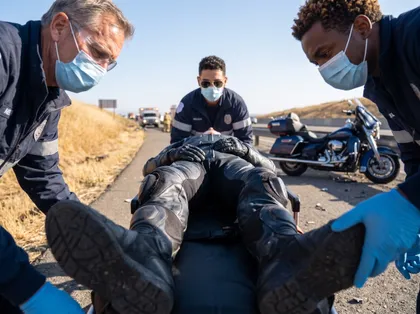
Move out of active traffic if you can do so safely. Try to reach a sidewalk, shoulder, or another protected area. Do not move if you have severe pain or believe you have suffered a neck or spinal injury. Wait for emergency personnel instead.
Avoid removing your helmet immediately after the crash. A serious impact can injure your head, neck, or spine. Let a paramedic assess you and help remove the helmet when necessary.
Step 2: Call 911 And Report The Crash
Call 911 and request medical help and law enforcement. Tell the dispatcher where the crash happened and whether anyone suffered injuries.
The responding agency can depend on the location of the collision.
- California Highway Patrol (CHP): Generally handles crashes on Los Angeles freeways, including I-405 and US-101.
- Los Angeles Police Department (LAPD): Generally handles crashes on city streets.
Before you leave the scene, ask the responding officer for:
- The law enforcement agency’s name.
- The officer’s name and badge number.
- The incident or report number.
- Instructions for requesting the collision report.
The report can help identify the drivers, witnesses, vehicles, and other basic facts about the crash.
California Vehicle Code § 20008 requires the driver involved in a crash causing injury or death to make or cause to be made a written report within 24 hours to the CHP or, when the crash occurs within a city, to either the CHP or the local police department. This requirement is separate from the DMV SR-1 report discussed below.
For minor-injury crashes in Los Angeles, the LAPD or CHP may not send an officer, especially if traffic can’t be safely diverted. If this happens, you can still create a record: photograph everything, obtain the other driver’s license, insurance, and plate information yourself, and collect witness contact information.
If no officer responds, document the scene and contact the appropriate law-enforcement agency for instructions on whether and how to make the required report. You’re still required to submit a DMV SR-1 within 10 days if the crash meets the reporting threshold, whether or not an officer came to the scene.
Step 3: Get Medical Care
Seek a medical evaluation even if you initially feel well. Adrenaline can make pain less noticeable after a serious collision. Some concussions, internal injuries, and neck or back injuries may also become more noticeable later.
Los Angeles has several hospitals that treat serious trauma. Los Angeles General Medical Center is a Level I Trauma Center. Other facilities may also provide emergency care depending on where the crash occurs.
Tell medical providers about every symptom you notice. Explain where you feel pain and whether you have dizziness, numbness, weakness, confusion, or limited movement. Accurate medical records can help connect your injuries and treatment to the motorcycle crash.
Step 4: Document The Crash Scene
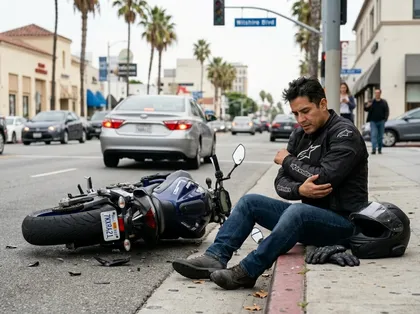
Gather evidence before vehicles are moved or the scene changes, but only if you can do so safely. Photos and videos can preserve details that may become difficult to prove later.
Try to document:
- The position and damage of each vehicle.
- Skid marks, debris, and fluid on the road.
- Potholes, uneven pavement, or other road hazards.
- Traffic lights, signs, and lane markings.
- Your helmet and riding gear.
- Any visible injuries.
Look around for nearby business or residential surveillance cameras and record their locations. Some footage may not remain available for long.
Preserve footage from your own devices, too. They may include a helmet camera, phone photos or video, and any GPS or ride-tracking app data. Back it up on a separate device in case the phone or camera is damaged.
Step 5: Get Witness Information
Witnesses can provide an independent account of what happened. Ask for their names, phone numbers, and email addresses.
You can also ask what they saw. Keep the conversation brief and avoid arguing about fault. Your attorney or insurer can follow up with witnesses later.
Step 6: Exchange Information With The Other Driver
California law generally requires drivers involved in an injury crash to exchange identifying and insurance information.
Collect the following:
- Driver’s full name and contact information.
- Driver’s license information.
- License plate number.
- Vehicle make and model.
- Insurance company and policy information.
Photograph the driver’s license, insurance card, and license plate when possible. Avoid discussing who caused the crash while exchanging information.
Step 7: Preserve Your Motorcycle, Helmet, And Riding Gear
Do not immediately repair, alter, or dispose of your motorcycle or damaged riding equipment. These items may contain physical evidence about how the collision occurred.
Keep your helmet, jacket, gloves, boots, and other damaged gear. Photograph them before moving or storing them. Arrange secure storage for your motorcycle if a towing company removes it from the scene.
Act quickly once your motorcycle is towed. Storage yards charge daily fees and can move toward lien sale or salvage on a short timeline if the bike isn’t claimed. Get the tow company’s name, lot location, and storage account number at the scene, and arrange for an independent inspection or transfer to secure storage before those fees accumulate or the yard takes further action.
An attorney or accident reconstructionist may need to inspect the motorcycle before repairs begin.
Step 8: Report The Crash To Your Insurance Company
Notify your insurer as required by your policy. Provide basic information, such as the date and the location of the collision.
Be cautious when answering questions about fault or injuries. You may not yet know the full extent of your injuries. Avoid guessing about speed, distance, or other facts you cannot accurately remember.
You can also ask whether your policy includes uninsured or underinsured motorist coverage. That coverage may become important if the responsible driver lacks enough insurance.
Step 9: Be Careful With The Other Driver’s Insurance Company
The other driver’s insurer may contact you soon after the crash. You generally do not have to give them a recorded statement simply because an adjuster requests one. Avoid guessing about the fault or the extent of your injuries. Early symptoms can change as doctors evaluate your condition.
Do not sign anything or accept an early settlement check before you understand your injuries. A settlement is finalized through a release, which generally ends your right to seek further compensation, even if your injuries turn out to be worse than they first appeared.
An early offer may be made before the full extent of your injuries, treatment needs, and other losses is known. If an adjuster pushes you to resolve things quickly, treat that pressure as a reason to slow down, not speed up, and talk to an attorney before signing anything.
Avoid posting about the accident, your injuries, or your recovery on any platform. Insurers may review publicly available social media posts, and even an innocuous post, a photo at an event, or a comment about “feeling fine,” can be used to argue your injuries are less serious than you’ve reported.
Step 10: Submit The DMV SR-1 Form When Required
California Vehicle Code § 16000 generally requires a driver to report a crash to the California Department of Motor Vehicles (DMV) within 10 days if the crash causes:
- More than $1,000 in property damage.
- An injury to any person.
- A death.
The SR-1 requirement is separate from a police or CHP collision report. Filing a police report does not replace your duty to submit the SR-1 when required by law.
Your insurance agent, broker, or accident attorney may complete and submit the report on your behalf.
Step 11: Consult A Motorcycle Accident Lawyer
Consider speaking with a motorcycle accident lawyer before important evidence disappears or you make major decisions about your claim. An attorney can review the crash and identify the parties who may bear responsibility.
If you hire a lawyer, they can also work to preserve evidence. That work may include requesting available surveillance footage, obtaining collision records, contacting witnesses, inspecting the motorcycle, and reviewing insurance coverage.
In addition, a lawyer can explain the deadlines that apply to your case. California generally gives injured people two years to file a personal injury lawsuit under Code of Civil Procedure § 335.1. Shorter deadlines may apply if a public entity is responsible. For example, a claim involving a dangerous public roadway generally requires a government claim to be filed within six months.
Evidence That Supports A Los Angeles Motorcycle Accident Claim
Strong evidence can help show how a motorcycle crash happened, who may be responsible, and what losses resulted. Some evidence can disappear soon after the collision. Video may be overwritten, vehicles may be repaired, and witnesses may become harder to locate.
The table below explains key types of evidence, why each one matters, how quickly it may disappear, and who may control it.
| Evidence Type | Why It Matters | Retention or Action | Who Controls It |
|---|---|---|---|
| LAPD or CHP Traffic Collision Report |
|
LAPD reports can be requested online or by mail to LAPD Records and Identification Division, Document Processing Unit, P.O. Box 30158, Los Angeles, CA 90030. | Los Angeles Police Department or CHP |
| Private business surveillance footage | May capture the crash or the approach if a business camera has a line of sight. | Usually overwritten within days to weeks. Request preservation in writing as soon as possible. | Business owners near the crash location |
| Your motorcycle | The damage may show:
|
Do not repair or release for insurer repairs until after an independent inspection. | You and your insurer after a claim is opened. |
| Damaged helmet and riding gear | Shows impact forces and may counter insurer arguments about helmet compliance or gear adequacy. |
|
You |
| Witness statements and contact information | Bystander accounts may fill in gaps in the police report or what your camera did not capture. | Collect at the scene. Contact information degrades quickly. | Witnesses |
| Medical records from the treating facility |
|
Request in writing from the hospital health information department. California law generally requires providers to furnish records within 15 days of a written request under Health & Safety Code § 123110 et seq., subject to statutory exceptions. | Los Angeles General Medical Center or other treating hospital |
| City of Los Angeles Claim for Damages record | Required before filing a lawsuit against the City or road defects; filing itself is a form of evidence. | File with the LA City Clerk at clerk.lacity.gov. Deadlines for this filing are short (see Filing Deadlines below). | City of Los Angeles Office of the City Clerk |
Legal Basis: Government Code §§ 911.2, 7920 et seq.; California Health and Safety Code § 123110 et seq. (medical records, 15-day furnishing requirement); California Vehicle Code § 21658.1 (lane-splitting documentation).
California Motorcycle Laws That Affect Your Los Angeles Claim
California law allows lane splitting but requires motorcycle riders and passengers to wear approved helmets. After a Los Angeles crash, these rules can affect how the parties evaluate fault and damages. They can also shape the evidence you need to support your claim.
Lane Splitting And Comparative Fault
Lane splitting (riding between rows of stopped or moving vehicles in the same lane) is legal in California under Vehicle Code § 21658.1. Los Angeles’s heavily congested freeways, particularly the I-405 during peak hours, are a common setting for lane-splitting collisions between riders and drivers who change lanes without checking mirrors.
Legal lane splitting does not automatically make a rider free from fault. The California Highway Patrol advises riders to use extreme caution when lane splitting. CHP notes that danger increases as the speed difference between a motorcycle and surrounding traffic increases. Risk also rises as overall speed increases. Riders should consider traffic, roadway, weather, lighting, lane width, and surrounding vehicles.
California follows pure comparative negligence, rooted in Li v. Yellow Cab Co. (1975) 13 Cal. 3d 804. Under that rule, your recovery decreases by your percentage of fault, but you generally do not lose your right to compensation entirely.
A lane-splitting rider found 30% at fault on a $200,000 injury claim recovers $140,000, not zero. The key is documenting your speed, the traffic conditions, and the other driver’s actions, particularly whether they made an unsafe lane change or opened a door into your path, before that evidence is lost.
Helmet Use And Your Claim
California Vehicle Code § 27803 requires all motorcycle riders and passengers to wear a safety helmet that meets U.S. Department of Transportation (DOT) Federal Motor Vehicle Safety Standard 218. Not wearing a helmet does not eliminate your right to pursue compensation. Still, insurers will argue that it contributed to the severity of head or brain injuries under California’s comparative fault rules.
In Los Angeles, the responding LAPD or CHP officer may note the helmet’s condition in the collision report. Preserve your helmet in its post-crash state and photograph it immediately, as this documentation will become part of your evidentiary record for an LA-based claim.
Key points to understand about helmet use and your claim:
- Helmet use does not determine who caused the crash. If another driver was negligent, that negligence is generally the basis of liability regardless of whether you were wearing a helmet.
- Comparative fault arguments apply only to related injuries. Insurers may argue helmet non-compliance contributed to head, brain, or facial injuries. A helmet-related comparative-fault argument generally must be causally connected to the injuries the helmet could have prevented or reduced.
- Photograph your helmet immediately. Visible damage to your helmet documents the impact forces the crash produced and may counter insurer arguments about the adequacy of your protection.
A separate product liability claim may arise if a helmet had a design defect, manufacturing defect, or inadequate warning that contributed to your injuries. Compliance with DOT standards does not by itself determine whether a helmet was defective under California product liability law. The evidence must support the claimed defect and connect it to the injuries.
Filing Deadlines For A Los Angeles Motorcycle Accident Claim
Los Angeles riders may face different deadline tracks depending on who is responsible. Missing an applicable deadline can limit or prevent your ability to pursue compensation.
Crashes Involving Private Parties:
- You generally have two years from the date of injury to file a personal injury lawsuit under CCP § 335.1.
- You generally have three years from the date the property was damaged, typically the crash date, to file a property damage lawsuit under CCP § 338(c)(1).
- If the injured person was a minor at the time of the crash, the two-year personal injury deadline is generally tolled until their 18th birthday under CCP § 352. Exceptions may apply, especially when a public entity is involved. Consult an attorney to confirm the applicable deadline.
Crashes Involving the City of Los Angeles or Another Public Entity:
- If a road defect, signal failure, or other City of Los Angeles action or inaction contributed to your crash, you generally must first present a government claim before filing a lawsuit against the City
- A claim for personal injury generally must be presented within six months of the incident under Government Code § 911.2. If you miss that deadline, California law provides a late-claim procedure in certain circumstances. A late-claim application generally must be presented within one year of the incident under Government Code § 911.4.
- Additional deadlines apply after the City’s response to the claim. For example, a written rejection generally triggers a six-month deadline to file a lawsuit under Government Code § 945.6. Consult an attorney promptly to determine which deadline applies.
Legal Basis: CCP §§ 335.1, 338(c)(1), 352; Government Code §§ 911.2, 911.4, 945.6.
What Arash Law Has Recovered For Motorcycle Accident Clients
The results below involve motorcycle accident cases handled by Arash Law. They show how our attorneys investigated disputed liability, challenged opposing arguments, and pursued compensation for injured riders.
| Recovery | Case | What Our Lawyers Did |
|---|---|---|
| $5,000,000 | Auto vs. Motorcycle | The police report initially placed our severely injured client at fault. Our legal team investigated further and showed that the truck driver violated his training and company policies when making a dangerous turn. The evidence helped establish that the driver’s actions contributed to the collision. |
| $1,550,000 | Motorcycle vs. Rideshare Vehicle | Our lawyers represented a rider who suffered spinal and wrist injuries in a collision involving a rideshare vehicle. The case resulted in a $1.55 million settlement in July 2021. |
| $1,450,000 | Motorcycle vs. Construction Contractor | Our client struck uneven pavement in a construction area and suffered fractured ribs and head trauma. The contractors and the city disputed liability. Our lawyers continued pursuing the case through litigation to trial. The case settled after the first day of trial. |
| Case results are not a guarantee of outcome. Every case is unique, and results depend on the facts and circumstances of each matter. | ||
What A Los Angeles Attorney Does For Your Motorcycle Accident Claim
Hiring an attorney is not just about negotiating a number. The most consequential attorney actions happen in the first days after a crash, before evidence disappears and before an insurer’s narrative hardens.
Preserving Evidence Before It Is Overwritten
An attorney can send written preservation demands to private businesses immediately after being retained, before camera footage is overwritten. Some vehicles are equipped with event data recorders (EDRs) that may store limited pre-crash data such as speed, braking, and impact forces. Access and data retention depend on the specific vehicle, whether it has been repaired or reprogrammed, and the legal process. Acting quickly can help preserve whatever data exists.
Responding To Disputed Fault
In motorcycle claims, insurers may examine whether the rider’s speed, lane position, lane splitting, visibility, or evasive actions contributed to the collision. Your attorney’s first job is to dismantle that assumption with objective evidence.
The LAPD or CHP collision report, business surveillance camera footage, witness statements, and, where appropriate, an independent accident reconstructionist whose analysis can be used in negotiations or at trial.
Managing The Medical Picture
Some treating providers may agree to treat on a lien basis, deferring billing until a case resolves, in appropriate cases; others require insurance or upfront payment. Your attorney can help explore available options and coordinate lien arrangements when providers agree to them.
At resolution, an attorney can negotiate lien amounts to help maximize what you receive after medical bills are paid. Hospitals and providers may also assert reimbursement claims or liens against your recovery, which your attorney can address in the settlement process.
Handling Communication
If you retain Arash Law, the firm can direct the at-fault insurer to communicate with counsel rather than contacting you directly. This approach can reduce direct contact from the adjuster, including early requests for a recorded statement. Your attorney can handle these communications while you focus on your recovery.
How To Choose A Lawyer For Your Los Angeles Motorcycle Accident Case
The attorney you hire can affect how your case is handled. Los Angeles has many personal injury lawyers, and their experience, approach, and resources for handling motorcycle cases may vary.
Behaviors that may indicate how a lawyer approaches your case:
- Reviews the LAPD or CHP collision report and identifies errors or disputed findings that other evidence may clarify.
- Takes timely steps to preserve available evidence, including traffic camera footage, private surveillance footage, vehicle data, and other records.
- Determines whether your crash may involve a government entity and explains the shorter government claim deadline that may apply.
- Has verifiable litigation or trial experience in Los Angeles County courts, including experience handling personal injury cases.
- Does not pressure you to accept an early settlement offer before you understand your injuries, treatment needs, and available legal options.
Behaviors that may give you pause:
- Pressures you to settle without adequately reviewing the facts, evidence, injuries, and available compensation.
- Cannot clearly explain which law enforcement agency investigated your crash or how to obtain the collision report.
- Does not consider whether a government entity or a dangerous road condition may have contributed to the crash.
- Pushes you to accept a quick settlement before you understand the full extent of your injuries and their impact.
How To Verify A Los Angeles Lawyer’s Track Record
Before signing a representation agreement, you can check an attorney’s credentials and experience through publicly available sources and direct questions.
- California State Bar Licensing: Search the attorney’s name through the California State Bar’s Attorney Search to confirm license status, admission date, and disciplinary or administrative history.
- Court Records: The Los Angeles Superior Court provides online access to certain civil case information. You can search by case number or use the court’s name-search service to find cases by party name. Some searches and documents require a fee, and some records may require additional steps to access.
- Ask Directly: Ask about cases the firm has taken to trial in Los Angeles County and whether any resulted in jury verdicts. You can also ask about the firm’s experience handling motorcycle accident cases and litigating personal injury cases in Los Angeles County courts.
What Compensation You May Pursue After A Los Angeles Motorcycle Crash
California Civil Code §§ 3281 through 3294 allow motorcycle accident victims to pursue economic damages, non-economic damages, and, in limited circumstances, punitive damages through a personal injury claim.
Economic damages compensate for measurable financial losses, including:
- Emergency medical care, hospital stays, surgeries, medication, and rehabilitation.
- Future medical expenses, including ongoing therapy and long-term care.
- Lost wages and employment benefits during recovery.
- Reduced earning capacity if your injuries affect your ability to work going forward.
- Repair or replacement of your motorcycle and riding gear.
Non-economic damages address personal losses that don’t appear on a bill, including:
- Physical pain and discomfort.
- Emotional distress, anxiety, or trauma.
- Loss of enjoyment of activities you can no longer participate in.
- Permanent disability or disfigurement.
Punitive damages may be available when the at-fault party’s conduct involved extreme recklessness or intentional misconduct, under California Civil Code § 3294. These are rare and are not meant to compensate for losses; they are designed to punish particularly dangerous behavior.
California generally does not cap damages in ordinary motorcycle injury cases. However, Proposition 213 (Civil Code § 3333.4) can bar certain uninsured owners or operators from recovering non-economic damages, such as pain and suffering.
A limited exception may apply when an uninsured owner is injured by a driver who is convicted of DUI. Economic damages, such as medical expenses and lost income, may still be recoverable.
Certain coverage issues or legal circumstances can affect what categories of damages are recoverable in your specific case. Los Angeles General Medical Center, as the area’s Level I Trauma Center, is often the source of the billing records that anchor economic damages calculations in severe Los Angeles motorcycle cases.
Calculating your damages requires assembling medical records, emergency department reports, surgical notes, pay stubs, tax returns, and, for future losses, expert assessment of your diminished earning capacity. No attorney can guarantee a specific outcome, but Arash Law pursues every category of damages the evidence supports.
Other Compensation And Benefits That May Apply
Depending on the circumstances of the motorcycle crash, workers’ compensation benefits or wrongful death damages may also be available.
- Workers’ Compensation Benefits: If you were injured while riding a motorcycle in the course and scope of your employment, you may qualify for California workers’ compensation benefits. These may include:
- Medical treatment.
- Temporary disability benefits.
- Permanent disability benefits.
- Supplemental job displacement benefits.
- Death benefits for qualifying dependents.
A work-related crash may also support a separate personal injury claim against a negligent third party. For example, an injured worker may have a workers’ compensation claim and a separate claim against an at-fault driver. Different rules apply to each type of claim.
- Wrongful Death Damages: If a motorcycle crash results in death, eligible individuals may pursue a wrongful death claim under California Code of Civil Procedure § 377.60. Depending on the circumstances, recoverable damages may include:
- Funeral and burial expenses.
- Financial support the deceased would have contributed.
- Loss of gifts or benefits the survivors could have expected.
- The reasonable value of household services the deceased would have provided.
- Loss of the deceased person’s companionship, care, assistance, and moral support.
A separate survival action under California Code of Civil Procedure § 377.30 may allow the deceased’s personal representative or successor in interest to pursue certain claims the deceased could have pursued if they had survived.
Common Los Angeles Motorcycle Crash Situations
Motorcycle crashes can occur in various ways throughout Los Angeles. Busy intersections, congested freeways, frequent lane changes, and lane splitting can create situations where a rider and another vehicle collide. How the crash occurred can affect fault, the evidence required, and the applicable laws.
The Left-Turn Collision At A City Intersection
A driver turning left across oncoming traffic on a Los Angeles city street fails to yield to a motorcyclist proceeding straight through the intersection. These crashes are among the most serious because the car’s front end strikes the rider directly.
Key Questions:
- Did the LAPD report capture the signal phase at the time of impact?
- Does a business on the corner have surveillance footage that covers the turn lane?
The Freeway Lane Change On The I-405 Or US-101
A driver changes lanes on a Los Angeles freeway without checking mirrors and strikes a motorcycle that was in the adjacent lane. CHP handles the report for these crashes.
Key Question:
- Was the motorcycle’s event data recorder preserved before the insurer took the vehicle for repairs?
The Lane-Splitting Crash
A rider splits lanes on the I-405 during slow traffic, and a driver makes an abrupt lane change into the rider’s path. The insurer immediately argues the rider was at fault because of the lane split.
Key Questions:
- Was the rider’s speed documented before the split?
- What were the surrounding traffic speeds?
- Did the other driver signal before changing lanes?
Lane splitting is legal under Vehicle Code § 21658.1, but adjusters and juries may examine how the rider split lanes, including speed differences, lane width, and visibility.
If You Were A Passenger
A motorcycle passenger generally isn’t at fault for how the bike was operated, which often makes a passenger’s claim more straightforward than the rider’s. You can typically pursue a claim against the rider, the other driver, or both, depending on who caused the crash.
Key Questions:
- Did the rider carry passenger liability coverage?
- Was the motorcycle legally equipped to carry a passenger, such as a proper passenger seat and footrests?
The Crash Involving A Rideshare Or Delivery Driver
A rideshare or delivery driver may strike a motorcycle while working on a Los Angeles street. The insurance issues depend on the type of service the driver was providing.
For qualifying rideshare services, California regulates Transportation Network Companies (TNCs) under Public Utilities Code § 5431. Insurance requirements under § 5433 depend on the driver’s status:
- App on, No Ride Accepted: At least $50,000 per person / $100,000 per incident for death and personal injury, plus $30,000 for property damage. The TNC must also maintain at least $200,000 in excess coverage per occurrence for this period.
- Ride Accepted Through Completion: $1 million in primary TNC insurance for death, personal injury, and property damage. Coverage starts when the driver accepts the request and continues until the transaction or ride ends, whichever occurs later.
Separate UM/UIM requirements apply while a passenger is in the vehicle.
Delivery drivers require a separate insurance analysis. A driver delivering food, packages, or other goods does not automatically fall under the TNC insurance requirements above. Available coverage may depend on the delivery platform, the driver’s personal or commercial policy, the driver’s work status, and the facts of the crash.
Key Questions:
- What was the driver’s app status at the exact moment of the crash?
- Was the driver operating a personal or company-owned vehicle?
- Are there multiple insurance policies that may apply?
The Crash Caused By A Road Defect On A City Street
A pothole on a Los Angeles city street causes a rider to lose control, or a failed signal leads to a collision at an intersection. The City of Los Angeles may share liability for road defects on streets it maintains. If the City of Los Angeles may share liability, you must present a government tort claim with the LA City Clerk within six months under Gov. Code § 911.2.
The Crash With An Uninsured Driver
An uninsured driver causes a motorcycle crash in Los Angeles. Your own uninsured or underinsured motorist (UM/UIM) coverage may provide another source of compensation. California Insurance Code § 11580.2 governs this coverage.
California auto policies generally include UM/UIM coverage unless the insured rejects it or selects lower limits in writing, subject to statutory requirements. Check your declarations page and policy terms to confirm your coverage and limits.
Different requirements may apply when a driver flees and cannot be identified. For certain claims involving an unknown hit-and-run vehicle, California law requires physical contact with the insured, the insured vehicle, or an occupied vehicle. The insured must also report the accident to the police within 24 hours. In addition, the insured must provide the insurer with a sworn statement within 30 days stating that the insured has a claim against an unknown person.
A CHP or LAPD collision report may provide important evidence for a UM/UIM claim. Other evidence may include photographs, videos, witness statements, medical records, vehicle damage, and available surveillance footage.
California increased its minimum auto liability limits on January 1, 2025. Drivers generally must carry at least $30,000 per person and $60,000 per accident for bodily injury, plus $15,000 for property damage. A serious motorcycle injury can result in losses that exceed these minimum limits, making UIM coverage relevant when the at-fault driver’s insurance is insufficient.
Key Questions:
- Does your policy include UM/UIM?
- What are the policy limits?
- Are there other sources of recovery, for example, a third party whose negligence contributed to the crash?
- Did you report the hit-and-run to law enforcement within 24 hours?
What To Bring To Your Free Consultation With Arash Law
Arash Law generally reviews Los Angeles motorcycle accident cases at no charge. The more information you bring, the more our attorneys can assess your options in the first conversation.
Bring or be ready to describe:
- The crash date, time, and exact location (street address or freeway mile marker).
- The incident number or DR number from the LAPD or CHP report, if you received it at the scene.
- The other driver’s name, insurance company, and policy number.
- Your insurance policy declarations page.
- Any photographs or videos you took at the scene.
- Medical records and bills received so far, including the name of the hospital or clinic where you were treated.
- Your motorcycle registration and any repair or total-loss estimate from your insurer.
Do not give the at-fault driver’s insurer a recorded statement before this consultation. If an adjuster has already contacted you, note what was said and when, but do not agree to a recorded session or sign any release until you have spoken with an attorney.
If English is not your first language, you can request assistance in another language when contacting our firm.
Frequently Asked Questions About Los Angeles Motorcycle Accidents
After a serious crash in Los Angeles, riders and their families often have questions that go beyond the immediate checklist. What follows addresses the most common issues that come up after the scene is cleared, the report is filed, and the insurer starts calling. These answers are informational and not a substitute for legal advice specific to your situation.
What Happens If The Driver Who Hit Me Blames Me For The Crash?
Fault disputes are common in Los Angeles motorcycle cases, and insurers frequently attempt to shift blame onto riders. California’s pure comparative negligence rule means your recovery is reduced by your percentage of fault, not eliminated. A rider found 25% at fault on a $300,000 claim recovers $225,000, not zero.
Preserve the evidence that supports your account: the crash location photographs, the LAPD or CHP report, witness contact information, and any camera footage. Avoid recorded statements to the at-fault insurer before speaking with an attorney. The facts of the crash (not the insurer’s initial position) can help determine liability.
How Do Insurance Companies Handle Motorcycle Claims Differently In Los Angeles?
Fault can be disputed in motorcycle claims, particularly when the parties disagree about speed, lane changes, lane splitting, or visibility. An insurer may argue that the rider’s speed contributed to injury severity even when the speed was within the legal limit, claiming the rider failed to take evasive action a reasonable person might have taken, pointing to lane-splitting as evidence of recklessness even though the practice is legal under Vehicle Code § 21658.1, and using a rider’s choice of protective gear to argue comparative fault.
In Los Angeles, the CHP report or the LAPD report can serve as evidence in UM/UIM negotiations. Securing and reviewing that report with an attorney before speaking with any adjuster is an important step. Speaking with Arash Law before those conversations gives you a clearer picture of your options and prevents anyone from using your statements against you.
What If The Driver Who Hit Me Had No Insurance?
Your own UM/UIM coverage, if you carry it, may provide a recovery path. California Insurance Code § 11580.2 permits claims against your insurer when the at-fault driver is uninsured or underinsured. An attorney can also identify other sources of recovery.
Should I Give A Recorded Statement To The Adjuster?
Do not give a recorded statement to the at-fault driver’s insurer before consulting an attorney. You have no legal obligation to do so. Their adjuster is trained to gather statements while facts are fresh and while you may still be in pain or uncertain about the full picture. Notify your own insurer of the crash promptly (most policies require it), but limit that report to the basic facts of when and where the crash occurred. Do not discuss fault or describe your injuries in detail until you have spoken with an attorney.
Talk To Arash Law About Your Los Angeles Motorcycle Claim
A motorcycle crash in Los Angeles can leave you facing mounting medical bills, a damaged or totaled bike, missed work, and an insurer that started building its defense before you left the emergency room at Los Angeles General Medical Center. You do not have to respond to any of that alone.
If you are looking for Los Angeles motorcycle accident lawyers, Arash Law represents injured riders throughout LA and the surrounding communities. Our attorneys know how LAPD divisions process collision reports. If a road defect may have contributed to your crash, they can determine whether a government claim is required.
Arash Law handles every motorcycle case on a contingency fee basis: you pay nothing unless we recover for you. California Business and Professions Code § 6147 requires that a contingency fee agreement be in writing and contain specific disclosures; we will provide that agreement at the start of the representation.
Call Arash Law today at (888) 488-1391 or the Los Angeles direct line at (213) 277-5878, available 24/7. Make them pay, call AK.
About This Guide
This guide was prepared by Arash Law using verified data from the California Office of Traffic Safety 2023 crash rankings for the City of Los Angeles, the Los Angeles Police Department’s official traffic collision report filing process, the Los Angeles Superior Court civil division records for Stanley Mosk Courthouse at 111 N. Hill St., and the City of Los Angeles Office of the City Clerk’s Government Tort Claim procedures at clerk.lacity.gov. Statutory references, including CCP § 335.1, Government Code § 911.2, Vehicle Code § 21658.1, Vehicle Code § 27803, and California Civil Code §§ 3281 through 3294, were verified against official California legislative and court sources.
The guide addresses the specific procedural and evidentiary issues that arise from motorcycle crashes in the City of Los Angeles: the LAPD/CHP jurisdictional split at city street versus freeway boundaries, the general camera footage overwrite risk that requires immediate preservation demands, the six-month Government Tort Claim deadline that applies when a City of Los Angeles road defect contributed to a crash and the rider-bias patterns that Los Angeles insurers apply to metropolitan motorcycle files. It was reviewed by Arash Khorsandi, Esq., California State Bar #249405, admitted in 2007, in August 2026.
Arash Khorsandi, Esq., California State Bar #249405, admitted 2007, last reviewed August 2026
Sources
- California Office of Traffic Safety — Crash Rankings, City of Los Angeles (2023): https://www.ots.ca.gov/rankings/los-angeles-2023/
- California Office of Traffic Safety — OTS Crash Rankings methodology: https://www.ots.ca.gov/media-and-research/crash-rankings-results/
- Los Angeles Police Department — File a Traffic Collision Report: https://www.lapdonline.org/office-of-the-chief-of-police/office-of-special-operations/transit-services-bureau/file-a-traffic-collision-report/
- Los Angeles Superior Court — Civil Division: https://www.lacourt.ca.gov/division/civil/
- City of Los Angeles Office of the City Clerk — Claim for Damage: https://clerk.lacity.gov/clerk-services/council-and-public-services/claim-damage
- California Legislature — Code of Civil Procedure § 335.1 (two-year personal injury statute of limitations): https://leginfo.legislature.ca.gov/faces/codes_displaySection.xhtml?sectionNum=335.1.&lawCode=CCP
- California Legislature — Vehicle Code § 21658.1 (lane splitting): https://leginfo.legislature.ca.gov/faces/codes_displaySection.xhtml?sectionNum=21658.1.&lawCode=VEH
- Los Angeles County Department of Health Services — Los Angeles General Medical Center: https://dhs.lacounty.gov/lageneral/
- California Legislature — Health and Safety Code § 123110 et seq. (medical records furnishing): https://leginfo.legislature.ca.gov/faces/codes_displaySection.xhtml?sectionNum=123110.&lawCode=HSC
- California Legislature — Civil Code §§ 3281–3294 (damages): https://leginfo.legislature.ca.gov/faces/codes_displaySection.xhtml?sectionNum=3281.&lawCode=CIV
- California Legislature — Code of Civil Procedure § 338 (property damage statute of limitations): https://leginfo.legislature.ca.gov/faces/codes_displaySection.xhtml?sectionNum=338.&lawCode=CCP
- Li v. Yellow Cab Co. (1975) 13 Cal. 3d 804 (pure comparative negligence): https://scholarlycommons.pacific.edu/cgi/viewcontent.cgi?article=2458&context=mlr
Legal Disclaimer
The content on this page is provided for general informational purposes only. It does not constitute legal advice and does not create an attorney-client relationship between you and Arash Law or any of its attorneys. Every motorcycle accident case is different, and the outcome of any particular claim depends on facts, evidence, and legal standards specific to that matter. Reading this page does not substitute for consultation with a licensed California attorney. If you have been injured in a motorcycle accident in Los Angeles, contact Arash Law directly to discuss your specific situation.